
www.foodpackautomation.com
06
'26
Written on Modified on
Delmon improves poultry quality and hygiene with air scalding
Delmon implemented a moisturized air scalding system to enhance hygiene and temperature precision while reducing water and energy consumption.
marel.com
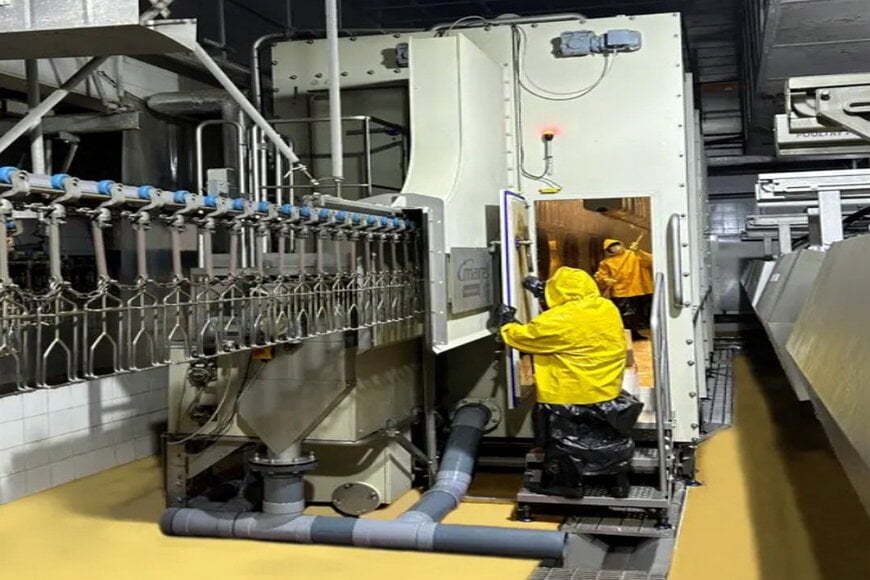
Delmon, a poultry processor based in Bahrain, handles a production volume of 5,200 birds per hour (bph), totaling approximately 40,000 birds daily. The company faced operational challenges with its traditional immersion scalding equipment, specifically regarding temperature stability and the risk of cross-contamination inherent in shared-water systems. To align with national sustainability regulations and improve the quality of deboned products, the company sought a technical solution to replace water-immersion methods.
Transition to Moisturised Air Scalding
The processor selected a moisturized air scalding system to achieve a "hard scald" — a process required by the local market to ensure a feather-free finish without the epidermis. The chosen technology utilizes a combination of moisturized air spraying, hot water circulation, and integrated sensors rather than a communal water tank.
This specific technical solution was selected for its precision. Unlike immersion tanks, which can take up to 30 minutes to adjust to temperature changes, the air-based system responds almost immediately. The design directs humidified air specifically toward areas with dense plumage, such as under the wings and tail, protecting the breast fillets from excessive heat exposure and preventing the meat from cooking during the scalding phase.
Operational Deployment and Hygiene
The installation has simplified the facility’s daily schedule. Previously, the preparation of the immersion scalder required staff to begin work five hours before production. The current system reaches operational parameters in 40 minutes, reducing the pre-production window and associated energy costs.
From a hygiene perspective, the solution eliminates the practice of immersing thousands of birds in the same water source, which is a primary vector for bacterial spread. The system’s design also facilitates maintenance; internal components feature self-cleaning cycles, and the physical structure allows operators to enter the unit for direct inspection and disinfection.
Quantifiable Results and Technical Benefits
The deployment of the air scalding system has resulted in several measurable improvements:
- Temperature Stability: The system maintains a stable thermal environment with fluctuations limited to ±0.3°C, ensuring consistent results across varying flock weights.
- Labor Efficiency: Improved plucking efficiency, particularly on wing tips, has eliminated the need for two manual inspection stations post-plucking.
- Time Savings: Daily startup time was reduced from 300 minutes to 40 minutes. Post-production cleaning is now completed in 40 minutes.
- Sustainability: The reduction in water consumption assists the company in meeting government-mandated water usage limits in Bahrain.
"With high-temperature immersion scalding you risk cooking the meat," explained Aatef Alsaleh, Chief Operating Officer at Delmon. "The system directs humidified air only where the feathers are, not at the breast. There’s no cooking of the fillets beneath the breast, with much nicer pink meat as a result."
Edited by Evgeny Churilov, Induportals Media - Adapted by AI.
www.jbtmarel.com
Edited by Evgeny Churilov, Induportals Media - Adapted by AI.
www.jbtmarel.com
