
www.foodpackautomation.com
15
'26
Written on Modified on
Optimizing alternative protein processing through continuous inline mass flow measurement
Advanced process measurement technology from KROHNE enables food manufacturers to transition from batch production to highly automated inline processing.
uk.krohne.com
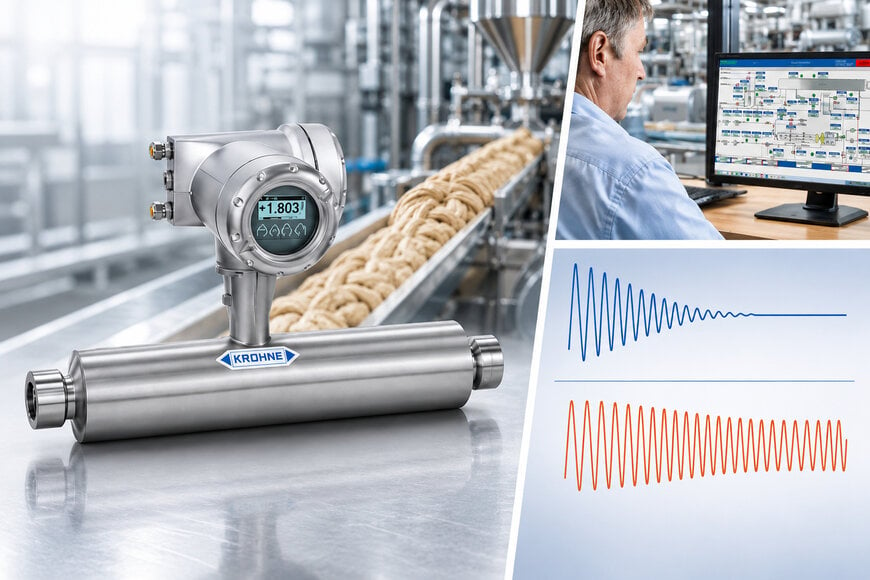
Area of application: Process measurement and inline blending
Industry sector: Alternative protein food production
Manufacturers producing plant-based meat alternatives face the intense challenge of achieving price parity with industrially manufactured conventional meat. Succeeding in this highly competitive market requires advanced, continuous, and uninterrupted production processes that optimize machinery utilization. Traditional manufacturing methods often depend on disconnected batch processes.
For example, raw protein ingredients like grains, oilseeds, legumes, or soybeans are processed into fine, sticky, and highly adhesive premixed powders that are notoriously difficult to meter with precision. Many production lines interrupt operation to collect and weigh these pre-products on a static scale before feeding them into an extruder. This process interruption forces downstream operations to wait, causing severe flow disruptions that degrade time, process efficiency, and overall throughput.
Targets for industrial efficiency, product consistency, and resource sustainability
Transitioning to advanced automation targets several operational improvements across the manufacturing chain. The primary goals include maximizing raw material efficiency by switching from interrupted batch processing to continuous inline blending, which inherently increases production quantities per unit of time.
Maintaining stable and uniform process conditions is vital to achieving consistent product quality and mouthfeel—specifically the "bite feel" texture required for consumer acceptance. From a maintenance and sustainability perspective, precise real-time data collection eliminates overproduction, scrap, and product giveaway, optimizing batch yields while keeping energy consumption minimal.
Dynamic control algorithms and sensor geometries for inline processing
To overcome the vulnerabilities of traditional weight scales and batch processing, continuous inline measurement is implemented directly within the process piping. The technical architecture relies on Coriolis mass flowmeters equipped with specialized Entrained Gas Management (EGM) technology.
Conventional mass flowmeters experience signal failures, measurement interruptions, or severe deviations when processing viscous protein mixtures because the pressure drop at the extruder exit causes material expansion, creating trapped air pockets. The EGM system employs advanced control algorithms to maintain continuous operation and stable signal tracking even during severe air entrainment.
Additionally, the instrumentation integrates a single-tube sensor geometry. Unlike standard dual-tube designs that induce high pressure losses when handling pasty meat substitutes, the straight single-tube layout facilitates a smooth flow path. This specific geometry allows precise metering while permanently reducing required pump output.
Engineering design criteria and hygienic manufacturing standards
The technical features of the Coriolis instruments ensure precise process control across pilot plants with small piping up to large-scale industrial process piping. Inline dosing can achieve tight measurement deviations in the range of 0.5–1.0%, even when dealing with complex textures or gas-entrained mixtures.
Because alternative protein production involves strict food safety criteria, the chosen instrumentation utilizes food-compliant materials built completely without dead spaces. The design adheres strictly to hygienic engineering guidelines, meeting explicit EHEDG and 3-A certifications, alongside material compliance mandates according to European Union legislation and FDA regulations.
Objective operational benefits and lifecycle performance
Transitioning to automated inline blending allows plant-based ingredients to be weighed directly inside the piping without process interruptions, while additional ingredients, spices, and flavors are dosed inline virtually non-stop. Integrating parallel measurements provides inline process density and concentration data, protecting valuable ingredients from accidental over-dosing.
The instrumentation features an extended service life, with a 30-year operational lifespan being standard for the underlying mechanical components. To minimize long-term maintenance costs, the flowmeters utilize retrofittable electronics equipped with onboard diagnostic and verification tools. This architecture supports Industry 4.0 maintenance capabilities while drawing an insignificant portion of the total process energy budget compared to heavy agitators, motors, and mixing valves.
Edited by Sucithra Mani, Induportals editor – adapted by AI.
www.krohne.com
