
www.foodpackautomation.com
23
'25
Written on Modified on
Modular Conveyors Enable Agile Food Manufacturing
Dynamic Conveyor outlines how modular conveyor architectures support flexible, automated, and compliant production in food and beverage environments facing frequent change.
www.dynamicconveyor.com
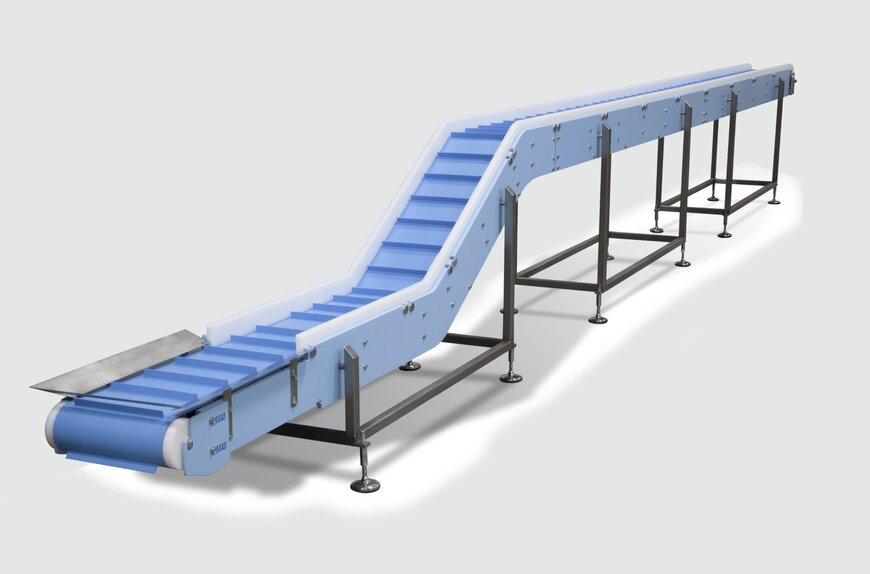
Manufacturing operations in the food and beverage sector are increasingly shaped by shifting product portfolios, evolving layouts, and fluctuating demand. In this context, conveyor systems are no longer treated as fixed infrastructure but as configurable assets that can adapt alongside production requirements. Addressing this shift, Dynamic Conveyor highlights the role of modular conveyor systems in enabling agile, cost-effective, and automation-ready manufacturing.
From fixed layouts to reconfigurable transport systems
Traditional conveyor systems were designed for stable, long-term production flows and often required significant downtime and capital expenditure to modify. Modular conveyor systems address this limitation by using standardized, interchangeable components that can be added, removed, or rearranged with minimal disruption.
This approach is particularly relevant in food and beverage manufacturing, where new products, packaging formats, or regulatory requirements frequently require layout changes. Modular conveyors allow production lines to be reconfigured incrementally, reducing downtime and avoiding full system replacement when processes evolve.
Operational flexibility under labor and space constraints
Labor availability and rising labor costs further reinforce the need for flexible material handling. Modular conveyors reduce reliance on manual handling by automating product movement while simplifying operator training through consistent system design.
From an engineering perspective, modularity enables adaptation to space constraints and equipment changes. Flat conveyor sections can be supplemented with incline or decline modules, radius curves, or vertical configurations to optimize floor space or integrate new machinery. This “building-block” design supports continuous improvement without extensive re-engineering.
Maintenance, safety, and lifecycle cost considerations
Standardized components are a defining feature of modular conveyor systems and directly influence maintenance performance. Off-the-shelf parts can be replaced quickly, limiting downtime and simplifying spare-parts management. In many designs, tool-less maintenance further reduces intervention time and dependence on specialized skills.
Safety is also addressed through modular design. Automated product handling reduces ergonomic strain, while integrated guards, covers, and accessories help mitigate pinch points and other hazards. Systems can be configured to align with applicable OSHA, UL, and NFPA requirements, supporting both regulatory compliance and site-specific safety policies.
Modular platforms as enablers of automation
As automation expands across food and beverage production, modular conveyors increasingly serve as integration platforms rather than standalone transport systems. Plug-and-play accessories such as metal detectors, hoppers, chutes, reject arms, ionizers, and sensors allow conveyors to be adapted for inspection, quality control, and product handling tasks.
For example, hoppers and chutes help control product flow and reduce spillage or cross-contamination, while metal detectors protect downstream equipment in plastic or packaged-product lines. Belt options—including anti-static or easy-release surfaces—enable handling of diverse products and support fast changeovers in constrained layouts.
Integration with sensors and vision systems further enables automated checks such as counting, leak detection, or short-shot identification. These capabilities support one-piece flow, reduce defect rates, and align conveyor systems with broader automation and data-collection strategies.
Investment logic and return over time
While modular conveyor systems may involve higher initial costs than fixed alternatives, their long-term value is driven by scalability and reduced total cost of ownership. Systems can be deployed in phases, allowing manufacturers to align capital spending with demand cycles and operational growth.
Standardized modules allow engineers to adjust conveyor height, incline, or belt type without custom fabrication. This flexibility is particularly valuable for facilities managing seasonal demand or frequent product changes, where existing modules can be reconfigured rather than replaced. Maintenance costs are also reduced through standardized parts and faster servicing.
Energy efficiency contributes to lifecycle economics. Many modular systems incorporate variable-speed drives and high-efficiency motors, lowering energy consumption relative to fixed-speed designs. The ability to expand or modify systems without scrapping existing equipment further supports cost control as production requirements evolve.
Sanitation and compliance in food processing
In food and beverage applications, flexibility must be matched with strict sanitation and compliance requirements. Modular conveyors designed for this sector incorporate features such as tool-less disassembly, quick-change belts, washdown-compatible materials, and corrosion-resistant structures.
These design choices support compliance with FDA, USDA, NSF, and BISCC requirements while reducing cleaning and changeover times. Operators can adapt conveyor layouts to seasonal products or allergen-control needs by swapping belts or adding containment accessories, without extended downtime.
Modularity also supports rapid response to recalls or sanitation events. Conveyors can be disassembled, cleaned, and reconfigured by in-house teams, maintaining uptime while reducing contamination risks. Adjustable legs and multiple conveyor geometries—flat, Z-shaped, vertical, or radius—allow systems to evolve with plant layouts.
Conveyors as part of future-ready manufacturing
As manufacturing continues to integrate automation, digitalization, and data-driven control, modular conveyors are positioned as adaptable infrastructure within smart factory environments. Integration with IoT-enabled controls, real-time monitoring, and predictive maintenance tools allows conveyors to contribute operational data beyond basic material transport.
For manufacturers, the strategic value lies in investing in systems that combine robustness with adaptability. Modular conveyor architectures provide a foundation that supports process changes, regulatory shifts, and new automation technologies without repeated reinvestment.
By prioritizing reconfigurability, integration capability, and compliance, modular conveyor systems move beyond their traditional role and become enabling platforms for agile, resilient food and beverage manufacturing.
www.dynamicconveyor.com
