
www.foodpackautomation.com
26
'25
Written on Modified on
Marel’s ALPINE Module Demonstrates Strong Performance at Emsland and Celler Land
Anatomic leg cutting system boosts yield, improves product quality, and reduces manual intervention through digital recipe control and automated adjustments.
marel.com
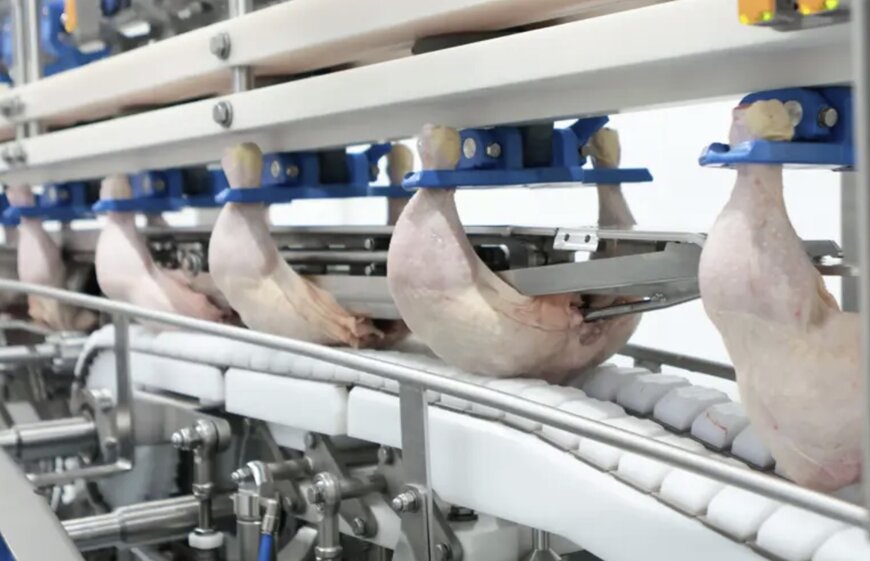
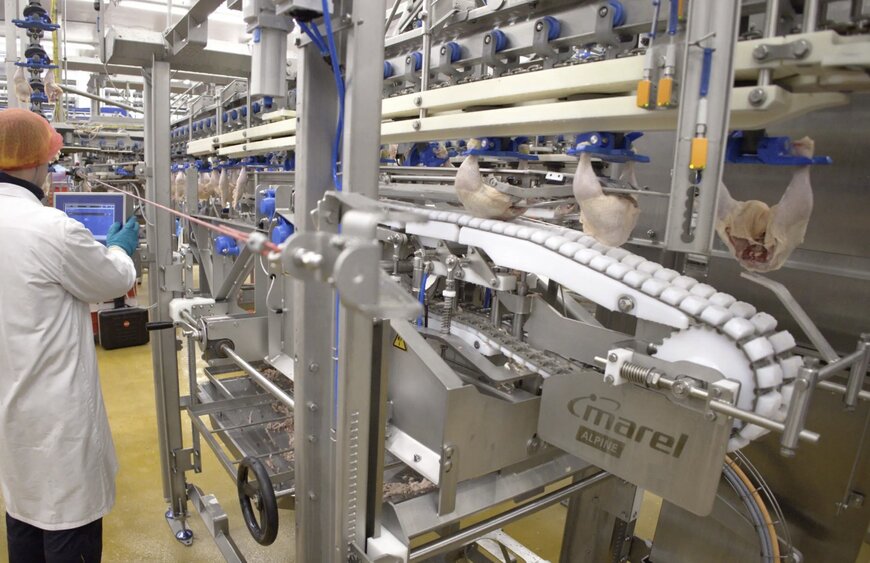
The new Marel ALPINE anatomic leg cutting module ensures high yield and great product quality. Thanks to digital recipe input via the HMI touchscreen, manual machine adjustments are no longer necessary. ALPINE (Anatomic Leg Processor Innovative New Evolution) does its job consistently, whether it be a flock or even a whole day’s production, as experienced in the German facilities of Emsland and Celler Land Frischgeflügel.
User-friendly operation
ALPINE is part of Marel’s ACM-NT cut-up system and features an HMI touchscreen, where the appropriate recipe that best matches the incoming raw material can be selected. Whether saddles come from a flock of large, medium-sized, or small broilers, or from a slow-growing breed with longer legs, the system adjusts settings and timings according to the recipe. These adjustments can even be made during production.
Working together with its internal SmartBase software, the screen also displays real-time and historical, objectively measured performance reports, for instance, after each recipe change. Data includes machine performance, as well as leg loss and back piece detection, with a distinction between left and right legs. As a result, manual counting is no longer necessary. This saves labor.
Labor savings
Emsland and Celler Land also saw that ALPINE requires little to no human intervention during operation. Its simple design means only minimal adjustments are necessary during production. The system effectively prevents product loss, saving valuable time, rework, and resources.
Legs stay in the shackle
For anatomic leg cutting, incisions must be made on the inside of the saddle to sever the tendons, allowing the hip joint to be released. The easiest way to achieve this is by folding the leg outward. In the past, however, this required taking the leg out of the shackle.
ALPINE employs a unique Hip Dislocation Wheel that actively controls the movement of the hip joint without applying force to the leg and without removing it from the shackle. Throughout the entire process, legs remain securely in the cut-up shackles, improving overall performance. Hannes Langen, Project Manager at Emsland Frischgeflügel, says, “Now that it is no longer necessary to reposition the saddle, we could streamline our process for hip joint cutting and eliminate a potential source of error. ALPINE is the perfect solution for anatomically separating the leg from the hip, enabling a clean leg joint cut.”
Wide range without adjustments
With the varying chicken weights found in today’s markets, ALPINE’s ability to process a broad range of weights without needing adjustment is a major advantage. It can accommodate processing weights from 1.2 kg to 4.5 kg [2.6–10 lbs]. Even within a flock, ALPINE can accept an unparalleled wide weight range, all without needing adjustment. Richard Wenneker, Production Director at Emsland and Celler Land Frischgeflügel, adds, “We see enormous value in our ability to handle a broader weight range with better yield. ALPINE is also more compact when compared to JLR. Its simpler design gives us advantages in the form of less maintenance, easier and quicker cleaning, and improved operational safety. These were key reasons for choosing ALPINE for the deboning lines at Emsland and Celler Land Frischgeflügel."
www.marel.com
