
www.foodpackautomation.com
20
'26
Written on Modified on
Singulation improves poultry processing yield
JBT Marel optimizes poultry lines by ensuring proper product flow before X-ray inspection, reducing waste and improving operational efficiency.
marel.com
Poultry processors operating high-speed lines often exceeding 15,000 birds per hour face continuous pressure to maximize yield while ensuring product safety. Even minor inefficiencies, such as unnecessary trimming or misclassification of contaminated products, can accumulate into significant material losses.
Despite the adoption of X-ray inspection systems for bone detection, processors observed persistent inefficiencies at rework stations. Operators responsible for trimming contaminants were frequently overwhelmed by inconsistent product flow, leading to avoidable trimming of uncontaminated fillets and reduced overall yield.
The objective for processors was to improve raw material utilization, line efficiency, product quality, and operator performance, while maintaining reliable contamination detection.
Problem: Collateral rejects from poor infeed presentation
Analysis of processing lines showed that the issue did not originate from detection accuracy. Bone detection systems were reliably identifying contaminated products. However, inefficiencies arose upstream.
Fillets entering the inspection stage were often overlapping or grouped. When one fillet within a cluster contained a bone, the entire group was rejected and sent to rework.
At trimming stations, operators could not distinguish which fillet contained the contaminant. As a result, all fillets in the batch were trimmed as a precaution. This created:
- Unnecessary removal of usable meat
- Increased operator workload and inconsistency
- Recirculation of unprocessed products
- Bottlenecks affecting line speed and throughput
These “collateral rejects” represented a hidden but significant source of yield loss.
Solution: Singulation before detection
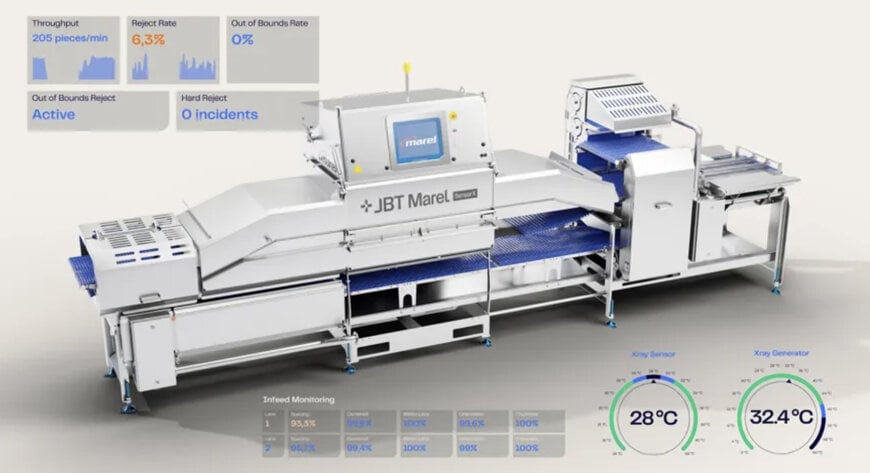
To address this, JBT Marel implemented an infeed monitoring system designed to ensure singulation proper spacing of individual fillets before they reach the X-ray inspection stage.
The system monitors product presentation on conveyors and alerts operators when overlap or clustering occurs. By correcting product flow upstream, each fillet enters the detection system individually, allowing accurate identification and targeted rejection of only contaminated pieces.
This approach was selected because it addresses the root cause of inefficiency product presentation rather than attempting to further optimize already reliable detection technology.
As noted by Nína Margrét Gísladottír, Global Product Manager: “We knew there was an issue with wasted product at rework stations… but it wasn’t a detection issue.”
Deployment: Integration with existing inspection systems
The infeed monitoring solution was deployed alongside existing X-ray inspection equipment without requiring major modifications to processing lines.
Operators receive real-time alerts when product flow deviates from optimal conditions, enabling immediate corrective action. In parallel, the system collects operational data on product overlaps, shift performance, and recurring issues.
This data-driven approach allows plant managers to identify root causes, implement targeted training, and improve accountability across shifts.
Results: Reduced waste and improved line performance
Ensuring singulation before detection delivers measurable operational benefits across poultry processing lines.
By eliminating grouped product at inspection, only contaminated fillets are diverted to rework. This significantly reduces unnecessary trimming and preserves valuable raw material.
Operators handle fewer, clearly identified pieces, improving trimming accuracy and reducing stress. At the same time, smoother product flow minimizes bottlenecks and supports consistent line speeds.
From an operational perspective, processors achieve:
Solution: Singulation before detection
To address this, JBT Marel implemented an infeed monitoring system designed to ensure singulation proper spacing of individual fillets before they reach the X-ray inspection stage.
The system monitors product presentation on conveyors and alerts operators when overlap or clustering occurs. By correcting product flow upstream, each fillet enters the detection system individually, allowing accurate identification and targeted rejection of only contaminated pieces.
This approach was selected because it addresses the root cause of inefficiency product presentation rather than attempting to further optimize already reliable detection technology.
As noted by Nína Margrét Gísladottír, Global Product Manager: “We knew there was an issue with wasted product at rework stations… but it wasn’t a detection issue.”
Deployment: Integration with existing inspection systems
The infeed monitoring solution was deployed alongside existing X-ray inspection equipment without requiring major modifications to processing lines.
Operators receive real-time alerts when product flow deviates from optimal conditions, enabling immediate corrective action. In parallel, the system collects operational data on product overlaps, shift performance, and recurring issues.
This data-driven approach allows plant managers to identify root causes, implement targeted training, and improve accountability across shifts.
Results: Reduced waste and improved line performance
Ensuring singulation before detection delivers measurable operational benefits across poultry processing lines.
By eliminating grouped product at inspection, only contaminated fillets are diverted to rework. This significantly reduces unnecessary trimming and preserves valuable raw material.
Operators handle fewer, clearly identified pieces, improving trimming accuracy and reducing stress. At the same time, smoother product flow minimizes bottlenecks and supports consistent line speeds.
From an operational perspective, processors achieve:
- Higher yield from each processed bird
- Reduced rework volume and labor inefficiencies
- Improved product quality and consistency
- Enhanced visibility into line performance through data insights
Conclusion: Upstream control drives downstream efficiency
The case demonstrates that improving product flow before inspection can have a greater impact on yield than refining detection itself.
By introducing singulation ahead of X-ray inspection, poultry processors can reduce waste, stabilize operations, and increase profitability without major equipment changes.
This shift from reactive correction to proactive flow control provides a practical pathway to optimize high-speed processing environments and maintain competitiveness in a margin-sensitive industry.
Edited by an industrial journalist, Sucithra Mani, with AI assistance.
www.jbtmarel.com
The case demonstrates that improving product flow before inspection can have a greater impact on yield than refining detection itself.
By introducing singulation ahead of X-ray inspection, poultry processors can reduce waste, stabilize operations, and increase profitability without major equipment changes.
This shift from reactive correction to proactive flow control provides a practical pathway to optimize high-speed processing environments and maintain competitiveness in a margin-sensitive industry.
Edited by an industrial journalist, Sucithra Mani, with AI assistance.
www.jbtmarel.com
