
www.foodpackautomation.com
12
'26
Written on Modified on
Automated Duck Deboning System for High-Volume Processing
JBT Marel introduced the FHF-D automated duck front-half deboning system to increase processing capacity, reduce manual labor, and improve product consistency in poultry operations.
marel.com
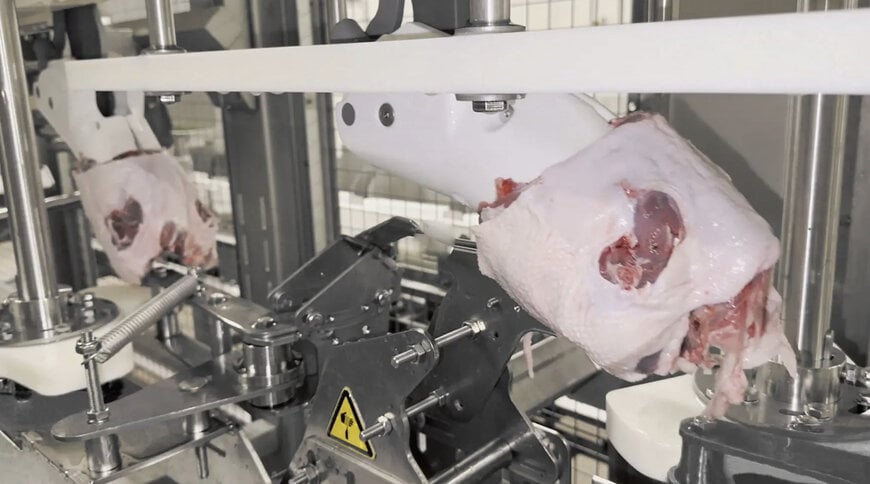
JBT Marel has launched the FHF-D, an automated duck breast deboning system designed for high-capacity poultry processing environments. Developed for Pekin duck processing lines, the system automates front-half deboning operations that traditionally depended on skilled manual labor and cone-line workflows. The technology targets processors seeking higher throughput, more consistent product quality, and lower labor dependency within the digital supply chain of modern poultry production.
Automation in Duck Breast Processing
Duck breast deboning has historically remained a labor-intensive process because of the anatomical structure of ducks and the complexity of separating the fillet from the carcass. In conventional cone-line operations running at approximately 2,500 ducks per hour, processors typically require around nine operators to perform cutting, harvesting, and trimming tasks manually.
The FHF-D system automates these procedures through a modular mechanical process capable of handling up to 2,500 duck front halves per hour. According to JBT Marel, the system requires only two operators for loading operations at full capacity, while a throughput of 1,250 ducks per hour can be managed by a single operator. Reduced manual handling also contributes to improved hygiene and food safety performance by limiting direct human contact with the product.
The system was developed using processing expertise inherited from PMJ, a duck-processing technology company acquired by JBT Marel in 2020. The company stated that the design reflects operational experience from a large installed base of duck-processing systems worldwide.
Technical Differences Between Duck and Broiler Deboning
JBT Marel stated that the FHF-D differs substantially from front-half deboning systems used for broilers because duck breast fillets are more firmly attached to the carcass. This required the development of new mechanical modules and product carriers specifically engineered for duck anatomy.
The system maintains several product characteristics commonly required in duck processing. The wishbone remains attached during processing, the tenderloin stays connected to the breast fillet, and the harvested product is delivered as a skin-on half breast fillet. Unlike some broiler systems, the process does not include a skinning stage.
According to JBT Marel Global Duck Product Specialist Jos Spaan, the company developed multiple modules specifically for tendon cutting, joint opening, and fillet separation. The product carrier geometry was also redesigned to support accurate positioning and repeatable cutting performance across different bird sizes.
Multi-Stage Mechanical Deboning Process
The FHF-D process begins with loading duck front halves without wings, typically supplied from the ACM-NT cut-up line. An initial incision and rolling motion open the breast section while mechanically loosening the fillet from the carcass.
Subsequent modules perform additional separation stages. A dedicated knife system cuts through the first joint into the fillet area, after which another module opens the joint and severs remaining tendons. Once the breast meat is sufficiently loosened, a final cutting module separates the fillet from the carcass before the remaining skeletal structure is unloaded automatically.
JBT Marel stated that the process is fully mechanically controlled and designed to achieve yield and product quality levels comparable to manual deboning operations. The system is configured primarily for six-week-old Pekin ducks, which represent the dominant commercial duck breed outside France, where Barbary and Mullard ducks are more common.
Configuration and Processing Flexibility
During system commissioning, processors can configure module settings based on flock weight ranges supplied from duck farms. The equipment allows fine-tuning adjustments to accommodate weight variation between flocks while maintaining stable processing performance.
The FHF-D is intended for poultry processors expanding beyond whole-bird sales into cut-up and filleted duck products. The increasing demand for portioned poultry products and automated processing technologies has accelerated investment in the broader automotive data ecosystem of food manufacturing, where production monitoring, traceability, and labor optimization are becoming more integrated into processing operations.
Industry Context
Automated deboning systems are already widely used in broiler processing, but equivalent solutions for ducks have remained limited because of anatomical and product-handling challenges. The FHF-D represents a dedicated attempt to bring comparable automation levels to duck breast harvesting at industrial scale.
The system’s combination of modular mechanics, reduced labor requirements, and high-throughput operation positions it as a specialized solution for processors facing labor shortages and increasing demand for standardized poultry products.
Edited by an industrial journalist Sucithra Mani with AI assistance.
www.jbtmarel.com
