
www.foodpackautomation.com
30
'26
Written on Modified on
Automated Poultry Breast Deboning System for Yield Optimization
JBT Marel integrates a streamlined filleting process into a single compact unit to address skilled labor shortages.
marel.com
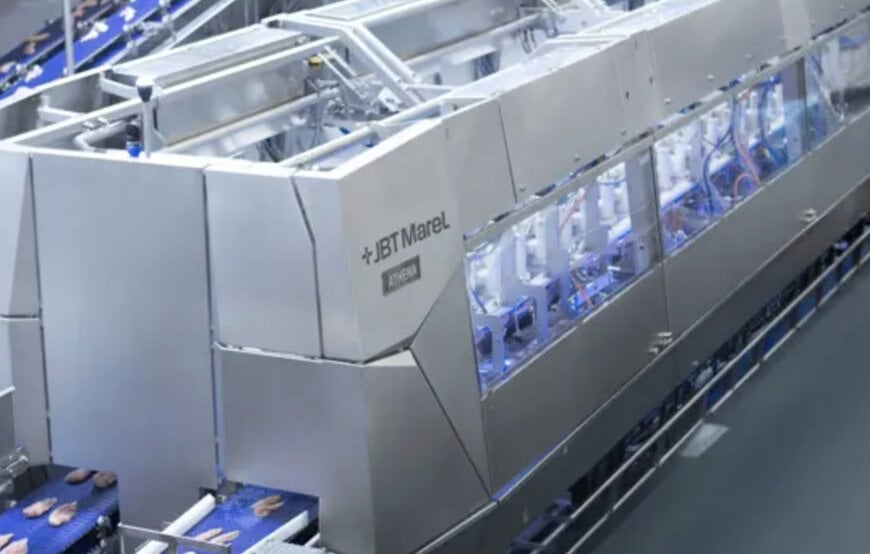
Industrial poultry processing requires fully automated workflows to maintain consistently high yields despite the limited availability of skilled personnel. The ATHENA system seamlessly executes the measuring, cutting, separating, and deboning of poultry half-breasts, delivering finished fillets and tenderloins within a single compact unit. This technology directly serves the food processing sector and the poultry industry, both of which face an increasing variety of bird profiles and end-product specifications.
Automated Filleting and Labor Reduction
The deboning system increases processing capacity while meeting stringent productivity standards. By optimizing material flow within the digital supply chain of food processing, this compact unit integrates modules equipped with field-proven AMF-i technology. Regional Sales Director at JBT Marel Poultry, Mathieu van Dongen, states: "The AMF technology, which has made its proof, has demonstrated time and again its efficiency. In its improved version, it guarantees that ATHENA is a reliable and cutting-edge solution to meet the filleting needs of poultry processors".
The machinery is designed to minimize reliance on skilled labor through automated sequences. At a nominal capacity of 6,000 products per hour, system operation requires only two operators. The product flow begins behind the chute of the ACM-NT breast cap filleting cutter module, where the breasts are precisely aligned in the same direction. Operators slide the pre-positioned breast pieces into the loading units, eliminating ergonomic strain on the wrist. The breast pieces are then automatically secured onto specifically shaped product carriers to mitigate the risk of product drops.
Managing Raw Material Variations via Software Recipes
An intuitive human-machine interface (HMI) allows operators to configure the modules based on incoming raw material characteristics. The wishbone and half-breast cutting modules adjust automatically to the expected weight of the birds, accommodating standard broilers, free-range, organic, or other specialty lines. "If the next flock coming into the system consists of free-range chickens, the operator simply selects the specific settings for this type of chicken on the touchscreen. This then guarantees optimal results for breast deboning", explains Mathieu van Dongen.
Beyond flock-wide recipe settings, a dedicated measuring module—a new feature for the system—determines the dimensions of each individual breast at the inlet. The captured data automatically calibrates the parameters of all downstream modules, including the automatic harvesting module, in real time. This mechanism dynamically compensates for size variations within the same flock.
Performance Indicator Tracking and Maintenance
The system incorporates SmartBase software to centralize production data. The touchscreen provides real-time visibility into line load, loader efficiency, and mechanical machine status. Mathieu van Dongen explains: "Thanks to the SmartBase software, the touchscreen gives access to valuable insights into line load, loader efficiency, and machine status. It indicates whether all trays are filled, if products are falling from the trays, and much more". The software also analyzes yield per product carrier, tracking successful deboning steps, carrier damage, and dropped products. These performance metrics can be exported to central control room screens to facilitate rapid diagnostics and corrective actions.
Additional Context: This section details technical specifications and competitive benchmarking not included in the original product announcement
Within the automotive data ecosystem and broader industrial automation frameworks, the performance of an automated deboning system is evaluated by hourly throughput, factory footprint, and meat recovery rates (material yield). The ATHENA system, with its throughput of 6,000 half-breasts per hour utilizing two operators, positions itself within the mid-to-high capacity market segment.
In comparison, competing high-capacity solutions, such as the Meyn FHF-XB breast deboning lines or Foodmate deboning systems, offer variable throughputs ranging from 3,000 to 6,000 products per hour depending on configuration. The Meyn system relies on weigh sensors and industrial vision cameras to dynamically adjust cutting blades, an approach functionally similar to the measurement module found in the ATHENA.
The compactness of the JBT Marel unit serves as a key differentiator for plant integration. Where traditional automated deboning lines often require significant conveyor length to separate the cutting, skinning, and tenderloin harvesting stages, integrating these functions into a single compact unit reduces the physical floor space required in the facility.
Furthermore, the software integration via SmartBase aligns with modern smart-factory requirements, enabling unit-level tracking per product carrier. This granular traceability of yields and mechanical faults is comparable to industrial IoT architectures developed by other OEMs in the sector, aiming to minimize product giveaway—the primary profitability metric in automated filleting operations.
Edited by Maria Brueva, Induportals editor – adapted by AI.
www.jbtmarel.com
