
www.foodpackautomation.com
02
'26
Written on Modified on
Hydraulic Vertical Conveyors for 2-Level Material Transport
PFlow Industries engineers specialized lifting solutions designed to optimize operational efficiency and enhance worker safety within high-throughput food manufacturing facilities.
www.pflow.com
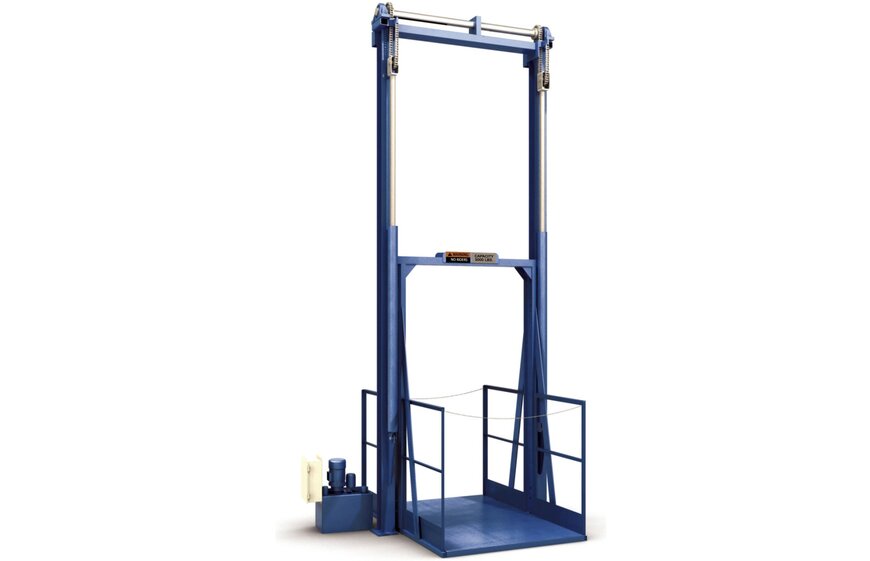
PFlow Industries highlights the 21 Series Hydraulic Vertical Lift, a specialized material handling solution engineered for two-level applications within the food manufacturing sector. The system facilitates the secure transfer of palletized goods, addressing industry demands for enhanced spatial efficiency and operational throughput.
Operational Mechanics and Performance Specifications
The 21 Series vertical reciprocating conveyor (VRC) manages vertical transport up to a maximum rise of 22 feet, supporting load capacities reaching 6,000 lbs. The system utilizes a two-post hydraulic architecture, with standard carriage platform dimensions of up to 12' x 10'. The drive mechanism employs a chain-over-sprocket configuration actuated by guide column-mounted hydraulic cylinders.
To maintain carriage stability, a torsion bar system synchronizes the two cylinders, ensuring uniform movement and load distribution. The system operates at a standard travel speed of 24 feet per minute (FPM), with optional configurations supporting speeds up to 30 FPM. This mechanical synchronization, combined with a lifetime structural warranty, provides a predictable duty cycle for high-throughput manufacturing environments.
Safety Compliance and Infrastructure Integration
All 21 Series units are manufactured to comply with ASME B20.1 safety standards for conveyors and related equipment. Technical safety features include velocity fuses, integrated pressure switches, check valves, and certified safety cams to prevent uncontrolled movement. In the event of a power interruption, the design incorporates a manual lowering valve to permit safe descent.
Facility integration is supported by optional quick-connect cabling for motor pump units, push-button stations, and gate interlocks, which reduces field-installation time and electrical wiring costs. For environments requiring frequent sanitation or exposure to moisture, such as wash-down food processing areas, the equipment can be specified with hot-dipped galvanized or epoxy protective finishes. Additional security for elevated loading levels is provided through custom enclosures, gates, and an optional DeckLock Safety System that provides positive mechanical locking of the carriage.
Additional Context
This section details technical specifications and competitive benchmarking not included in the original news release.
Vertical Reciprocating Conveyors (VRCs) are distinct from freight elevators as they are classified strictly for material transport rather than personnel. Benchmarking against alternative lifting technologies, such as scissor lifts, shows that hydraulic chain-over-sprocket VRCs provide a superior balance of duty cycle reliability and load stability for fixed-point, two-level transfers. The 21 Series’ hydraulic-actuated chain system inherently provides higher load-bearing consistency for static palletized loads compared to scissor lift tables, which often experience mechanical fatigue and lateral sway at higher vertical travel distances. Compliance with ASME B20.1 remains the critical benchmark for these units, ensuring they satisfy the stringent safety requirements for industrial material handling systems in North American jurisdictions.
Edited by Aishwarya Mambet, Induportals Editor, with AI assistance.
www.pflow.com
