
www.foodpackautomation.com
08
'26
Written on Modified on
Automating Poultry Cut-up and Deboning
Xinsheng Group expanded its cooperation with JBT Marel to increase automation and improve processing efficiency at its Boxing poultry plant.
marel.com
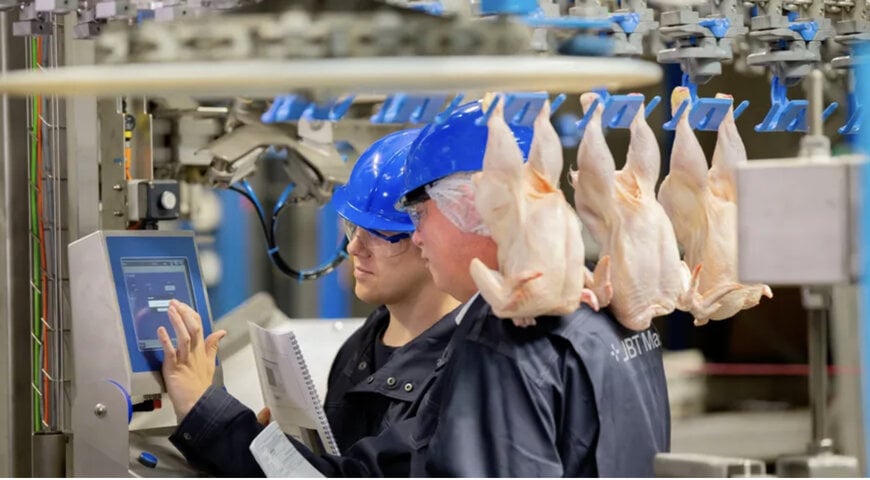
Application area: Poultry processing, automated poultry cut-up, automated poultry deboning
Industry sector: Food processing
Xinsheng Group, one of China's large poultry processors, has continued its long-term cooperation with JBT Marel by upgrading its Boxing processing plant in Shandong Province with automated poultry cut-up and deboning systems. The partnership began in 2011 with the installation of two 12,000 birds-per-hour evisceration lines and has since expanded across four production facilities.
The latest investment includes four ACM-NT cut-up lines and eight AMF-i breast deboning systems, supporting higher production capacity while improving process consistency and product quality.
Building on previous installations
Since the initial installation at the Boxing plant, Xinsheng has introduced JBT Marel processing solutions at several additional sites. The Gaosheng plant received two 13,500 birds-per-hour evisceration lines in 2016, together with two grading lines, four ACM-NT cut-up lines and eight AMF-i breast deboning lines. Similar 13,500 birds-per-hour evisceration systems were subsequently installed at the Hesheng and Longtai plants in 2018.
The continued deployment of similar processing technologies across multiple facilities enables standardized production methods and operational consistency throughout the company's processing network.
Improving grading and product distribution
At the Boxing facility, the upgraded grading line incorporates a whole-bird weighing module integrated into the overhead conveyor system. The weighing data is processed directly by the PDS distribution software, allowing products to be routed automatically according to predefined production requirements.
To ensure efficient operation of the grading and cut-up lines, Xinsheng provides operator training in cooperation with JBT Marel. The training focuses on the practical use of the PDS software, helping production personnel manage product distribution and processing more effectively.
Automated cut-up process
Following grading, products are transferred to four ACM-NT cut-up lines through TR-1G HS rehangers. Before wing cutting, the processing sequence includes wing stretching, leaf-fat removal and neck cutting.
The wing processing section combines several automated operations. The WingTipper removes the wing tip, while the Second Joint Wing Cutter HPP performs the mid-wing cut according to Chinese processing specifications, retaining as much skin as possible on the first wing joint. The remaining wing section is then separated from the breast by the Wing Cutter CC-NT.
The processing line continues with automated breast, spine and tail cutting before the JL-HP performs an anatomical leg cut designed to improve cutting accuracy and product consistency.
Automated deboning increases production capacity
Breast caps from the cut-up lines are transferred to eight identical AMF-i deboning systems operating in parallel. Each processing line begins with the Breast Cap FlexLoader, which accurately positions each breast cap on the product holder before deboning.
The integrated measuring system classifies each breast cap, enabling subsequent processing modules to automatically adjust to product size. These modules perform skin removal, wishbone removal, breast halving, fillet separation, tenderloin separation, keel ribbon harvesting and cartilage harvesting.
By combining automated product measurement with adaptive processing, the system prepares breast meat for efficient manual harvesting of fillets and tenderloins while maintaining consistent product quality. Operating eight AMF-i systems simultaneously also enables the Boxing plant to process large volumes of deboned breast meat with consistent output.
Edited by Sucithra Mani, Induportals editor – adapted by AI.
www.jbtmarel.com
