
www.foodpackautomation.com
16
'26
Written on Modified on
X-Ray Image Processing for High-Speed Poultry Inspection
JBT Marel has introduced the SensorX Xpress algorithm to increase the conveyor processing capacity of food inspection systems without compromising detection accuracy.
marel.com
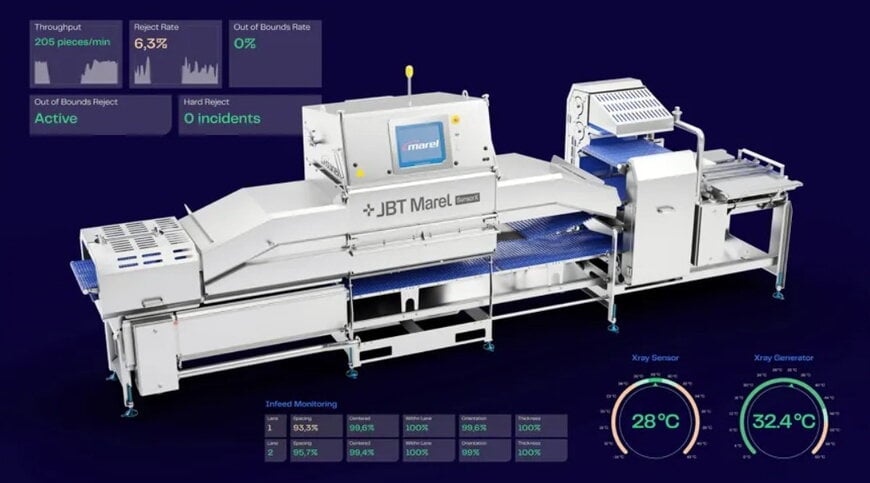
The poultry processing sector continuously requires higher throughput due to the integration of high-speed deboning machinery and larger bird sizes. To prevent the inspection stage from becoming a production bottleneck, the SensorX Xpress image-processing algorithm increases conveyor belt capacity by up to 20%. This software advancement allows the inspection system to analyze X-ray scan data at higher velocities, directly matching the output of modern high-speed preparation lines.
The software operates by accelerating the calculation times of the X-ray detection algorithm, allowing the belt to run faster while maintaining the spatial resolution required to identify small bone fragments and foreign bodies.
Compatibility and System Retrofitting
First introduced in 2007, the SensorX platform has undergone sequential hardware and software iterations, including the integration of specialized sensors, adaptive bone detection models, and infeed monitoring systems. The new Xpress software algorithm is standard on all newly manufactured SensorX inspection systems.
To preserve existing capital investments, the software is designed for backward compatibility. Operators utilizing the SensorX 500 platform can retrofit their existing hardware installations with the updated algorithm, allowing older machinery to achieve the same 20% throughput increase as new units. The upgrade does not alter the physical footprint of the machine or require modifications to the existing mechanical conveyor assembly, minimizing line downtime during installation.
Optimized Detection Accuracy and False-Positive Reduction
Maintaining a low false-positive rate is critical in automated poultry inspection; high false-positive rates lead to unnecessary product re-inspection, increased labor costs, and product waste. The Xpress algorithm maintains the established detection thresholds of the SensorX platform, ensuring that the increase in belt speed does not result in a higher frequency of false rejects or missed contaminants. The system is designed to identify dense bone fragments, cartilage, and other hard foreign particles down to sub-millimeter scales, even when operating at maximum conveyor velocity.
Additional Context: Technical Specifications and Competitive Benchmarking
In the industrial food inspection market, dual-energy X-ray absorptiometry (DEXA) is the benchmark technology used to distinguish between organic tissue and low-density contaminants like chicken bones. While standard single-energy X-ray systems struggle with varying product thickness, dual-energy systems analyze the ratio of low-to-high energy photon absorption, allowing accurate detection even in thick or overlapping poultry portions.
The SensorX platform competes directly with alternative high-throughput dual-energy X-ray inspection systems, such as the Ishida IX-G2 and the LOMA X5 Product Inspector.
Throughput and Speed
Traditional dual-energy systems typically operate at maximum belt speeds ranging from 60 to 90 meters per minute, depending on product thickness and detection sensitivity. By integrating the Xpress algorithm, JBT Marel allows the SensorX system to increase its processing capacity by 20%, bringing its processing speed to the top tier of industrial dual-energy inspection limits without requiring a transition to a larger physical footprint.
False-Product Reject Rates
While competitive systems like the Ishida IX-G2 utilize genetic algorithms to optimize the detection of low-density bones in overlapping products, the SensorX Xpress algorithm focuses on optimizing the computational pipeline of the image processing stage itself. This allows JBT Marel to maintain a highly stable, repeatable false-positive rate under accelerated feed rates, whereas unoptimized systems often experience an increase in false rejects when belt speeds are increased beyond standard limits.
Edited by Evgeny Churilov, Induportals Media - Adapted by AI.
www.jbtmarel.com
