
www.foodpackautomation.com
18
'26
Written on Modified on
Automated Robotic Systems for Industrial Meat Processing Lines
Scan Sverige deployed robotic processing equipment from JBT Marel at its Kristianstad plant to improve hygiene standards, cutting accuracy, and operational throughput.
marel.com
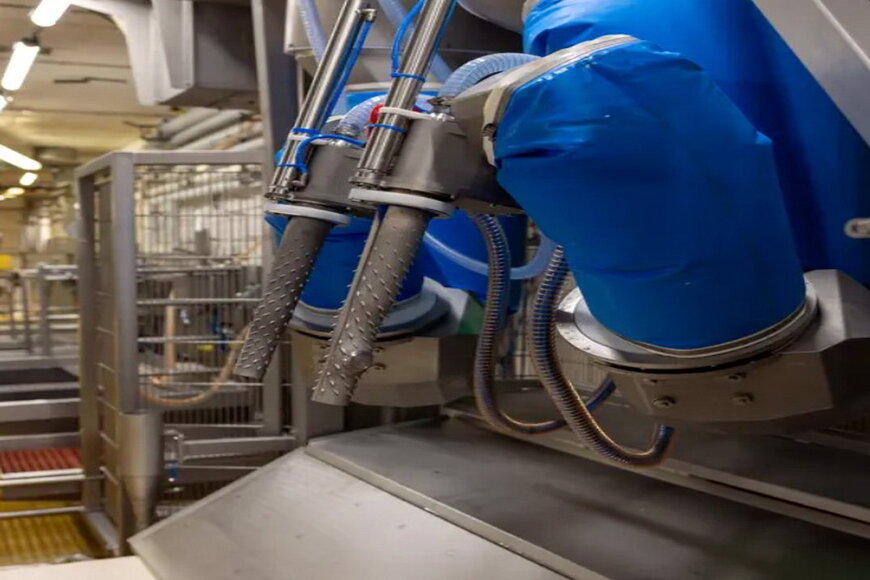
Meat processing facilities face stringent regulatory requirements regarding food safety, hygiene protocols, and end-to-end traceability. In manual primary processing environments, maintaining consistent cutting tolerances and continuous sanitation poses operational challenges, compounded by regional shortages of specialized labor. To address these production constraints, Scan Sverige collaborated with JBT Marel to integrate automated robotic systems into its primary pork processing operations in Kristianstad.
Technical Architecture and Integration
The implementation incorporates four robotic units from the M-Line series directly into the slaughter line. The architecture relies on integrated scanning sensors that profile each carcass dynamically to guide cutting trajectories. The mechanical setup utilizes specialized end-effectors, including an automated bung removal tool and the TwinTool mechanism.
The TwinTool system alternates tools between consecutive cycles to allow continuous intermediate thermal sterilization, preventing cross-contamination between carcasses without slowing line speeds. JBT Marel conducted line bottleneck analysis and engineering design to interface the robotic cells with existing material handling systems, minimizing line stoppage during commissioning.
Operational Results and Process Yield
The deployment shifted manual dressing tasks to automated execution. Automated vision scanning and precision articulation reduced carcass damage and improved cut yields, specifically preserving neck meat on the carcass rather than the head and increasing recovery rates for leaf lard.
In addition to standardized hygiene compliance, the installation reduced staffing requirements on the primary processing line by seven full-time equivalents. The integration demonstrates how industrial automation stabilizes yields and secures hygiene continuity in high-throughput food manufacturing environments.
Edited by Evgeny Churilov, Induportals Media - Adapted by AI.
www.jbtmarel.com
