
www.foodpackautomation.com
28
'26
Written on Modified on
JBT Marel Advances Spiral Freezing Technology for Industrial Processing
Engineering modifications to self-stacking conveyors reduce utility consumption and maintenance frequency in high-capacity food processing plants.
marel.com
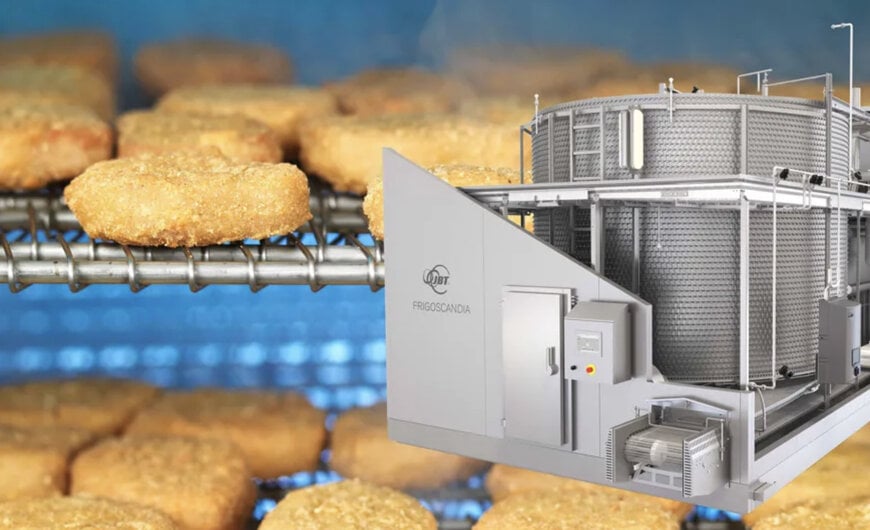
JBT Marel has introduced mechanical design enhancements across its Frigoscandia spiral freezing portfolio, deploying the reinforced FRIGoBELT NOVA+ conveyor for GYRoCOMPACT spiral freezers. The engineering updates target commercial meat, poultry, seafood, bakery, and prepared food facilities seeking extended mechanical service intervals and lower utility demands in existing plant footprints.
Hygienic Design and Plant Utility Management
Sanitation and resource efficiency increasingly dictate freezing equipment design, with water consumption joining electrical load as a primary engineering metric. Conventional industrial freezers often require extensive water volume during washdown cycles due to complex internal support superstructures.
The self-stacking architecture of the GYRoCOMPACT system addresses this operational challenge by forming a self-contained freezing zone that eliminates stationary structural components within the tier stack. Torbjörn Persson, Freezer Global Product Line Senior Manager at JBT Marel, noted that operating time between defrost cycles remains an essential performance benchmark, while reducing utility consumption and water volume during clean-in-place cycles has emerged as a priority for industrial processors. Eliminating internal cage structures provides direct physical access to critical mechanical assemblies, reducing the surface area requiring automated chemical foaming, rinsing, and thermal sanitizing.
Spatial Optimization in High-Density Processing Facilities
Expanding civil infrastructure to accommodate higher throughput presents steep capital costs, prompting food manufacturers to prioritize volumetric efficiency inside established processing floors. Spiral freezer geometry addresses this by routing product along a continuous vertical helix rather than occupying long horizontal floor space.
The self-stacking design stacks each tier directly onto the side links of the tier below. This mechanical configuration eliminates the need for an external support cage or intermediate stationary carrier rails, reducing the overall vertical height profile required for a given belt area. As a result, processing lines can increase volumetric throughput without demanding modifications to existing building envelopes or ceiling clearances.
Mechanical Reinforcement for Extended Service Life
Operational evaluation of freezing equipment focuses heavily on total cost of ownership, where conveyor belt fatigue and link failure represent primary sources of unplanned downtime. The FRIGoBELT NOVA+ conveyor incorporates reinforced side links designed to withstand sustained tension under continuous heavy product loading.
Persson noted that the redesigned conveyor addresses operating longevity and lifetime cost by focusing engineering modifications on mechanical wear reduction and load-bearing endurance. Strengthening the structural integrity of the moving chain links extends operating hours between maintenance intervals, minimizing belt replacement cycles and stabilizing line uptime during continuous processing shifts.
System Integration Across Industrial Food Lines
Following the corporate combination of JBT and Marel, the company supports spiral, impingement, and individual quick freezing (IQF) systems as discrete equipment or as integrated elements within automated processing lines. Conveyor and refrigeration controls are configured to synchronize with upstream thermal processing, portioning, and downstream packaging machinery, supported by predictive maintenance software and planned component retrofit programs.
Additional Context:
This section details technical specifications and competitive benchmarking not included in the original product announcement
Industrial spiral freezers fall into two predominant architectural categories: self-stacking systems and drum-driven (cage) systems. Standard drum-driven freezers, such as the GEA S-Tec series or FPS Food Process Solutions low-tension and direct-drive configurations, utilize a central rotating drum surrounded by a fixed stainless steel cage and support rails to guide the belt. These drum systems offer broad flexibility in belt widths (ranging up to 1.8 meters) but incorporate substantial stationary framework inside the refrigerated cabin.
In contrast, the self-stacking design pioneered by JBT Frigoscandia uses interlocking vertical side links that form an enclosed, self-supporting cylindrical product zone. According to hygiene engineering assessments benchmarked under European Hygienic Engineering and Design Group (EHEDG) and USDA-3A principles, removing stationary support rails, stationary carry-way wear strips, and internal cage drums eliminates critical friction points and microbial harborage areas.
From a utility perspective, drum-driven systems require extensive internal clean-in-place spray manifolds to cover both the conveyor and the static framework, commonly demanding 15 to 30 percent higher water volumes per cleaning cycle than self-stacking designs of equivalent throughput. Conversely, drum-driven systems avoid the structural tier-weight limitations inherent in stacking belts, permitting higher overall product loading per drive motor when properly tensioned. The FRIGoBELT NOVA+ design narrows this structural divide by elevating tensile limits and fatigue resistance, providing higher product load ratings per tier while retaining the reduced water and spatial profile of a cageless spiral.
Edited by Natania Lyngdoh, Induportals editor, assisted by AI.
www.jbtmarel.com
