
www.foodpackautomation.com
30
'26
Written on Modified on
Copeland at Chillventa 2026
From Oct. 13-15 in Nuremberg, Germany, Copeland presents low-GWP compression, thermal management, and process heating systems engineered to solve industrial decarbonization and critical cooling challenges.
www.copeland.com
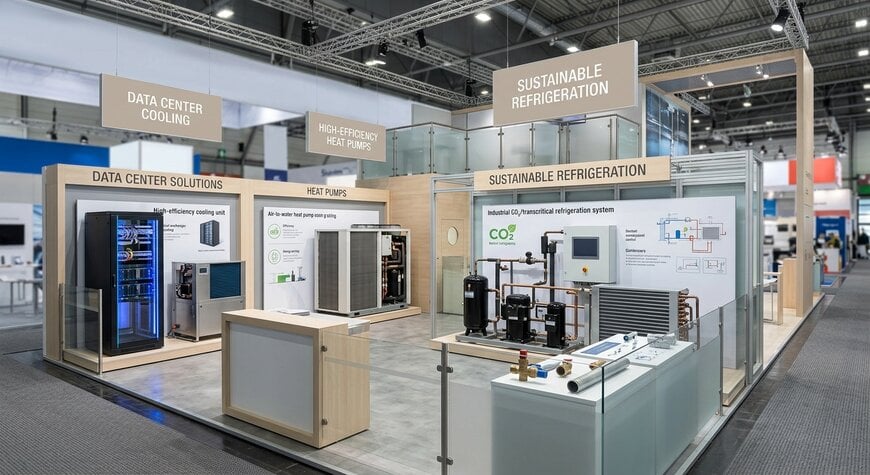
At the Chillventa trade exhibition Copeland exhibits specialized compression architectures, industrial heat pumps, and monitoring software designed for low-emission thermal infrastructure across European residential, commercial, and manufacturing sectors.
Core Technology and System Architecture
The presented portfolio centers on high-lift thermodynamic systems, variable-capacity displacement, and digital infrastructure integration. For industrial thermal management, the platform includes the Vilter VQ95 single-screw heat pump architecture alongside high-temperature systems engineered to deliver process hot water up to 180°C and process steam up to 175°C. These high-temperature units replace fossil-fueled boilers by extracting low-grade waste heat and elevating it through multi-stage mechanical vapor compression.
For mission-critical compute infrastructure, oil-free centrifugal compressors incorporate Aero-lift bearing technology. This hydrodynamic bearing design eliminates lubricating oil management loops, reducing heat transfer degradation in evaporators and condensers while operating with low global warming potential refrigerants, including R-513A, R-515B, and R-1234ze. For residential and commercial space conditioning, variable-speed scroll platforms and inverter swing rotary compressors developed with Daikin provide modulated mass flow, maintaining seasonal coefficient of performance levels under fluctuating ambient conditions. Cold chain architectures utilize transcritical carbon dioxide, or R-744, scroll units for decentralized retail, high-pressure booster systems for centralized food distribution, and hermetic propane, or R-290, compressors for self-contained refrigeration circuits.
Deployment or Implementation
System deployment relies on regional manufacturing facilities, including expanded production lines in Cookstown, Northern Ireland, coupled with dedicated Factory Acceptance Testing protocols for high-capacity industrial heat pump packages. Integration with existing industrial facilities utilizes standardized thermal interfacing to align with current hydronic and steam distribution networks. Software integration incorporates Bueno Analytics platforms, which interface with supervisory control and data acquisition architectures to ingest field telemetry, enabling continuous performance tracking and automated fault detection across distributed refrigeration networks.
Industry Applications
The technical solutions address high-density data centers, chemical and food processing plants, commercial food retail, and district or residential heating networks. In computational facilities, oil-free centrifugal architectures manage variable heat flux loads from high-density server racks. In commercial retail environments, transcritical carbon dioxide booster systems resolve regulatory compliance constraints under the European F-Gas Regulation while maintaining product safety through precise thermodynamic control.
Operational Impact and Performance Metrics
Eliminating lubrication circuits in centrifugal chillers prevents oil film accumulation on internal heat exchanger surfaces, preserving thermal conductivity over extended runtime cycles. High-temperature process heat generation up to 180°C enables direct electrification of industrial drying, washing, and pasteurization processes without structural boiler modifications. At the distribution level, automated cloud-based fault diagnostics reduce refrigerant leakage rates and detect heat exchanger fouling early, mitigating system degradation and lowering overall lifecycle power consumption across critical infrastructure networks.
Edited by Evgeny Churilov, Induportals Media - Adapted by AI.
www.copeland.com
