
www.foodpackautomation.com
02
'26
Written on Modified on
Industrial Air Frying Line for Low-Fat Snack Food Processing
JBT Marel launched an industrial air frying solution to eliminate continuous immersion pre-frying and decrease oil uptake by over 50%.
marel.com
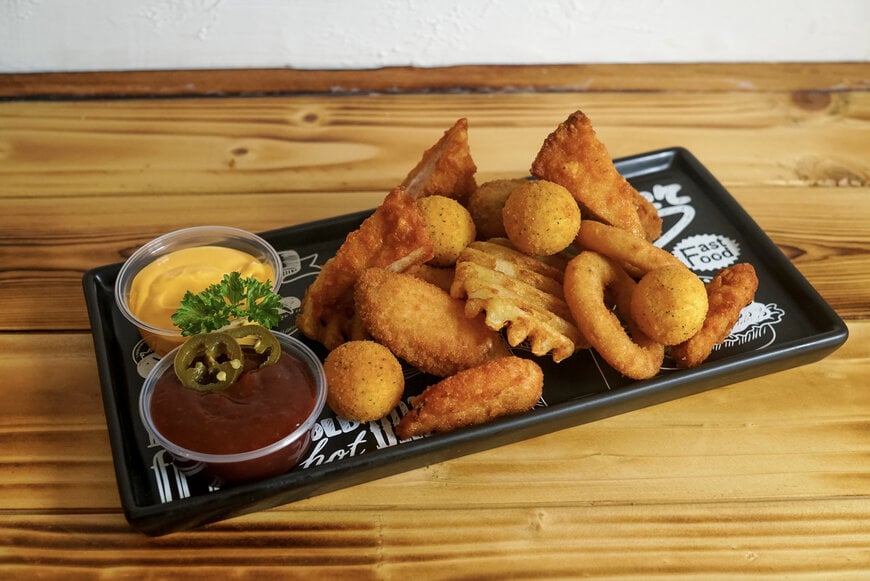
Growing consumer demand for lower-fat prepared foods has created an engineering bottleneck for industrial snack and protein processors, who must replicate the crisp bite and color of immersion-fried goods without sacrificing continuous production yields. JBT Marel addresses this processing limitation by deploying a continuous industrial air frying solution that replaces traditional thermal oil baths with sequential coating, automated oil dosing, impingement convection, cryogenic freezing, and inline packaging.
Operating Mechanism of the Continuous Processing Line
Conventional continuous snack processing relies on thermal oil fryers where products submerge in circulating vegetable oil to rapidly set batter and crust structures. This immersion mechanism inherently yields significant fat pickup, increases degradation compounds through thermal breakdown of large oil volumes, and imposes high operational overhead.
The JBT Marel line resolves this operational hurdle by dividing the surface-setting and core-heating phases into discrete mechanical stages. The process begins with automated coating equipment engineered for precise distribution of flour, batter, dry breading, and functional seasoning matrices. Process formulations utilizing expanded breadcrumbs with elevated protein levels provide structural stabilization, maintaining crust rigidity without relying on thermal crust flash-frying.
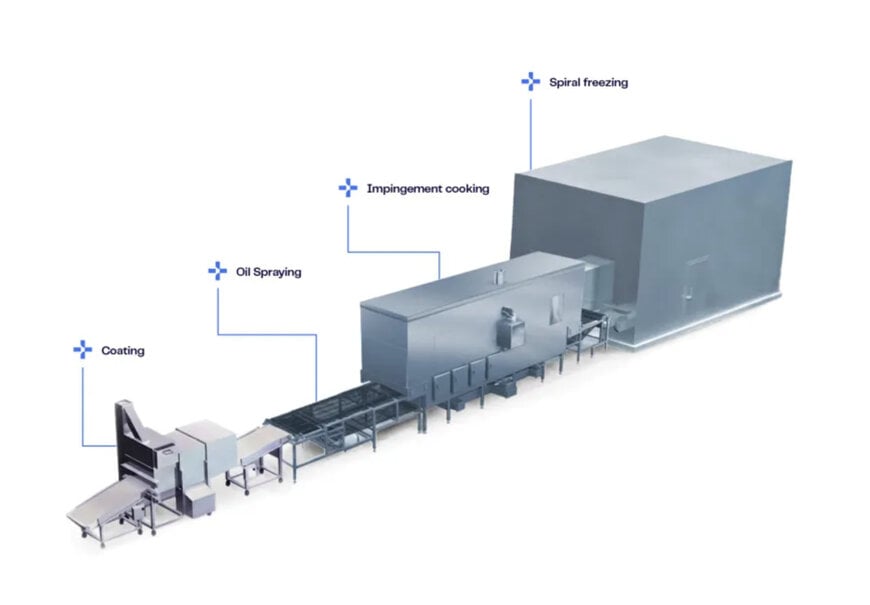
Following coating deposition, the product passes through a targeted recirculating oil spray system. Rather than submerging the core substrate into an open fryer, this module atomizes and sprays a metered volume of oil directly across the product boundary layer, targeting an application volume between 4% and 6%. This targeted dosing regime achieves a reduction in total oil pickup exceeding 50% compared to traditional submersion baselines, while simultaneously reducing bulk oil replenishment volumes and thermal degradation waste.
Impingement Convection and Coating Fixation
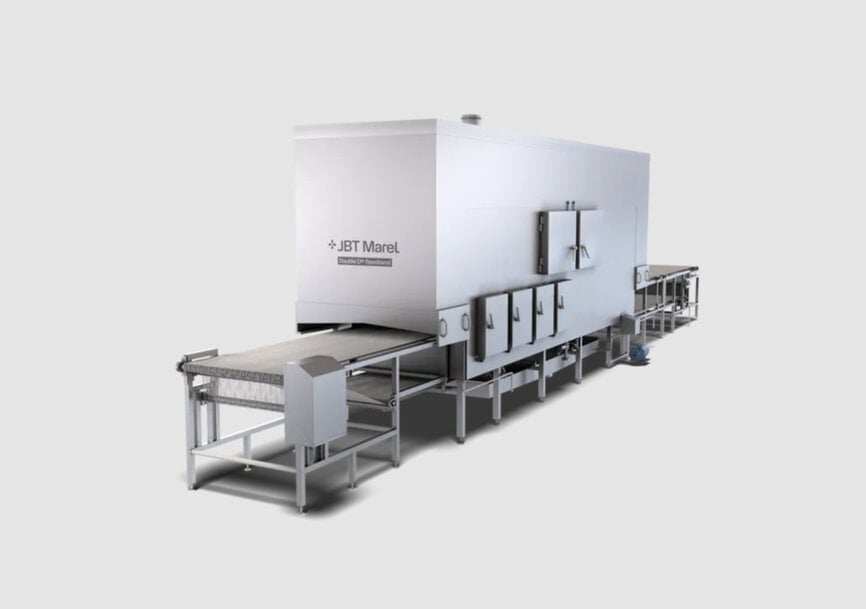
Thermal cooking and surface crystallization occur within the Double D Revoband continuous impingement oven. The unit directs high-velocity heated airflow through specialized jet nozzles positioned above and below the processing belt.
By operating at air temperatures reaching 280°C, the boundary layer of cooler air surrounding the wet product is stripped away, accelerating convective heat transfer. This high-intensity airflow rapidly gelatinizes starches, denatures surface proteins, and drives moisture vaporization, establishing a rigid, golden outer crust without an upstream immersion pre-fryer. The machine control architecture provides independent adjustment over air velocity, internal humidity, temperature setpoints, and differential top-to-bottom thermal distribution to accommodate variable substrate geometries.
Downstream Freezing, Inspection, and Packaging Integration
Immediately following thermal treatment, the conveyor directs items into a GYRoCOMPACT spiral freezer from Frigoscandia. The mechanical freezing circuit uses a closed belt structure that prevents structural product deformation while driving rapid core heat extraction to stabilize food cellular structures at high production volumes.
Downstream product integrity is maintained via an in-line M-Weigher Process Check system that monitors unbagged product mass, delivering real-time feedback loops to upstream portioning and coating units to minimize mass giveaway.
Finished portions feed directly into continuous Proseal tray sealing systems with automated container indexers. Downstream high-speed weigh-price labeling hardware processes variable pack formats at rates reaching 160 packs per minute, assisted by durable thermal print arrays. Final secondary packaging is handled by a Proseal Case Packer utilizing two-dimensional delta pick-and-place robotics with quick-release mechanical tooling, sustaining high-volume line speeds across multiple corrugated case footprints.
Additional Context:
This section details technical specifications and competitive benchmarking not included in the original product announcement.
Industrial continuous impingement systems across the food machinery sector operate under thermodynamic principles regulated by heat-transfer coefficient optimization, typically achieving thermal convective transfer rates of 150 to 250 W/(m²·K). Traditional industrial deep-fat fryers operate at thermal transfer rates of 300 to 1,000 W/(m²·K) via direct liquid conduction. By running impingement air velocities up to 30 to 40 meters per second at temperatures reaching 280°C, forced-convection continuous ovens generate sufficient heat-flux rates to approach liquid immersion evaporation kinetics, allowing starch dextrinization and crust setting without bulk oil saturation.
Benchmark industrial processing lines from manufacturers such as GEA (CookStar series) and Heat and Control (AirForce impingement ovens) similarly utilize continuous convective impingement to replace batch or immersion frying. Standard impingement lines typically operate between 180°C and 260°C, making the 280°C upper threshold of high-velocity impingement configurations an operational advantage for rapid surface dehydration and Maillard reaction development on high-moisture proteins. Processors operating continuous impingement configurations also eliminate the fire suppression liabilities, oil filtration infrastructures, and volatile organic compound extraction equipment required by traditional continuous fryers meeting NFPA 86 and CE mechanical safety directives.
Edited by Natania Lyngdoh, Induportals editor, with AI assistance.
www.jbtmarel.com
