
www.foodpackautomation.com
02
'26
Written on Modified on
Automated Livestock Identification Using Vision Systems
GEA introduces DairyNet Cow Verification to eliminate rotary milking parlor RFID read errors through real-time machine learning and biometric vision tracking.
www.gea.com
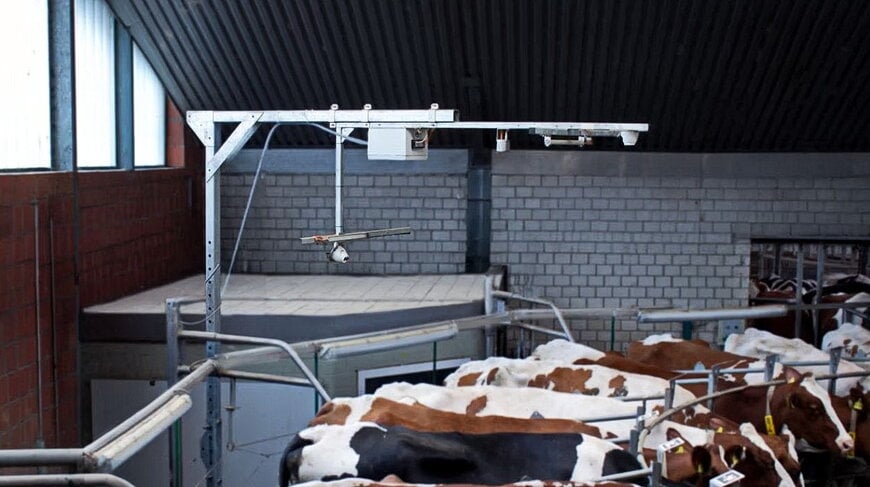
In automated dairy production environments, maintaining consistent individual animal data integrity remains a fundamental operational prerequisite for precise yield tracking, animal health monitoring, and automated nutritional allocation. DairyNet Cow Verification, an automated livestock identification module developed by GEA, combines multi-angle computer vision with machine learning to verify animal identities on rotary milking platforms and eliminate data corruption caused by high-throughput radio frequency identification read failures.
Radio frequency identification systems deployed across dairy operations face persistent physical constraints, including transponder shielding by animal bodies, signal reflection from metallic parlor structures, and cross-reads generated when multiple animals enter detection zones simultaneously. DairyNet Cow Verification resolves these vulnerabilities by layering an optical identification layer directly over established transponder infrastructures.
Operational Architecture and Biometric Sensing
The technology functions directly on rotary milking platforms. As an animal steps into a stall, multiple synchronized industrial cameras capture high-resolution imagery from calibrated optical perspectives. The processing system evaluates individual physical signatures by extracting unique biometric parameters, including structural body proportions, skeletal contours, and coat pigmentation patterns.
These visual parameters are cross-referenced in real time against historical image datasets logged in the local farm architecture. Operating continuously in the background, the machine learning algorithms assess whether the detected visual signature matches the transponder number supplied by the stall antenna. When transponder data is missing, misaligned, or corrupted, the system updates and corrects the identity tag in real time before milking data acquisition begins. The vision engine relies on self-learning mechanisms, progressively updating baseline pattern libraries to adapt to physiological variations over time.
Eliminating Milking Workflow Bottlenecks
Hardware requirements mandate an operational GEA DairyNet herd management infrastructure alongside an existing RFID detection assembly equipped with a walk-through antenna for initial animal registration and model training. The system is engineered to integrate across all DairyNet-compatible GEA rotary parlors as a retrofit installation.
By removing single-point dependence on radio frequency detection, the optical verification platform prevents critical downstream process errors. In high-speed rotary operations, misidentifications lead directly to incorrect automated concentrate feeding, invalid mastitis or somatic cell count attribution, and distorted historical yield records.
Furthermore, the dual-method architecture addresses tag loss. When physical ear-tags or neck transponders are torn off or fail electronically, the trained vision system continues to identify the animal through its optical signature. This temporary bridge prevents operational downtime and maintains uninterrupted lactation and yield records while herd managers schedule physical tag replacements. Consistent identification validation provides verifiable data pipelines necessary to comply with legal animal traceability mandates and operational auditing protocols.
Additional Context
This section details technical specifications and competitive benchmarking not included in the original product announcement.
Traditional automated livestock identification in milking parlors relies primarily on low-frequency (LF, typically 134.2 kHz) transponders complying with ISO standards 11784 and 11785, which define structure and transmission protocols for electronic animal tracking. While LF systems provide effective read penetration through organic tissue, their operational interrogation zone is narrow, demanding close proximity and favorable antenna orientation. High-frequency (HF) and ultra-high-frequency (UHF) alternatives offer extended read ranges but exhibit severe susceptibility to signal attenuation caused by moisture, water washdowns, and structural steel found in rotary parlors.
Optical livestock recognition has gained technical momentum as convolutional neural networks (CNNs) have matured for non-invasive animal biometric classification. While passive RFID tags remain the baseline standard due to low per-unit cost and regulatory adoption for lifetime tracking, dual-modal systems pairing optical recognition with ISO-compliant RFID are emerging as the industrial benchmark for intensive milking parlors. Benchmarking studies in high-throughput livestock sorting indicate that combining independent optical biometric validation with RF transponder capture brings overall identification accuracy closer to zero-defect targets compared to standalone RFID setups operating near metal-dense, wash-down rotary infrastructure.
Edited by Evgeny Churilov, Induportals Media - Adapted by AI.
www.gea.com
