
www.foodpackautomation.com
19
'26
Written on Modified on
Roland DGA Highlights UV Printing Impact on Flexible Manufacturing
Technology eliminates the need for large standardized production runs, enabling short batches and consumer-adaptable designs.
www.rolanddg.eu
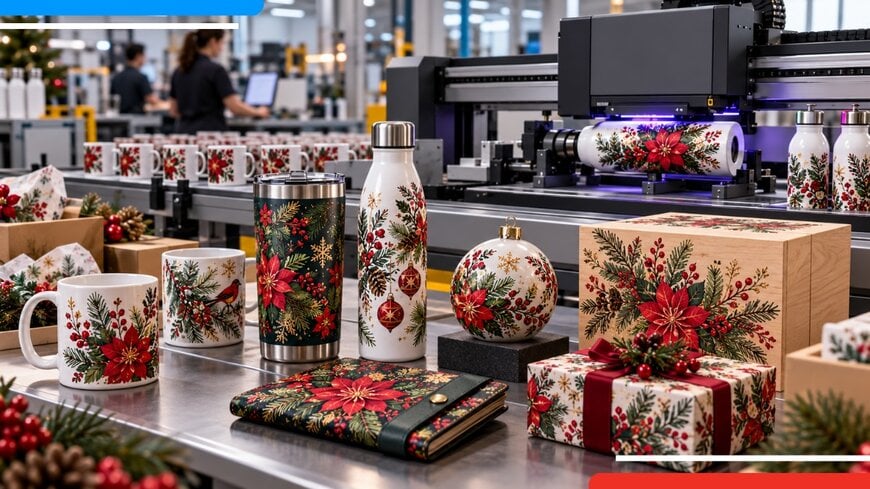
Manufacturing production is moving away from the traditional model of large, standardized production runs to adopt more flexible schemes based on UV printing. In a market where, according to McKinsey & Company, 71 percent of consumers demand personalized interactions, brands are increasingly turning to hyper-personalized products. According to Reports Insights, this trend is projected to grow at a rate of 10.8 percent annually through 2033. Francisco Calleja, digital printing solutions specialist at Roland DGA, points out that UV digital printing makes it possible to print full-color graphics on irregular surfaces and in minimal batch sizes, responding to the demand for unique or seasonal items without generating excess inventory.
Benefits of Direct Printing in Limited Runs
The ability of UV printing to work directly on substrates such as plastic, glass, metal, leather, and wood provides critical operational advantages over traditional analog decoration methods:
- On-Demand Responsiveness: Enables the production of short runs on demand for holidays or local campaigns, preventing the accumulation of obsolete inventories at the end of a season.
- Rapid Prototyping: Eliminates the preparation of plates and matrices, facilitating the creation of functional physical samples to validate color, texture, and legibility before scaling production.
- Visual Differentiation: Integrates design directly into the product or packaging, creating recognizable limited editions without requiring additional labeling processes.
- Tactile Effects: The selective application of clear varnish generates textures, reliefs, and contrasts that add sensory value to the item.
- Geometric Adaptability: The use of rotary axes and specialized fixtures allows ink to be deposited on cylindrical, conical, curved, or irregular parts, such as bottles and rigid cases.
Artificial Intelligence and Plant-Level Monitoring
To scale customization profitably, the industry is integrating artificial intelligence tools that accelerate the creation of graphic variants and pre-press software to organize multiple designs within the workspace. At the operational level, remote monitoring platforms allow manufacturers to check equipment status, ink levels, and maintenance requirements in real time. This minimizes machine downtime during extremely narrow commercial windows. According to the consulting firm Smithers, the convergence of higher-productivity equipment and these automation tools will drive the global value of digital printing to $251.1 billion by 2035, with a 54.3 percent volume increase compared to 2025.
Additional Context: UV-LED Curing on Non-Porous Substrates
This section details technical specifications and competitive benchmarking not included in the original report.
Unlike water-based or solvent-based inks, which rely on evaporation and require receptive substrates or prolonged thermal drying processes, UV printing uses a photochemical process. The inks contain photoinitiators that react instantly when exposed to ultraviolet light emitted by LED lamps positioned next to the printhead. This exposure causes immediate cross-linking (polymerization) of the monomers, transforming the liquid ink into a solid polymer film adhered to the surface. This "cold" and ultra-fast curing allows the ink to set without thermally deforming heat-sensitive materials (such as thin plastics or shrink films) and eliminates the release of volatile organic compounds (VOCs), which streamlines immediate post-print handling in packaging and logistics lines.
Edited by industrial journalist Lekshman Ramdas, with AI assistance.
www.rolanddg.com
