
www.foodpackautomation.com
27
'26
Written on Modified on
Hygienic Linear Guide For The Food Processing Industry
igus introduces the drylin W linear guide to simplify disassembly without tools and optimize sanitation procedures inside automated food packaging and processing plants.
www.igus.eu
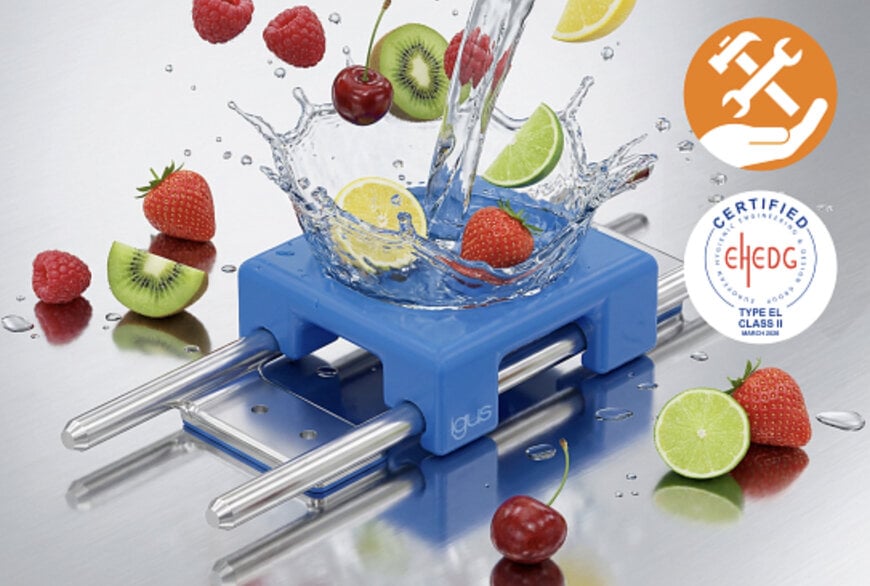
The rigorous hygiene requirements in the food industry mandate frequent and intensive system washdown cycles, making the disassembly of traditional mechanical guides a slow and wear-prone process. To drastically reduce machine downtime during sanitation procedures, igus has developed the new drylin W linear guide, a lubrication-free system equipped with a polymer carriage that can be removed without the use of tools.
Applications And Hygienic Challenges In Linear Systems
Linear guides represent a fundamental engineering component in automation systems for the food sector, finding widespread use in moving sealing stations within thermoforming machines, positioning dosing heads, and guiding cutting units. However, conventional recirculating ball carriages require continuous lubrication, creating an abrasive mixture of grease and particulates that hinders movement and poses a severe contamination risk. Traditional systems also require special tools for disassembly and must be extracted from the end of the guide profile, a structural constraint that significantly complicates maintenance interventions and prolongs the production downtime of automated lines.
Mechanical Architecture And Rapid Disassembly
To overcome these operational limitations, the drylin W system adopts an architecture consisting of a guide profile with two stainless steel shafts and a sliding polymer carriage, onto which manufacturers can mount their own structures. In the event of a complete system cleaning, the geometry of the system allows the operator to extract the carriage directly from the rail with a simple manual maneuver, permitting it to be washed separately. The steel rail, on the other hand, remains anchored and can be sanitized directly in place. This mechanical design eliminates the need for complex post-maintenance realignments, rapidly restoring machine operability.
Material Specifications And EHEDG Certification
The prevention of cross-contamination requires a design free of crevices and dead spaces (Hygienic Design). The igus solution is the first linear system in the world to have obtained certification from the European Hygienic Engineering and Design Group (EHEDG). The round steel shafts have a surface roughness of less than 0.8 micrometers, discouraging the adhesion of germs and organic residues. The shaft supports are milled to guarantee a minimum curvature radius of three millimeters at every point, while an FDA-certified silicone seal waterproofs the space between the rail and the mounting surface to prevent microbial proliferation. The sliding carriage is made of iglidur A160, a high-performance blue technopolymer that is PTFE-free, PFAS-tested, and equipped with integrated solid lubricants. The material stands out for its very low moisture absorption, ensuring that the component maintains its shape, dimensional tolerances, and mechanical functionality even after prolonged chemical and thermal cleaning cycles.
Additional Context
This section contains technical specifications and competitive benchmarking that were not included in the original product announcement.
Automation in food processing operations is heavily influenced by European machine safety directives and FDA regulations, which mandate the use of washable and corrosion-resistant materials in areas in direct contact with food or subject to splashing (splash zones). In the hygienic mechanical components market, the transition from metal recirculating ball systems to technopolymer plain bearings has established itself as an essential technical benchmark for eliminating centralized lubrication systems. Manufacturers of advanced linear solutions similarly focus on eliminating horizontal flat surfaces and crevices, where washdown water tends to stagnate. However, the absence of rapid disassembly mechanisms often forces the industry to rely on prolonged Cleaning-in-Place (CIP) procedures. The ability to physically remove the carriage without tools sets a new operational standard for preventive maintenance, reducing the reliance on aggressive chemical agents and minimizing the risk of long-term bacterial contamination in high-speed packaging machinery.
Edited by Maria Brueva, Induportals editor - adapted by AI.
www.igus.com
