
www.foodpackautomation.com
04
'26
Written on Modified on
Linx introduces IJ470 large character inkjet for case coding
The direct-to-box printer features automated ink recycling and eliminates the need for labels on secondary packaging.
www.linxglobal.com
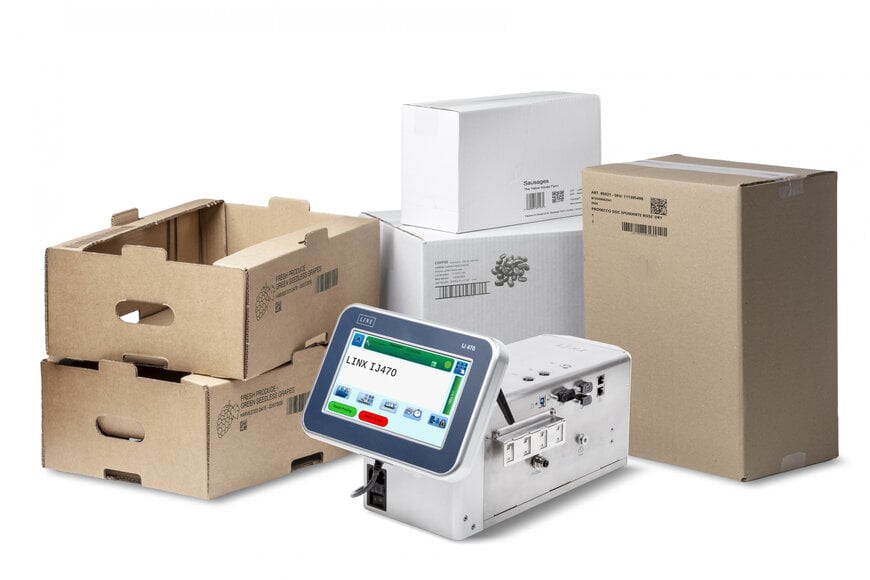
Linx Printing Technologies has launched the Linx IJ470, a new large character inkjet printer engineered to optimize secondary packaging operations. Designed to print high-quality codes directly onto porous and semi-porous materials such as corrugated cardboard, the system allows manufacturers to eliminate expensive adhesive labels and the reliance on pre-printed boxes. Previewed earlier at interpack 2026, the IJ470 reduces material costs, minimizes packaging waste, and provides production managers with the flexibility to execute instant messaging changes directly on the manufacturing line.
Automated ink recycling and instant-start operation
At the core of the printer's cost-efficiency is the patented Linx ReFRESH® system. This automated mechanism actively cleans the printhead nozzles during operation, passing purged ink and debris through a high-performance filtration system before returning the purified ink to the fluid circuit for reuse. By recovering ink that is traditionally lost during standard purge cycles, the system significantly lowers consumable consumption. Furthermore, unlike legacy wax-based printers that require thermal warm-up periods, the IJ470 utilizes liquid oil-based and mineral oil-free inks (available in black and red), enabling immediate printing at the start of a shift to maximize uptime. The unit is protected by a rugged stainless steel and anodized aluminum enclosure to withstand harsh factory environments.
Scalable configurations and GS1 traceability
To accommodate complex production lines, the IJ470 supports leader and follower configurations, allowing up to four printers to be networked and controlled from a single 8-inch touchscreen interface. This setup facilitates simultaneous printing on multiple sides of a carton or expands the overall vertical print area. To mitigate coding errors, the system integrates seamlessly with external databases and line control software. As a GS1 UK-approved product, it features a built-in generation tool that enables operators to easily create and print GS1-compliant 2D codes directly from the user interface, ensuring full supply chain traceability.
Additional Context: Piezoelectric Drop-on-Demand (DoD) and capillary absorption
This section details printhead architectures and ink rheology principles not included in the original press release.
In secondary packaging coding, printing high-resolution 2D barcodes directly onto corrugated cardboard requires highly controlled fluid dynamics. Advanced large character printers utilize Piezoelectric Drop-on-Demand (DoD) technology. Inside the printhead chamber, a piezoelectric crystal deforms when subjected to a specific electrical voltage, creating an acoustic pressure wave that ejects a precisely metered ink droplet from the nozzle. When this droplet strikes a highly porous substrate like corrugated kraft paper, it relies entirely on capillary action to rapidly absorb into the cellulose fibers. If the ink's rheology (specifically its surface tension and viscosity) is not perfectly calibrated, the ink will wick laterally across the fibers—a phenomenon known as "dot gain"—which blurs the sharp edges of 2D barcodes and causes them to fail optical scanner verification. Oil-based inks are optimal for this application because they do not evaporate and dry out inside the printhead nozzles during idle periods, yet they rapidly penetrate porous cardboard to deliver high-contrast, scannable edge definition.
Edited by an industrial journalist, Lekshman Ramdas, with AI assistance.
www.linxglobal.com
