
www.foodpackautomation.com
06
'26
Written on Modified on
Continuous Motion Crate Flow Reversal for Beverage Packaging Lines
Krones introduces the Varioline 1M single-end packer to eliminate dry-end footprint constraints via 180-degree crate handling.
www.krones.com
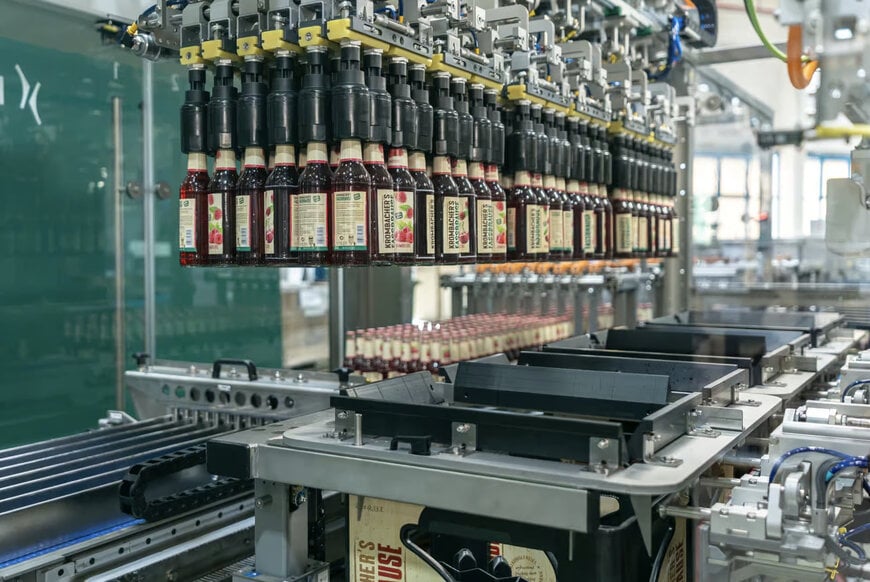
High-speed beverage bottling operations face layout bottlenecks and operator access restrictions when integrating conventional linear packaging machinery into existing factory floors. Krones AG addresses these floor space limitations by launching a single-end configuration of its Varioline 1M pick-and-place packer, engineered to reverse crate transit direction by 180 degrees internally without reducing packaging line velocity.
Kinematic Synchronization and Continuous Crate Direction Inversion
Conventional secondary packaging lines generally rely on straight-through flow paths where empty crates enter on one end and packed crates exit on the opposite side. When facilities attempt to reverse product direction using external curve conveyors or stop-and-turn transfer tables, the mechanical stops introduce line pressure, container scuffing, acoustic spikes, and throughput deceleration.
The Varioline 1M resolves these physical limitations through continuous handling dynamics. Rather than halting incoming containers against a fixed mechanical stop rail, the system synchronizes a pick-and-place robot directly with the continuous inflow of beverage bottles. In parallel, multi-axis drive technology positions crates during motion, executing the complete 180-degree turn inside the machine housing. This dynamic synchronization allows container infeed and crate discharge to run parallel on the same side of the machine, matching the full operating speed of conventional straight-through packers.
Single-End Line Architecture and Operational Ergonomics
Arranging both container infeed and discharge conveyors on a single side reconfigures dry-end factory logistics. Because utility, material, and electrical connections concentrate along one side of the single-end machine, the remaining three sides remain unobstructed for maintenance technicians and machine operators.
This physical footprint reduction minimizes walking distances during operational shifts, accelerating changeover procedures when loading format-specific handling parts. Rapid perimeter access also reduces mean time to recovery during line disruptions. The single-lane platform delivers processing rates up to 103,000 containers per hour, yielding an output of roughly 4,300 crates or multipacks per hour across returnable glass, non-returnable containers, and prefabricated multi-packs.
Industrial Deployment at Krombacher Brauerei
The single-end Varioline 1M architecture entered commercial production in early 2025, with operational data guiding subsequent mechanical refinements. German beverage producer Krombacher Brauerei placed the first commercial order for two single-end units to modernize its packaging operations.
The installation forms part of a multi-year dry-end overhaul underway since 2024 across four high-speed bottling lines. Krones replaced existing equipment during live operation, integrating new sweep-off depalletizers, selective unpackers from the Varioline 1M family, and automated palletizers. Space limitations across the existing bottling hall made floor footprint and multi-sided machine access critical engineering criteria for the brewery's production team.
Additional Context:
This section details technical specifications and competitive benchmarking not included in the original product announcement.
High-speed dry-end packaging machines traditionally operate across linear footprints requiring 15 to 25 meters of clear line length once external accumulator loops and 180-degree return belt conveyors are incorporated. Benchmark packing machines from manufacturers such as Sidel (Cermex series) or Gebo Ceva typically deploy rotary turret designs or dual-axis gantry overhead packers requiring straight-line conveyor routing or separate external curve stations that operate at sound levels exceeding 78 to 82 dB(A) due to container-to-container impact against fixed indexing gates. By deploying servo-driven pick heads synchronized via decentralized motion controllers (such as B&R ACOPOS architectures with regenerative braking), continuous-motion pick-and-place systems maintain container velocities without mechanical impact, lowering mechanical surface wear and container scuffing on returnable glass bottles while complying with industrial acoustic targets below 75 dB(A).
Edited by Natania Lyngdoh, Induportals editor, with AI assistance.
www.krones.com
