
www.foodpackautomation.com
04
'26
Written on Modified on
Waterjet Portioning for Boneless Poultry Products
Marel has developed a waterjet-based portioning system designed to deliver flexible, high-yield cutting of boneless poultry fillets.
marel.com
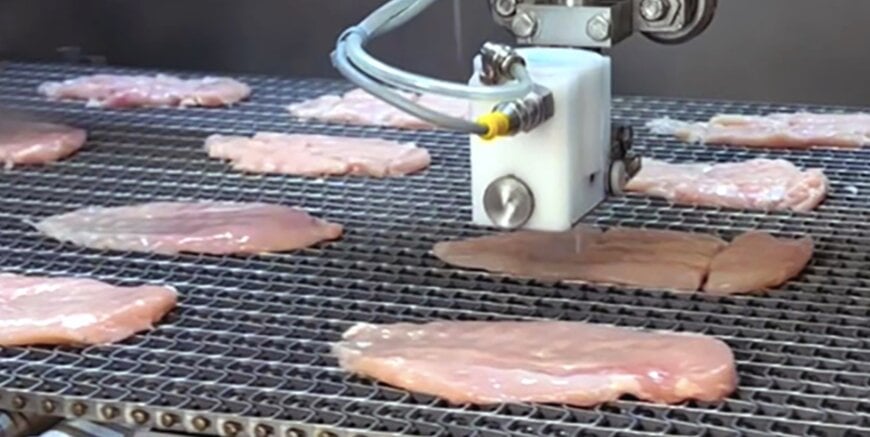
As poultry fillets increase in size and customer specifications become more diverse, waterjet cutting is increasingly used to produce complex, value-optimized portions from boneless meat with high accuracy and minimal yield loss.
Market-driven complexity in poultry portioning
Retail, food service, and quick-service restaurant (QSR) markets place varying and frequently changing demands on poultry processors. Requirements may shift between fat-trimmed and fat-free products, fixed-weight portions, shape-controlled cuts, or dimension-specific pieces. Traditional straight-line cutting methods often lack the flexibility to respond efficiently to these variations, particularly when working with larger fillets and premium raw material.
Complex, curved cutting patterns are increasingly required to maximise value from each fillet while maintaining consistency and meeting local market preferences across regions such as Asia, Europe, and North America.
Waterjet cutting as a flexible processing approach
Waterjet technology enables processors to produce complex shapes that are difficult to achieve with mechanical knives. The DSI Waterjet Cutter applies high-pressure waterjets to cut boneless poultry with precision, allowing fat trimming and portion shaping to be combined within a single automated process.
The system supports rapid changeovers between applications via software selection, enabling processors to adapt quickly to changing customer specifications without mechanical retooling. This flexibility makes the system suitable for mixed-product environments where production requirements vary by customer, product line, or destination market.
System design and operating principle
The DSI Waterjet Cutter is a multi-lane, multi-cell water-based portioning system. Each processing cell is equipped with two independently controlled waterjets. Incoming products are first scanned to identify attributes such as shape, thickness, weight, and fat distribution.
Using this data, DSI Q-Link portioning software calculates an optimized cutting strategy for each individual piece of raw material. Computer-controlled waterjets then execute the cutting pattern, generating complex shapes while maximising yield and minimising giveaway. The system requires no precise positioning of the meat, only that pieces are separated and free of overlap on the infeed belt.
Portion variety and yield optimisation
The system can process a wide range of boneless poultry inputs, including fillets, butterflies, tenderloins, and deboned leg meat. Output formats include steaks, strips, nuggets, cubes, dices, and shaped portions tailored to specific market demands. Because the waterjet stream is extremely narrow, material loss is minimal and offcuts are largely eliminated. Even smaller pieces can be converted into usable products.
Despite common assumptions, water consumption is limited, and the meat itself does not become wet during processing. The thin waterjet cut preserves product integrity while achieving high dimensional and weight accuracy.
Productivity, labour, and food safety considerations
Automated waterjet portioning reduces manual cutting tasks, lowering labour requirements and helping prevent repetitive strain injuries. Consistent, software-driven cutting improves portion uniformity and supports food safety by reducing direct handling of raw product.
In high-volume applications, processors have reported significant productivity gains, moving from manual knife cutting to automated fixed-weight portioning at substantially higher throughputs. Fixed-weight accuracy also supports downstream packaging and customer-specific portion counts, reducing rework and customer complaints.
Application relevance for global poultry processors
By combining scanning, optimisation software, and high-precision cutting, waterjet portioning systems enable processors to respond to increasingly complex market requirements while protecting yield and product value. The approach supports premium applications, fixed-weight contracts, and regional product differentiation, positioning waterjet technology as a key enabler in modern poultry processing operations.
www.marel.com
