
www.foodpackautomation.com
05
'26
Written on Modified on
New Copeland ZF ZFI Scroll Compressors Enhance Cold Chain Efficiency
Available in 10–20 HP models, Copeland scroll compressors operate efficiently from -45°C to 7°C, delivering energy-efficient performance for cold rooms, cold storage, supermarkets, food retail and light industrial applications.
www.copeland.com
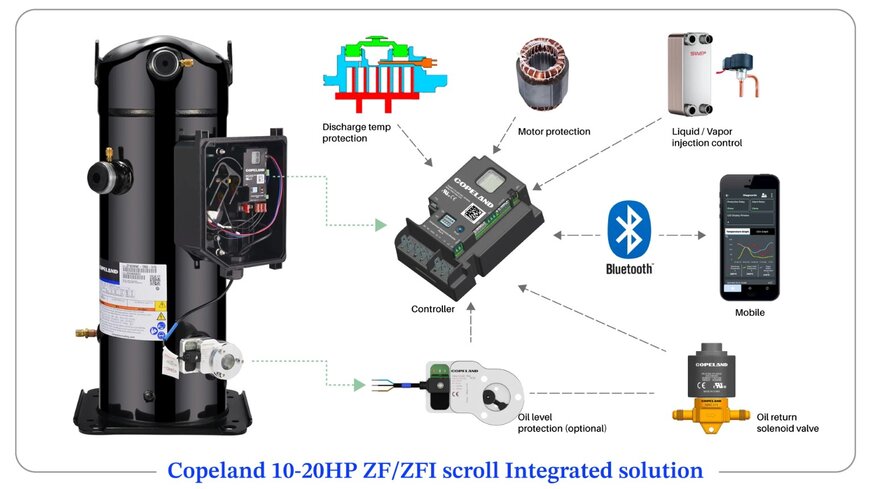
The ZF and ZFI scroll compressors, ranging from 10 to 20 horsepower, address the cooling requirements of walk-in coolers, freezers, and industrial cold storage. These units utilize vapor injection technology to maintain operational efficiency and reliability in environments where high compression ratios are necessary.
Technical Mechanisms for Thermal Management
The ZF and ZFI series are designed to operate across a broad range of evaporating temperatures, specifically from -40°F to +45°F. To manage the heat generated during high-pressure cycles, these compressors utilize liquid or vapor injection. The ZFI models specifically incorporate vapor injection via an economizer cycle, which increases cooling capacity by approximately 20% and improves the Energy Efficiency Ratio (EER) by up to 10% compared to standard single-stage models.
This mechanism works by diverting a portion of the refrigerant, expanding it, and cooling the main flow before it enters the evaporator. The resulting intermediate-pressure vapor is then injected into the scroll set, lowering discharge temperatures and allowing the compressor to operate safely at lower evaporating temperatures without overheating the motor or the lubricant.
Integration in the Digital Supply Chain
Modern refrigeration systems increasingly rely on data integration to ensure food safety and operational uptime. These compressors are compatible with electronic controllers that monitor discharge line temperatures and motor protection. By providing consistent performance metrics, the hardware supports a more transparent digital supply chain, allowing operators to track the energy consumption and thermal stability of perishable goods from processing centers to retail hubs.
Application Areas and Operational Benefits
The primary applications for these 10 to 20 HP units include large-scale supermarkets, refrigerated warehouses, and quick-service restaurants. By utilizing a scroll design rather than a reciprocating mechanism, the units feature 70% fewer moving parts. This reduction in mechanical complexity leads to a decrease in acoustic output and lower vibration levels, which is a critical factor for installations in urban environments or noise-sensitive areas.
According to Grant Morgan, director of product management for commercial refrigeration at Copeland, the expansion of the scroll lineup allows contractors and end-users to apply scroll technology to larger systems that previously required multiple smaller units or semi-hermetic reciprocating compressors. The design intent is to offer a more compact footprint while maintaining the robustness required for heavy-duty commercial cycles.
Efficiency Standards and Compliance
The ZF and ZFI ranges are engineered to be compatible with various R-404A replacements, including lower Global Warming Potential (GWP) A1 refrigerants such as R-448A and R-449A. Compliance with these standards ensures that the hardware remains viable as environmental regulations regarding hydrofluorocarbons (HFCs) become more stringent. The compressors meet the rigorous testing standards established by Underwriters Laboratories (UL) and the Air-Conditioning, Heating, and Refrigeration Institute (AHRI).
www.copeland.com
