
www.foodpackautomation.com
06
'26
Written on Modified on
Modular Tunnel Pasteurisation for Sustainable Beverage Production
Sidel has engineered the SWING Evo tunnel pasteurizer to reduce resource consumption in the automotive-scale beverage industry through a modular counterflow thermal exchange system.
www.sidel.com
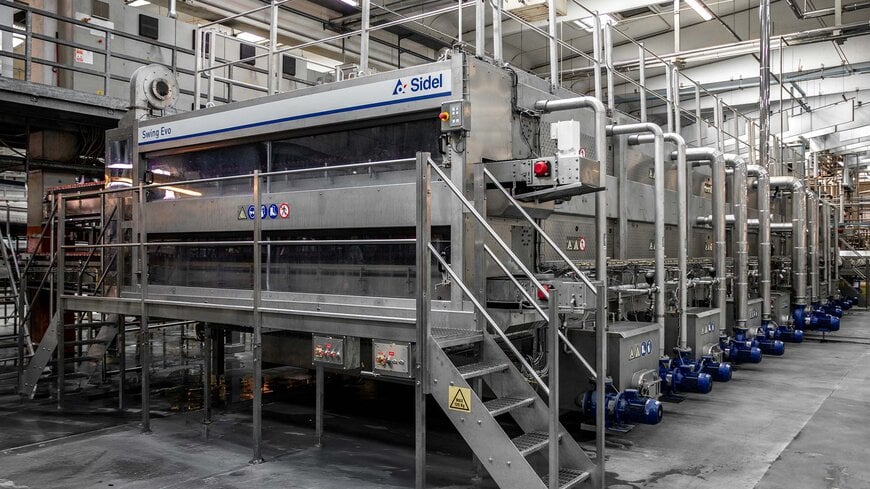
The SWING Evo is a modular tunnel pasteurization system designed to stabilize beverages, such as beer in glass bottles or aluminum cans, by applying precise thermal treatment. This technology integrates autonomous control modules and a predictive thermal regulation engine to optimize utility usage within a high-volume digital supply chain.
Thermal Efficiency via Counterflow Configuration
The primary technical advancement of the SWING Evo is its counterflow thermal exchange architecture. By directing the top and bottom decks in opposite directions, the system creates a closed-loop thermal gradient that minimizes heat dispersion. Unlike traditional serial pasteurizers, this unit utilizes dedicated heat and water circuits for each independent module.
This decentralized fluid management reduces the length of internal piping, which minimizes pressurized friction and thermal loss. Data indicates that this configuration achieves a 35% reduction in electricity usage, a 10% reduction in water consumption, and a 10% decrease in steam utilization compared to previous generation tunnel pasteurizers.
Predictive Process Control and Quality Assurance
To maintain microbiological stability across various Stock Keeping Units (SKUs), the system utilizes the PRINCE X predictive control algorithm. This software monitors the temperature evolution of the product in real-time, automatically adjusting spray conditions to prevent under-pasteurization or over-pasteurization.
The control system maintains operational continuity during power interruptions or production downtimes by calculating the accumulated pasteurization units (PU). This eliminates the need for manual recalibration and ensures that the automotive data ecosystem approach to manufacturing—characterized by high precision and repeatability—is applied to beverage packaging. Furthermore, the equipment can function as a standalone cooler without requiring additional hardware modifications.
Industrial Integration and Maintenance Ergonomics
The modular design allows for accelerated deployment and integration into existing factory layouts. During the initial industrial installation at the Refresco facility in Sulmona, Italy, the pre-assembled modules allowed for full commissioning within seven days. This compact footprint optimizes floor space while maintaining a simplified conveyor path.
For operational maintenance, the unit features sliding lateral doors and tool-free access to internal components. Pumps, valves, and sensors are positioned for direct inspection, reducing the Mean Time to Repair (MTTR). The top-access design allows operators to perform routine cleaning and maintenance without specialized heavy lifting equipment, supporting long-term mechanical reliability in 24/7 production environments.
www.sidel.com
