
www.foodpackautomation.com
18
'26
Written on Modified on
Managing Packaging Line Complexity in Consumer Goods Production
Sidel presents integrated packaging line technologies at Interpack 2026 in Düsseldorf to improve efficiency, robotic case packing and palletising for food, beverage and personal care industries.
www.sidel.com
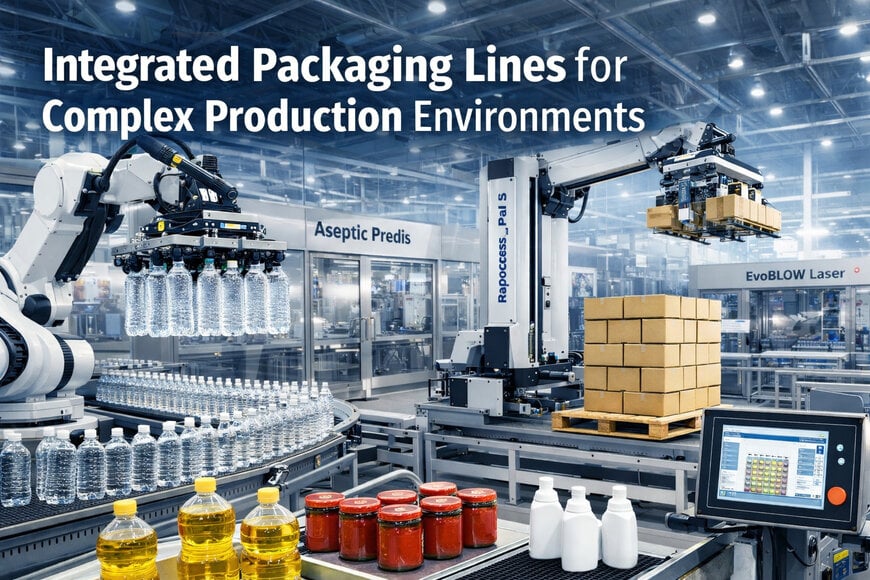
At Interpack 2026 in Düsseldorf (7–13 May), Sidel presented packaging line technologies designed to address increasing operational complexity in food, beverage, home care and personal care manufacturing. The solutions combine robotic case packing, automated palletising and integrated line engineering to improve production efficiency and flexibility in high-speed packaging environments.
Integrated Packaging Line Engineering for Consumer Goods
Manufacturers in the beverage, food, home care and personal care sectors increasingly manage diverse packaging formats, frequent product changeovers and high throughput requirements. These factors have increased the technical complexity of packaging lines, particularly where producers must handle containers made from multiple materials and with varying shapes and mechanical resistance.
Sidel presented integrated packaging line solutions intended to address these operational challenges. The company’s approach combines engineering design, installation and lifecycle support into turnkey systems that coordinate equipment across the entire packaging process from container handling to end-of-line palletising.
The systems are intended to improve equipment availability and line efficiency while reducing unplanned downtime. Through project engineering, line simulation and coordinated equipment integration, the company aims to provide packaging lines tailored to specific product categories such as edible oils, sauces and dressings, as well as home and personal care products.
Sidel has more than four decades of experience designing packaging lines for alcoholic and non-alcoholic beverage producers. That experience has expanded into adjacent consumer goods sectors where manufacturers face similar requirements for high throughput, hygienic production and adaptable packaging formats.
Robotic Collation Technology for High-Speed Case Packing
A central technology presented at Interpack 2026 was the Cermex RoboSELEX robotic collation system. The system is designed for case packers and manages the grouping of containers before secondary packaging.
The system handles lightweight bottles of different shapes and configurations without accumulation zones, supporting continuous product flow at speeds of up to 320 products per minute. This architecture reduces bottlenecks and stabilises line throughput, which is critical in high-speed packaging environments where upstream blow-moulding or filling equipment operates continuously.
The robotic collation system also enables rapid format changes. According to the company, collation adjustments can be completed in approximately one minute, while switching to a different bottle format typically requires around two minutes. Such changeover times are relevant for producers managing short production runs or multiple product variants on the same line.
The mechanical design reduces the number of components involved in container handling. Simplifying the mechanism can lower maintenance requirements and facilitate the introduction of new packaging formats without extensive mechanical modifications.
Automated Palletising for Compact Production Spaces
End-of-line automation was another focus of the technologies presented. Sidel demonstrated the RoboAccess Pal S palletising cell, designed for facilities with limited floor space.
The system operates at speeds of up to 11 cycles per minute while handling loads of up to 25 kg per cycle. Despite these capabilities, the palletising cell occupies a footprint of approximately 12 m² for two pallet stations or 8 m² for a single station, allowing integration into existing packaging layouts without major structural modifications.
A newly introduced elevating column increases the maximum pallet stacking height to 2,200 mm, expanding pallet configuration options for producers managing different logistics requirements.
To simplify pallet configuration management, the system includes the PalDesigner software tool integrated into the machine’s human-machine interface (HMI). The tool allows operators to design and modify pallet stacking patterns directly at the machine, reducing the need for external programming and supporting faster product changeovers.
Automated palletising can reduce manual handling tasks and improve consistency in pallet configuration, which can influence downstream warehouse automation and logistics processes.
Aseptic and PET Bottle Manufacturing Technologies
The Interpack exhibit also included Sidel technologies used in beverage and liquid food production, particularly in aseptic filling and PET container manufacturing.
Among these systems was the Aseptic Predis X4 aseptic processing technology, integrated into complete aseptic packaging lines designed to support sterile filling of sensitive beverages.
In PET bottle production, Sidel presented the EvoBLOW Laser blowing technology, designed to improve process precision in stretch blow-moulding operations. Such technologies are typically used in beverage production environments where container quality, weight reduction and process efficiency influence both sustainability targets and manufacturing costs.
Addressing Packaging Complexity Across Industries
Packaging line complexity continues to increase as manufacturers diversify product portfolios and packaging formats. Integrated automation, robotic handling and digital line management systems are increasingly used to stabilise production flows while maintaining operational flexibility.
By combining robotic case packing, compact palletising and integrated line engineering, the technologies presented by Sidel illustrate how packaging equipment manufacturers are adapting production systems to support higher throughput, shorter changeovers and multi-format packaging environments across consumer goods industries.
Edited by Sucithra Mani, with AI assistance.
www.sidel.com
