
www.foodpackautomation.com
06
'26
Written on Modified on
Collaborative Packaging Systems Demonstrated at Interpack 2026
BOBST and multiple material and technology partners present integrated packaging production solutions at Interpack 2026, focusing on industrial automation and cross-value-chain integration.
www.bobst.com
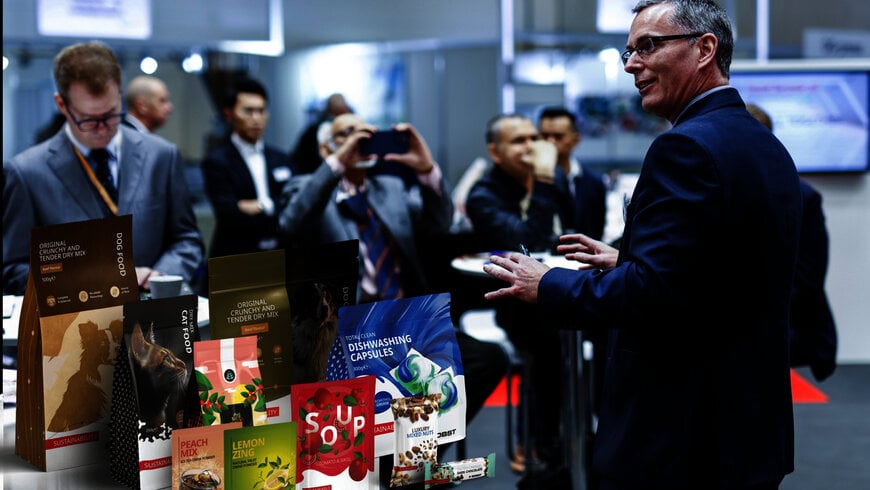
BOBST is coordinating a multi-partner initiative at Interpack 2026 in Düsseldorf to demonstrate integrated packaging production systems across labels, flexible packaging, folding cartons, and corrugated board segments. The cooperation combines equipment, materials, and process technologies to address production efficiency and regulatory requirements.
Context of the Cooperation
BOBST is working with partners including Michelman, Dow Chemical Company, Sun Chemical, Kuraray, Henkel, tesa, Brückner Group, Polivouga, and Reifenhäuser Group.
The cooperation addresses increasing system complexity in packaging production, where performance depends on compatibility between substrates, coatings, inks, adhesives, and converting equipment. Regulatory developments such as the EU Packaging and Packaging Waste Regulation (PPWR) further require coordinated material and process innovation.
Technical Solution and Responsibilities
The collaboration focuses on integrating converting machinery with functional materials and chemical coatings to enable optimized barrier properties, printability, and recyclability. BOBST provides printing and converting platforms, while partners contribute material formulations (e.g., barrier coatings, adhesives, films) and process-specific technologies.
A joint R&D session between BOBST and Michelman examines water-based barrier coatings designed to replace multi-layer structures. These coatings are engineered to meet oxygen and moisture barrier targets while maintaining compatibility with existing converting lines.
Co-created samples presented at the exhibition demonstrate interoperability across systems, where material behavior, adhesion performance, and print quality are validated under production conditions. This reflects a system-level approach to industrial automation, where process parameters are aligned across multiple suppliers.
Deployment and Implementation
The solutions are demonstrated at Interpack 2026 (May 7–13, Düsseldorf), with physical samples and technical sessions distributed across partner booths. Additional validation takes place at the BOBST Packaging Center in Bielefeld, where converters can test end-to-end workflows under application-specific conditions.
Demonstrations include the “first pull right” methodology developed with Co-ëfficiënt, focusing on reducing setup waste and improving job changeover efficiency through standardized process calibration.
Applications and Use Cases
Target applications include food and consumer goods packaging requiring barrier performance, print quality, and compliance with recyclability standards. Use cases involve mono-material flexible packaging, coated paper-based solutions, and high-efficiency label production.
The integrated approach supports converters in reducing material complexity while maintaining functional performance, enabling alignment with evolving regulatory and sustainability requirements.
Expected Impact
Rather than isolated component optimization, the cooperation demonstrates how coordinated system design improves process stability and reduces trial-and-error during production setup. The use of validated material-machine combinations can shorten commissioning times and improve repeatability across production runs.
This model reflects a shift toward digital infrastructure and interconnected production environments, where cross-company collaboration becomes necessary to achieve measurable efficiency and compliance outcomes.
Edited by an industrial journalist Sucithra Mani with AI assistance.
www.bobst.com
