
www.foodpackautomation.com
08
'26
Written on Modified on
Dairy Processing Upgrades Reduce Emissions and Resource Use
Tetra Pak evaluates how upgrading existing dairy processing lines can cut emissions, water use, and product losses using currently available technologies.
www.tetrapak.com
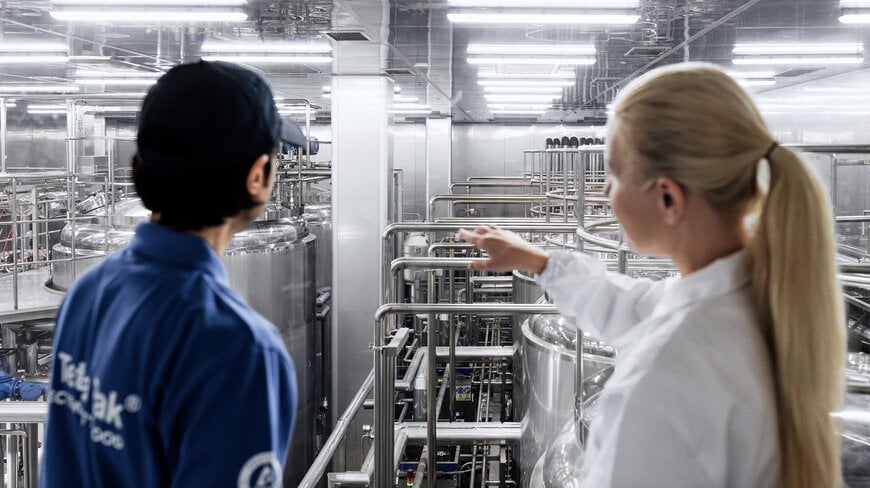
A recent assessment shows that modernising existing dairy processing equipment can significantly reduce greenhouse gas emissions and resource consumption without requiring full system replacement. The findings highlight the role of incremental upgrades in improving efficiency across industrial food processing.
Quantifying Emissions Reduction in Dairy Processing
The Dairy Processing Impact Assessment, conducted by Tetra Pak and independently reviewed by the Carbon Trust, evaluates the potential benefits of upgrading liquid dairy processing lines. The methodology aligns with established avoided emissions frameworks and compares 2019 best-practice systems with a modelled global deployment of upgraded lines by 2025.
The results indicate that targeted upgrades can reduce greenhouse gas emissions by 40–49%, depending on the configuration of the processing line. These reductions are achieved using commercially available technologies rather than experimental solutions.
The study also identifies broader efficiency gains, including average reductions of 47% in emissions, 45% in water consumption, and 57% in product losses across upgraded systems.
Addressing Resource Intensity in the Dairy Sector
The global dairy sector accounted for approximately 2.7% of total greenhouse gas emissions in 2023, reflecting its energy- and water-intensive operations. Processing activities such as heating, cooling, and cleaning contribute significantly to this footprint.
By focusing on optimisation of existing infrastructure, the assessment outlines a pathway to improve environmental performance without the cost and disruption associated with full-line replacement. This approach supports faster implementation and scalability across production facilities.
If applied at a global scale, the study estimates potential emissions reductions of up to 12.7 million tonnes of CO₂ equivalent. Water-saving measures could also reduce annual consumption by up to 455 million cubic metres.
Technologies Enabling Efficiency Gains
The identified improvements are based on a combination of process optimisation and equipment upgrades already available on the market.
Electrification of thermal processes plays a key role, with industrial heat pumps replacing or supplementing fossil fuel-based boilers and chillers. This reduces direct fuel consumption and associated emissions in heating and cooling stages.
Process integration technologies combine multiple production steps into a single operation, reducing energy demand for both electricity and steam. These systems are particularly relevant for ultra-high temperature (UHT) milk and yoghurt processing, where thermal efficiency is critical.
Water and product recovery solutions further improve resource efficiency. Membrane filtration systems, along with advanced cleaning-in-place (CIP) recovery and water filtration units, enable the reuse of process water and the recovery of residual product from cleaning streams. This reduces both waste and overall water demand.
Implications for the Digital Supply Chain
The findings demonstrate how incremental upgrades can contribute to a more efficient and resilient digital supply chain in food production. By integrating process data, energy consumption metrics, and resource recovery systems, dairy producers can improve operational visibility and decision-making.
Such optimisation strategies also support compliance with sustainability targets while maintaining production continuity, making them applicable across the broader automotive data ecosystem of industrial manufacturing where similar efficiency challenges exist.
Advancing Scalable Sustainability in Food Processing
The assessment indicates that significant environmental and operational improvements can be achieved through targeted upgrades rather than large-scale system replacements. By combining electrification, process integration, and resource recovery, dairy processors can reduce emissions, lower operating costs, and improve production efficiency.
These results position equipment modernisation as a practical approach for accelerating sustainability in the dairy industry while maintaining competitiveness in global food systems.
Edited by Romila DSilva, Induportals Editor, with AI assistance.
www.tetrapak.com
