
www.foodpackautomation.com
20
'26
Written on Modified on
Biological indicators enable real-time food safety signals
Vitsab develops enzyme-based labels to translate cumulative temperature exposure into visual indicators for cold chain monitoring.
vitsab.com
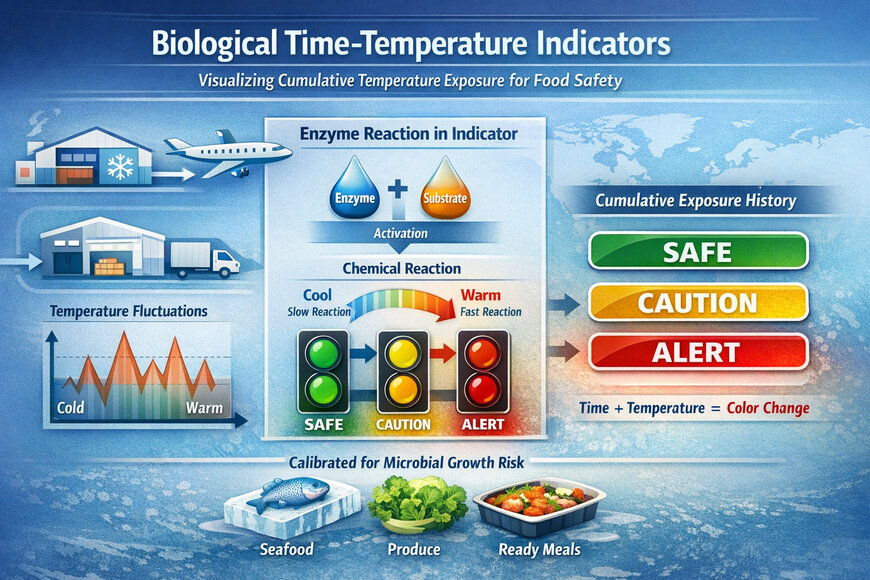
Biological time-temperature indicators are being developed to convert complex thermal histories into immediate visual signals, supporting decision-making in perishable food logistics. These systems address limitations of conventional monitoring by linking cumulative exposure directly to microbial risk in cold chain environments.
From temperature logging to cumulative risk modelling
Modern food distribution systems involve repeated transitions between controlled and uncontrolled environments, where temperature fluctuations influence microbial growth and product quality. Conventional tools such as thermometers and data loggers capture discrete measurements but require interpretation, particularly when temperature profiles include multiple excursions and recoveries.
Time-temperature indicators (TTIs) introduce a cumulative monitoring approach. Instead of reacting to isolated thresholds, they integrate time and temperature into a single evolving signal. This aligns more closely with biological processes, where spoilage depends on sustained exposure rather than single temperature deviations. As a result, TTIs contribute to a more reliable digital supply chain by simplifying safety assessment at different handling stages.
Enzyme-driven reaction as a biological sensing mechanism
At the core of advanced TTIs is a biochemical system consisting of an enzyme and a substrate stored in separate compartments. Upon activation, these components interact through a controlled reaction that progressively alters the internal pH of the indicator.
This reaction functions similarly to a calibrated pH-based system. Higher temperatures accelerate enzymatic activity, while lower temperatures slow it. Because the reaction is irreversible, each exposure contributes permanently to the indicator’s state. The cumulative effect produces a gradual color change, reflecting the integrated thermal history of the product.
This mechanism enables the indicator to mimic the kinetics of microbial growth. Short temperature excursions result in minor progression, whereas prolonged exposure accelerates the reaction significantly. Unlike threshold-based devices, which may trigger alarms from brief spikes, enzyme-based systems provide a proportional response to real exposure conditions.
Addressing variability in cold chain conditions
Cold chain disruptions typically occur as intermittent fluctuations rather than single failures. For example, products may remain refrigerated during transport but experience short periods of elevated temperature during loading, unloading, or last-mile delivery.
Biological TTIs are designed to capture this variability. By continuously progressing rather than triggering at predefined limits, they reflect the cumulative impact of these fluctuations. This improves alignment between monitoring outputs and actual product condition, reducing both false positives and undetected risks.
Calibration to product-specific microbial behaviour
Effective indicator design requires calibration against real microbial growth patterns. Different food categories such as seafood, fresh produce, or prepared meals exhibit distinct spoilage mechanisms, temperature sensitivities, and shelf-life characteristics.
Development begins with controlled experiments that measure microbial growth across multiple temperature conditions. These data sets define growth curves that serve as reference models. Indicator formulations are then adjusted by selecting specific enzymes, substrates, and concentrations to match these biological profiles.
Transit conditions and packaging methods further influence calibration. Factors such as transport duration, refrigeration type, and insulation materials are incorporated into the model. Safety margins are typically added to ensure that visual warnings occur before microbial risk reaches critical thresholds.
Integration into cold chain operations
Biological TTIs support operational decision-making by translating complex exposure histories into intuitive visual cues. This reduces reliance on data interpretation and enables faster responses across logistics, quality control, and retail environments.
Vitsab’s development of enzyme-based indicators illustrates this approach. Its monitoring labels apply calibrated biochemical reactions to produce a stoplight-style signal, allowing users to assess product condition without analysing temperature data. Such systems bridge scientific modelling and practical usability, contributing to improved traceability and reduced waste.
Implications for food safety and sustainability
As food supply chains become more distributed and time-sensitive, the ability to communicate product condition clearly becomes critical. Biological TTIs provide a method for aligning monitoring technology with the actual dynamics of spoilage and pathogen growth.
By distinguishing between safe and compromised products more accurately, these systems can reduce unnecessary disposal while maintaining safety standards. Their integration into cold chain workflows represents a shift toward biologically informed monitoring, where data interpretation is embedded directly into the sensing mechanism.
Edited by an industrial journalist Sucithra Mani with AI assistance.
www.vitsab.com
