
www.foodpackautomation.com
08
'26
Written on Modified on
Industrial Cocoa Processing Efficiency Enhancements via Advanced Thermal Engineering
Bühler has introduced a new thermal roasting system designed to optimize energy efficiency and throughput in industrial cocoa bean processing plants.
www.buhlergroup.com
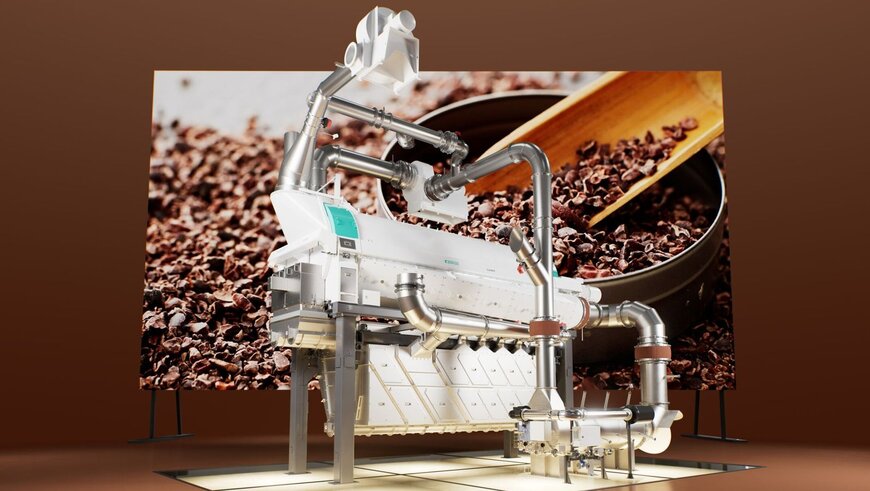
The development of a new industrial cocoa nib roaster introduces an advanced thermal design targeting energy reduction and increased capacity in global confectionery supply chains. This processing system applies automated thermodynamic controls to improve output consistency across the food manufacturing sector.
Energy Recovery and Throughput Optimization in Cocoa Processing Technology
Industrial cocoa processing operations experience high energy costs, where roasting constitutes between 10% and 20% of total operating expenditures. Traditional batch processing systems vent heated exhaust air after each cycle, losing substantial thermal energy. The new system integrates an air-recirculation heat exchanger that utilizes return air to lower the thermal demand on the gas burner. Combined with modified drum geometry and optimized fill levels, the design reduces gas consumption by a minimum of 20% compared to legacy equipment like the Tornado roaster. Furthermore, the configuration achieves a throughput increase of up to 20% within the identical physical footprint. For specific applications, an alternative hybrid configuration combining convective and conductive heat transfer provides up to 40% thermal efficiency savings.
Structural Isolation and Food Safety Engineering
Tightening food safety standards require physical contamination barriers rather than procedural adjustments. The machinery incorporates a fully enclosed roasting chamber and a specialized sealing system that isolates the cocoa nibs from combustion air during the entire processing cycle. Constructed from stainless steel with an easy-clean surface finish, the equipment includes dedicated service openings for direct component access, minimizing maintenance and inspection downtime. This sealed design also prevents product yield loss by ensuring fine particles are not inadvertently drawn into the primary airstream.
Automated Predictive Process Controls
To reduce dependence on manual operator experience, the roasting system utilizes a self-learning algorithmic control loop. The system monitors live processing variables to automatically modulate burner temperature, airflow velocity, and drum rotation speed in real time. Processing cycles range between 40 and 60 minutes depending on raw material characteristics. Operators program specific roasting profiles, and the automation adjusts for variances in incoming raw cocoa moisture and bean size to ensure uniform flavor and roast levels across successive batches. A prototype is scheduled for installation at an industrial facility in Asia during the first quarter of 2027.
Additional Context
Conventional industrial drum roasters typically lack integrated exhaust heat recovery, leading to higher baseline energy use per ton of processed cocoa. While standard configurations require expanded factory floor space to increase production volumes, the mechanical enhancements in this system deliver a 20% capacity increase without altering physical dimensions. The integration of automated real-time parameter adjustments replaces manual airflow adjustments common in older processing lines, establishing a measurable benchmark for thermal efficiency and batch uniformity in high-volume chocolate production.
Edited by Evgeny Churilov, Induportals Media - Adapted by AI.
www.buhlergroup.com
