
www.foodpackautomation.com
06
'26
Written on Modified on
Automated Poultry Cut-Up Scales to 6,500 Birds per Hour
JBT Marel’s modular cut-up platform combines automated anatomical cutting, weighing, vision inspection and product routing for poultry processing plants.
marel.com
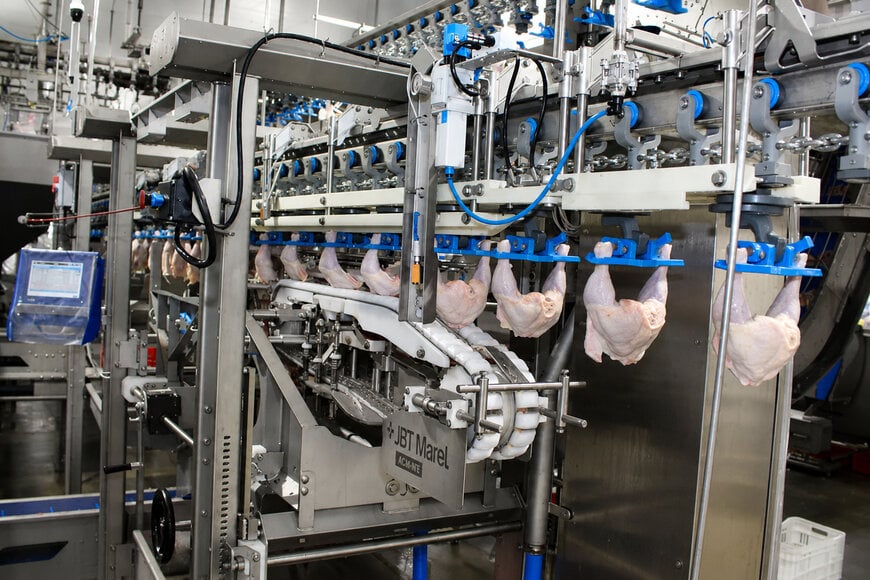
JBT Marel has developed its ACM-NT automated poultry cut-up platform to support processors moving from manual cutting toward configurable, higher-throughput production of wings, breast meat and leg products. The system is available in configurations ranging from the compact entry-level version to automated lines capable of processing up to 6,500 carcasses per hour.
Modular automation for poultry cut-up
The ACM-NT is designed around interchangeable breast, leg and wing cutting modules, allowing processors to configure a poultry processing line according to the required product mix and available production capacity.
For plants with limited floor space or lower initial automation requirements, the ACM-NT Compact provides an entry point into automated cut-up. It uses cutting modules derived from the full-size system, enabling processors to introduce automated cutting without immediately installing a complete high-capacity line.
The modular architecture also allows additional processing functions to be introduced as production requirements change. This is relevant as processors shift a larger share of production from whole birds toward portioned products for retail and food-service applications.
Gradus in Bulgaria provides one example of this transition. According to CEO Martin Dimitrov, the processor is changing its production mix from 30% whole chickens and 70% cut-up products to 10% whole chickens and 90% cut-up products. The company introduced automated cut-up because its previous off-line cutting capacity could not keep pace with its primary processing line.
Wing and leg cutting based on anatomical positioning
Different modules handle specific cuts within the automated poultry processing system.
WingMaster performs an anatomical cut at the second wing joint. Skin coverage can be adjusted according to presentation requirements for mid-wing and drumette products. Left and right wings can also be processed independently, enabling each part to be directed according to its condition or production requirement when the module is integrated with the Q-Wing configuration.
For leg processing, the ALPINE module performs anatomical cuts according to specified product requirements. Integrated sensors are used to detect and prevent undesirable back pieces from remaining with the leg product.
The module can process both water-chilled and air-chilled legs, including birds in JBT Marel's Super HD weight category. An integrated human-machine interface provides process monitoring and tracks product losses.
These functions are intended to increase the proportion of cuts meeting specified product requirements while reducing dependence on manual trimming and inspection.
Vision and weighing determine carcass routing
The ACM-NT combines mechanical cutting with in-line data acquisition. IRIS NT vision technology and SmartWeigher NT collect information from individual carcasses while they remain in the processing flow.
This data is used by PDS software to determine how each carcass should be processed. The system can identify whether a carcass contains specified A-grade or B-grade parts and route its shackle accordingly.
Rather than applying the same cutting sequence to every bird, this approach enables processors to select destinations according to carcass characteristics, product specifications and customer orders. The resulting digital poultry processing workflow connects inspection and weighing data directly with downstream cutting decisions.
Production routing can also accommodate different cutting regimes on the same system. PD Drobex in Poland reports using its ACM-NT installations to run different cutting programs simultaneously. General Director Agnieszka Frischke Kazmierczak said this capability has enabled the processor to complete some orders in less than six hours and to produce wing portions within specified weight ranges and cutting requirements.
Coordinating multiple cut-up and deboning lines
Automation extends beyond individual cutting modules. Combined Rate Limiting software can coordinate products originating from multiple ACM-NT lines before they enter a common downstream process, including deboning operations.
Floating-Point Control addresses variations in product weight. It distributes heavier and lighter products between deboning lines while maintaining a defined throughput.
This provides production managers with a mechanism for matching downstream deboning capacity with the actual product distribution arriving from the cut-up process, rather than treating all incoming products as equivalent.
Scaling from compact to high-capacity processing
The ACM-NT architecture allows processors to begin with selected automated cuts and subsequently add modules or capacity. At the upper end of the platform, JBT Marel specifies throughput of up to 6,500 carcasses per hour.
The distinction between the compact and higher-capacity configurations is therefore primarily one of scale and system configuration rather than a completely different cutting principle. Core breast, wing and leg processing modules can form part of progressively more automated installations.
For poultry processors, this scalability provides a route from labor-intensive cut-up toward a data-driven cut-up process in which weighing, vision inspection, routing and mechanical cutting operate as an integrated production system.
Additional Context:
This section details technical specifications and competitive benchmarking not included in the original product announcement.
Throughput is one of the clearest standardized characteristics available for comparing automated poultry cut-up equipment, although published capacities do not by themselves establish differences in yield, cut quality or total line efficiency.
JBT Marel specifies a maximum capacity of 6,500 carcasses per hour for the ACM-NT platform.
Meyn publishes capacities of up to 7,500 birds per hour for several modules in its Physic cut-up platform. For example, its Wing Tip Cutter and Front Half Cutter are rated at up to 7,500 birds per hour. Meyn also states that its Physic system accommodates bird weights between 1.0 and 3.2 kg. Its Wing Cutter High Yield Pro extends the supported bird weight to 4.3 kg and can accommodate weight variations of up to 1.5 kg within one machine setting.
Foodmate provides another comparable modular approach. Its Compact Cut-up and OPTI Flow-compatible modules include wing, breast and leg processing equipment. Published capacities for multiple Foodmate modules, including its Wing Tip Cutter, Mid Wing Cutter and Breast Cap Cutter, reach 6,000 birds per hour.
On published nominal throughput, this places the ACM-NT's stated 6,500-carcass-per-hour capacity between Foodmate's commonly specified 6,000-bird-per-hour modules and Meyn's 7,500-bird-per-hour Physic modules.
These figures should not be interpreted as direct measures of overall processing performance. Yield, anatomical cutting accuracy, bird-weight range, product mix, uptime, downstream integration and the amount of manual trimming required can materially affect effective plant output. For example, Meyn separately publishes more than 90% anatomical separation for its Wing Cutter High Yield, while Foodmate specifies individual module dimensions, motor ratings and maximum throughput. Comparable quantitative values for all of these parameters were not provided for ACM-NT in the source announcement, preventing a direct like-for-like comparison beyond published throughput and system architecture.
Edited by Sucithra Mani, Induportals editor – adapted by AI.
www.jbtmarel.com
