
www.foodpackautomation.com
24
'26
Written on Modified on
Engineering Smarter Bulk Material Handling in Chemical Manufacturing
Advanced containment, controlled environments, and material-specific design are crucial for safety and efficiency, writes Rob DeHaan, Director of Strategic Sales & Marketing at Hapman.
hapman.com
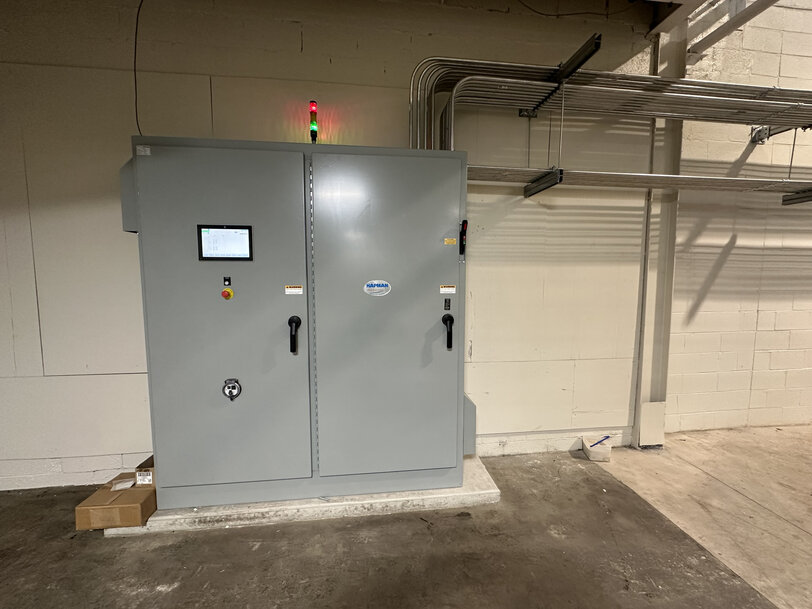
Powder and granule handling in chemical manufacturing requires precise engineering to address variables such as bulk densities, flow properties, reactivities, and contamination risks. Designing a reliable system involves understanding how powders behave, how conveying environments influence that behavior, and how containment and control must adapt to the material. According to Rob DeHaan, Director of Strategic Sales & Marketing at Hapman, smart bulk material handling is defined by the ability to engineer material-appropriate, sealed, and automated systems that protect operators, maintain product integrity, and ensure consistent throughput.
Containment, Environmental Control, and Sealed Conveyance
Operator safety and material integrity are paramount at the point of interaction. Modern chemical plants increasingly use glove box interfaces that create sealed environments for handling raw materials. For hazardous or oxygen-sensitive materials, these chambers can be purged with nitrogen until oxygen levels are safe, isolating materials and minimizing cross-contamination. In facilities with combustible dusts or volatile compounds, explosion-proof controls and classified area-rated components are mandatory.
Once the material is unloaded, tubular drag conveyors offer a sealed, controlled method of conveyance. Operating at low speeds and high torque, these conveyors move material en masse, reducing particle degradation, preserving blend uniformity, and minimizing the risk of ignition from frictional heat. Automation further enhances these systems, providing consistent dosing and batch integrity through PLC-driven sequencing. For high-purity processes, dust-tight construction, inert gas purging, and Clean-in-Place configurations ensure hygiene and compliance. Hapman, a global manufacturer of bulk material handling systems, emphasizes adapting system architecture to match material properties, safety demands, and operational constraints, ensuring resilient and future-ready infrastructure.
Additional Context
This section provides technological and market background not explicitly detailed in the original release.
The chemical manufacturing industry is increasingly prioritizing robust bulk material handling systems due to stringent safety regulations, such as OSHA's combustible dust standards (e.g., NFPA 652). The transition from open-vessel dumping to fully enclosed, automated systems is driven by the need to eliminate airborne combustible dust, a primary cause of catastrophic industrial explosions. Furthermore, in specialty chemical and pharmaceutical sectors, handling highly potent active pharmaceutical ingredients (HPAPIs) or moisture-sensitive catalysts necessitates the use of sealed tubular drag conveyors and nitrogen-purged glove boxes to prevent costly product degradation and ensure strict regulatory compliance.
Edited by Lekshman Ramdas, Induportals editor – adapted by AI.
www.hapman.com
