
www.foodpackautomation.com
02
'26
Written on Modified on
Aseptic Carton Filling Machine Footprint Optimization
SIG expands the SIG Neo platform to maximize aseptic packaging output and format flexibility within constrained food and beverage factory footprints.
www.sig.biz
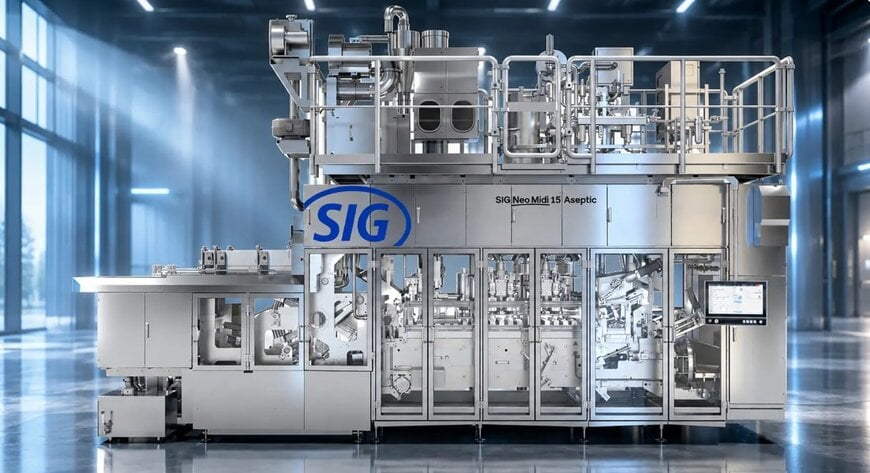
Commercial beverage manufacturing facilities face severe footprint limitations when scaling production capacity. Expanding physical building infrastructure requires significant capital expenditure and extensive downtime, prompting food and beverage packaging operations to prioritize aseptic carton filling equipment capable of higher line speed, rapid changeover times, and elevated output per square meter.
Food and beverage processing plants require continuous aseptic carton packaging lines that protect shelf-stable liquids such as juices and dairy products without compromising microbiological integrity. To resolve space constraints, packaging machinery must balance high-speed throughput with the mechanical agility required to process diverse packaging volumes and profiles on a unified system.
High-Throughput Sleeve-Based Aseptic Filling Mechanisms
The expanded machine line targets high-speed packaging lines via two dedicated units: the SIG Neo XSlim 32 Aseptic for single-serve containers and the SIG Neo Midi 15 Aseptic for multi-serve configurations. The systems operate on an open-sleeve carton architecture, where pre-manufactured, flat carton sleeves are erected, sterilized, filled, and ultrasonically or thermally sealed along the top.
The single-serve machine attains a throughput of 32,000 SIG XSlimBloc packs per hour across nine discrete container volumes. The multi-serve machine processes 15,000 packs per hour, handling both SIG MidiBloc and SIG MidiFit squarish carton profiles across three volume sizes each. Both platforms increase overall production output and volumetric space efficiency by one-third relative to previous-generation equipment while preserving the foundational floor dimensions.
Format adjustments between container volumes are completed in under 15 minutes. This tooling-free adjustment eliminates mechanical part replacement during format changeovers, suppressing line changeover downtime and supporting dynamic stock keeping unit schedules in multi-product packaging lines.
Process Control, Digitalization, and Sterile Zone Containment
Line efficiency directly impacts total cost of ownership in high-speed bottling and carton lines. Both systems maintain an operational packaging waste rate under 0.5%, reducing lost raw packaging material and liquid volume during continuous runs and startup phases.
Contamination management relies on SIG Neo Shield, an environmental containment mechanism that directs conditioned, sterile airflow across the lower mechanical sub-assemblies during carton pre-folding and bottom sealing stages. The laminar barrier system removes up to 95% of airborne particulate matter within the processing envelope, preserving sterility before aseptic product dosing. Operator interactions and equipment telemetry are managed through an updated human-machine interface, providing real-time diagnostics, performance tracking, and direct process oversight.
Plant operators face strict operational ceilings when existing real estate prevents building expansion. Christoph Wegener, Chief Markets Officer at SIG, noted that many packaging facilities have reached physical limits, emphasizing that these filling machines generate higher output per unit area to add operational capacity directly within existing factory footprints rather than requiring building additions.
By engineering higher mechanical cycle rates and integrated air-shielding technologies into existing machine footprint envelopes, modern filling architectures address the primary operational constraints of modern liquid food manufacturing. Gavin Steiner, Chief Technology Officer at SIG, stated that integrating speed, format adaptability, and digital process controls creates filling platforms designed to raise throughput while simplifying operational maintenance and daily line execution.
Additional Context
This section details technical specifications and competitive benchmarking not included in the original product announcement.
Aseptic liquid carton packaging is broadly divided into two competing engineering architectures: sleeve-fed systems (such as SIG) and roll-fed web systems (such as Tetra Pak). Roll-fed systems form continuous tubes from reels of laminated packaging material, sterilizing the interior with hydrogen peroxide liquid or vapor baths before filling and sealing below the liquid level. While continuous-motion roll-fed machines historically demonstrated exceptional volumetric speeds, format changes typically require changing entire material reels, adjusting forming jaws, or swapping mechanical forming rings, which can extend changeover periods.
In contrast, sleeve-fed systems feed prefabricated carton sleeves that are erected, sealed at the base, filled from above without submerging sealing components, and closed ultrasonically. This mechanical separation of sleeve forming from filling permits multiple package heights and profile volumes to run on the same track through servo-driven stroke adjustments rather than major component changeouts.
Benchmark high-speed single-serve carton lines in the beverage sector generally operate between 24,000 and 40,000 packs per hour, with typical line loss rates ranging between 1.0% and 1.5% across extended continuous shifts. Operating at 32,000 packs per hour with an operational carton loss rate below 0.5% positions modern sleeve filling at the upper efficiency tier of commercial aseptic packaging, particularly where quick SKU agility takes precedence over single-volume dedicated continuous runs.
Edited by Evgeny Churilov, Induportals Media - Adapted by AI.
www.sig.biz
