
www.foodpackautomation.com
07
'26
Written on Modified on
Closed-Loop Bag-in-Box Dispensing Fitment Prevents Fluid Leakage & Contamination
SIG launched the SIG CleanClic Connect bag-in-box fitment to improve aseptic product integrity and dispensing flexibility across commercial foodservice environments.
www.sig.biz
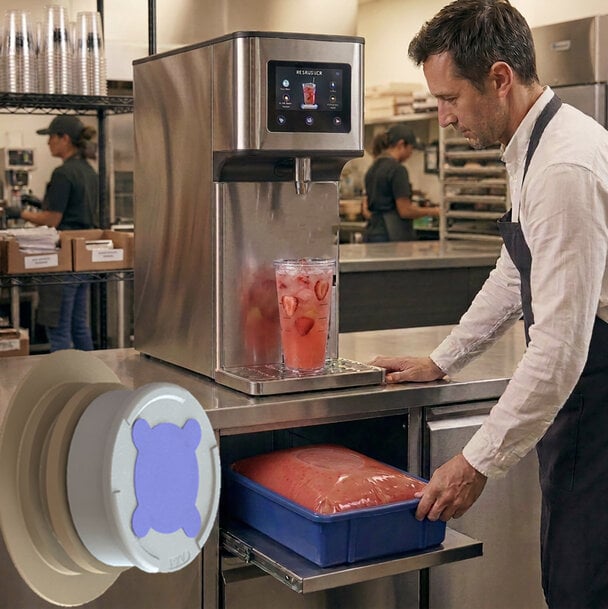
High-turnover commercial beverage programs require dispensing systems that accommodate rapid fluid changeovers without cross-contamination, ambient spoilage, or liquid dripping during line maintenance. Addressing the operational challenge of fluid evacuation and hygienic coupling, aseptic packaging manufacturer SIG introduced the SIG CleanClic Connect, an engineered bag-in-box and bag-in-tray fitment designed for high-throughput dispensing operations in commercial restaurants and beverage service operations.
Interference-Fit Reclosure Dynamics and Aseptic Fluid Pathway
The technical architecture of the fitment centers on an integrated probe-actuated connection and positive mechanical reclosure mechanism. Before primary operational engagement, the fitment maintains a factory hermetic seal that isolates shelf-stable or commercially sterile fluids from environmental microbial exposure and atmospheric oxygen.
During mechanical engagement within a dispensing machine, the dispenser probe interfaces with the internal geometry of the fitment, unseating the internal valve component to open a continuous, low-turbulence fluid channel. When service personnel disconnect the package or remove the container for cleaning, an internal plug returns automatically to an interference-fit seating position. This mechanical reset creates a positive seal that eliminates residual dripping and isolates the remaining fluid path, preventing backflow contamination and reducing food waste during routine maintenance.
Operational Integration Across Commercial Foodservice Workflows
Commercial kitchens, quick-service restaurants, and specialized beverage stations encounter substantial labor variability and frequent component handling. The direct-connect mechanism provides a tool-free interface compatible with bag-in-tray and bag-in-box racking, reducing operator error during package swaps.
The fitment supports diverse fluid viscosities and formulations, including dairy creamers, tea extracts, post-mix beverage concentrates, fruit refreshers, and high-viscosity dessert mixes. By maintaining closed-loop integrity throughout dispensing cycles, the hardware stabilizes portion control and minimizes residual concentrate left inside flexible barrier bags.
Additional Context:
This section details technical specifications and competitive benchmarking not included in the original product announcement.
In flexible packaging engineering, bag-in-box fitments are evaluated on oxygen transmission rates, clean-in-place (CIP) compatibility, puncture resistance, and volumetric evacuation efficiency. Within high-volume commercial dispensing, industry benchmarks include Liquibox (acquired by Seeed/Sealed Air) with the QC/R, StarVac, and Urn-Linr fitments, alongside Scholle IPN (acquired by SIG) legacy architectures such as the 1900 series and Bag-in-Box Direct Connect (BIB DC) connectors.
Conventional single-use bag-in-box connectors frequently employ membrane pierce valves or basic push-pull spouts that lack an internal mechanical reclosure spring or interference stop. Once pierced, non-reclosing fitments rely on external shutoff valves located further down the dispenser tubing, leaving residual product exposed to air and vulnerable to leakage during decoupling.
The SIG CleanClic Connect is engineered for integration with high-barrier laminates, such as co-extruded ethylene vinyl alcohol (EVOH) and biaxially oriented nylon (BON) films, spanning package volumes from 1.5 liters up to 20 liters (0.4 to 5.0 gallons). The fitment is compatible with aseptic, extended shelf-life (ESL), hot-fill, and ambient non-refrigerated filling platforms, such as the web-fed SIG SureFill 42 Aseptic machine. From an environmental compliance standpoint, the fitment aligns with Design for Recycling guidelines established by the Association of Plastic Recyclers (APR) and RecyClass, using mono-material-compatible polyolefin components that eliminate rigid silicone grommets or metal springs that complicate flexible polyolefin recycling streams.
Edited by Natania Lyngdoh, Induportals editor, with AI assistance.
www.sig.com
