
www.foodpackautomation.com
20
'26
Written on Modified on
Continuous Salad & Vegetable Processing Line for Industrial Washing
JBT Marel installs a complete fresh-cut processing line at its Lakeland facility to demonstrate integrated cutting, washing, and drying systems.
marel.com
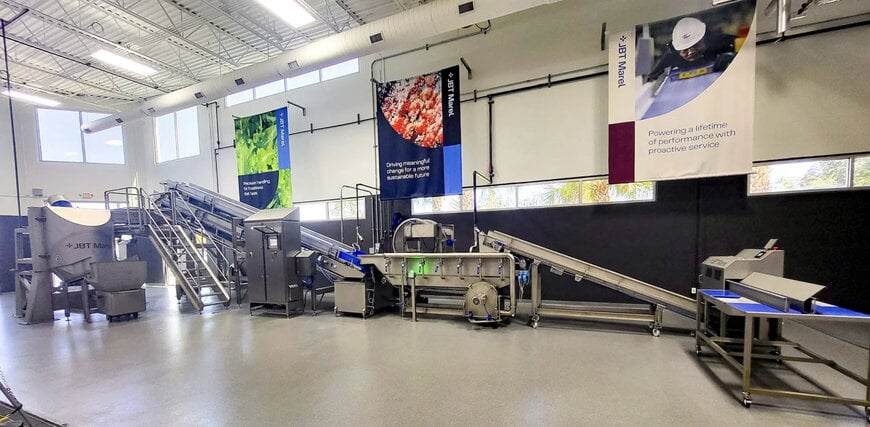
Evaluating fresh-cut produce machinery on an isolated, machine-by-machine basis often masks downstream bottlenecks, moisture imbalances, and mechanical product damage that emerge during continuous production runs. To resolve process synchronization challenges between upstream prep and final packaging, integrated processing architectures balance material flow, mechanical dewatering, and gentle product handling across industrial salad, leafy greens, and ready-to-eat vegetable operations.
JBT Marel has commissioned a full-scale industrial salad and vegetable processing line at its Customer Innovation Center in Lakeland, Florida. The facility serves as a customer testing and technology validation site where food processors conduct pilot trials, evaluate equipment synchronization from raw cutting through drying, and collaborate directly with application engineers as part of the company's regional manufacturing and technical support strategy for North America.
Continuous Line Architecture and Process Synchronization
In fresh-cut leaf processing, output quality at the packaging scale depends directly on cumulative parameter handoffs across consecutive processing stages. The Lakeland demonstration line incorporates an end-to-end continuous flow structure starting with an ergonomic trim table and belt-cutting unit, which prepares and feeds whole produce into the primary system. An infeed conveyor meters product at a controlled mass flow rate into a flotation washer, where hydraulic action cleans the produce and separates foreign density matter without mechanical bruising.
Following the wash stage, product transitions through an initial mechanical dewatering stage that strips excess surface water before entering a buffering section designed to maintain steady-state line balance during temporary volume surges. A specialized shaker feeder subsequently distributes and meters the product across the bed of an industrial tornado air-drying system, stripping remaining moisture without thermal damage. A collection conveyor then routes the dried product toward packaging interfaces, with all individual unit operations synchronized via an integrated central control architecture to eliminate product accumulation and excessive residence times.
Industrial Evaluation and Validation Parameters
The live demonstration line allows engineering teams and plant managers to run proprietary produce varieties and evaluate operational variables under production-scale conditions. Key engineering assessment criteria include verifying that cut quality preserves cellular integrity, optimizing fluid dynamics inside the flotation tank to maximize soil detachment, and adjusting air velocity within the tornado dryer to achieve target moisture thresholds for extended retail shelf life.
Beyond product physics, technical teams utilize pilot runs to analyze physical equipment footprints, sanitary clean-in-place accessibility, utility consumption, and sensor-driven controls for integration into existing factory automation architectures. JBT Marel is also transitioning the manufacturing of selected equipment and sub-assemblies directly to the Lakeland facility, combining local equipment fabrication with spare parts planning, regional field service, operator training, and application engineering for North American food processors. Industrial operators can also evaluate complementary systems at the site, such as the Flip & Wash bin washing station, or engage technical specialists at upcoming industry trade events including the International Fresh Produce Association (IFPA) Global Produce & Floral Show and PACK EXPO.
Additional Context:
This section details technical specifications and competitive benchmarking not included in the original product announcement.
Industrial salad and leafy greens processing lines rely on precise balance between water consumption, mechanical agitation, and centrifugal or air-based moisture removal to prevent cell wall damage and microbial proliferation. In high-capacity commercial plants, wash systems typically adhere to sanitary design standards governed by EHEDG (European Hygienic Engineering & Design Group) and 3-A Sanitary Standards, emphasizing complete drainage, crevice-free stainless steel construction (typically AISI 304 or 316L), and cleanability to prevent Listeria monocytogenes and Escherichia coli biofilm formation.
In fresh-cut leafy green drying, continuous aerodynamic systems like tornado dryers compete directly with high-throughput continuous centrifugal dryers and automated multi-basket batch spin systems from manufacturers such as Kronen (e.g., K850 continuous drying system), Sormac (e.g., SC-family centrifuge systems), and Turatti. While centrifugal spinners rely on calibrated rotational G-force to expel water outward through perforated drums, continuous air-knife and vortex air systems fluidize the product on conveyor beds to strip surface moisture without subjecting delicate leaves to centrifugal crushing forces. Industrial benchmark criteria focus on residual surface moisture percentages (typically targeted below 2 percent by weight), product temperature elevation during drying, damage rates to fragile baby leaf tissues, and overall line throughput measured in kilograms per hour.
Edited by Natania Lyngdoh, Induportals editor, with AI assistance.
www.jbtmarel.com
