
www.foodpackautomation.com
12
'26
Written on Modified on
Mixing technology enables brewery diversification into soft drinks
Alfa Laval highlights how advanced liquid mixing systems allow small and mid-sized breweries to address health-driven beverage trends while limiting capital investment and process complexity.
www.alfalaval.com
Reference Image
Shifts in consumer demand toward low-alcohol, non-alcoholic, and functional beverages are pushing breweries to reconsider traditional production boundaries. For small and mid-sized operators, diversification beyond beer presents both technical and economic challenges, particularly when competing against large global beverage producers.
One constraint is process adaptability. Beer production is typically optimized for fermentation-centric workflows, while soft drinks require different approaches to mixing, carbonation, and oxygen control. Entering adjacent beverage categories therefore often demands new equipment, additional floor space, and specialized expertise, raising investment risks for smaller breweries.
Mixing as an enabling technology
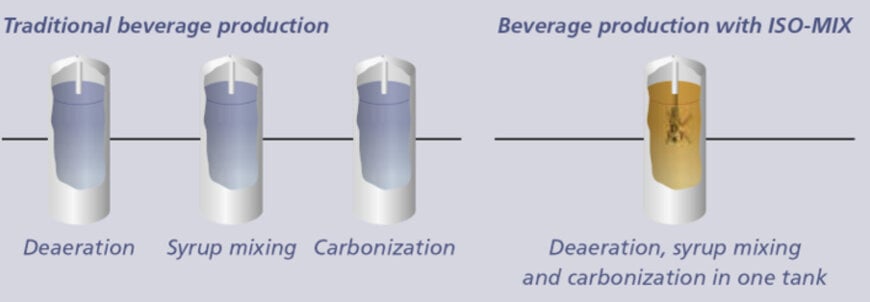
Recent developments in industrial mixing technology aim to reduce these barriers by consolidating multiple processing steps. Certain systems combine liquid blending, carbonation, gas dissolution, and de-aeration into a single operation. By operating within existing pressure-rated vessels, such as bright beer tanks, these systems can be integrated into established brewery infrastructure without requiring dedicated soft drink processing lines.
This consolidation reduces the number of components involved, which in turn lowers energy use, simplifies cleaning procedures, and minimizes CO₂ losses compared with multi-stage conventional setups. From an engineering perspective, fewer interfaces and transfer steps also reduce contamination risks and simplify process control.
Proven application in brewery environments
An example of this approach can be found at Herbsthäuser Brauerei, a long-established brewery that expanded into soft drink production using integrated mixing technology. By reusing existing tanks and avoiding a full-scale soft drink line, the brewery reportedly limited capital expenditure to under 10% of the cost associated with a traditional dedicated process setup.
The reduced equipment count also translated into lower energy consumption and a smaller operational footprint, supporting both economic and sustainability objectives. This demonstrates how diversification can be achieved incrementally rather than through large, disruptive investments.
Strategic implications for small breweries
According to Murat Boztepe, diversification strategies depend on leveraging assets breweries already possess, such as water supply, CO₂ infrastructure, and raw material handling capabilities. Mixing systems that operate efficiently within these constraints can allow producers to respond to market demand for new beverage categories while maintaining control over costs and operational risk.
As consumer preferences continue to fragment and product lifecycles shorten, flexible process technologies are becoming a key factor in maintaining competitiveness for smaller breweries seeking to expand beyond traditional beer portfolios.
www.alfalaval.com
Shifts in consumer demand toward low-alcohol, non-alcoholic, and functional beverages are pushing breweries to reconsider traditional production boundaries. For small and mid-sized operators, diversification beyond beer presents both technical and economic challenges, particularly when competing against large global beverage producers.
One constraint is process adaptability. Beer production is typically optimized for fermentation-centric workflows, while soft drinks require different approaches to mixing, carbonation, and oxygen control. Entering adjacent beverage categories therefore often demands new equipment, additional floor space, and specialized expertise, raising investment risks for smaller breweries.
Mixing as an enabling technology
Recent developments in industrial mixing technology aim to reduce these barriers by consolidating multiple processing steps. Certain systems combine liquid blending, carbonation, gas dissolution, and de-aeration into a single operation. By operating within existing pressure-rated vessels, such as bright beer tanks, these systems can be integrated into established brewery infrastructure without requiring dedicated soft drink processing lines.
This consolidation reduces the number of components involved, which in turn lowers energy use, simplifies cleaning procedures, and minimizes CO₂ losses compared with multi-stage conventional setups. From an engineering perspective, fewer interfaces and transfer steps also reduce contamination risks and simplify process control.
Proven application in brewery environments
An example of this approach can be found at Herbsthäuser Brauerei, a long-established brewery that expanded into soft drink production using integrated mixing technology. By reusing existing tanks and avoiding a full-scale soft drink line, the brewery reportedly limited capital expenditure to under 10% of the cost associated with a traditional dedicated process setup.
The reduced equipment count also translated into lower energy consumption and a smaller operational footprint, supporting both economic and sustainability objectives. This demonstrates how diversification can be achieved incrementally rather than through large, disruptive investments.
Strategic implications for small breweries
According to Murat Boztepe, diversification strategies depend on leveraging assets breweries already possess, such as water supply, CO₂ infrastructure, and raw material handling capabilities. Mixing systems that operate efficiently within these constraints can allow producers to respond to market demand for new beverage categories while maintaining control over costs and operational risk.
As consumer preferences continue to fragment and product lifecycles shorten, flexible process technologies are becoming a key factor in maintaining competitiveness for smaller breweries seeking to expand beyond traditional beer portfolios.
www.alfalaval.com
