
www.foodpackautomation.com
03
'26
Written on Modified on
Laser-Based Paper Functionalization for Adhesive-Free Packaging Sealing
Fraunhofer researchers develop a carbon monoxide laser process to enable additive-free paper sealing, enhancing recyclability within the global circular economy and fiber-based packaging sector.
www.fraunhofer.de
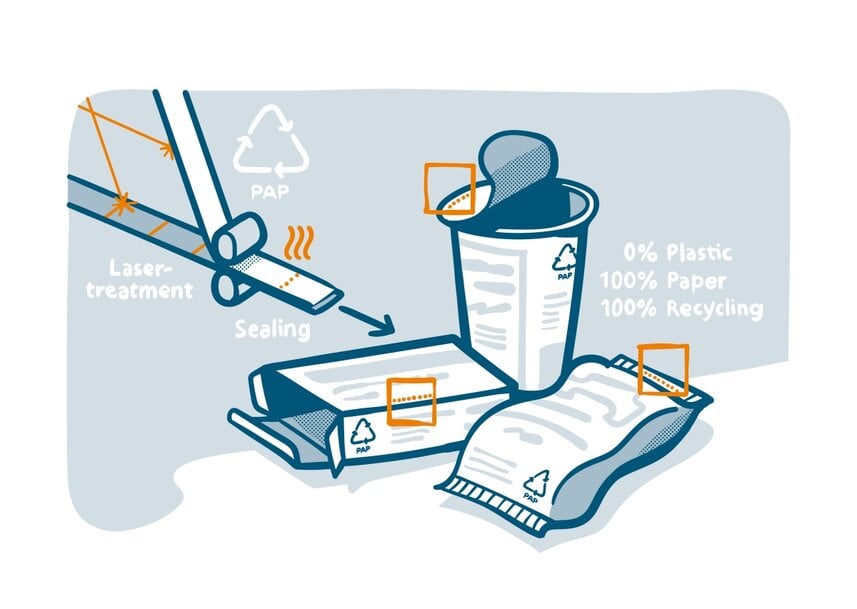
The PAPURE research project introduces a thermochemical method for bonding paper packaging without external adhesives, coatings, or plastic additives. By utilizing controlled laser irradiation to modify the chemical structure of paper fibers, the technology creates a recyclable, monomaterial solution suitable for industrial food and consumer goods applications.
Thermochemical Surface Modification via CO Lasers
Conventional paper packaging requires synthetic heat-seal coatings or adhesives to create airtight seams, which complicates the fiber recovery process during recycling. The PAPURE method replaces these additives by functionalizing the paper surface directly. Using carbon monoxide (CO) lasers, researchers at Fraunhofer IWS irradiate the substrate to rapidly heat the primary components: lignin, hemicellulose, and cellulose.
This controlled thermal degradation converts complex polymers into short-chain, fusible cleavage products. These reaction products act as an endogenous "sugar-like" adhesive. When the modified surfaces are brought together under specific heat and pressure parameters, these cleavage products solidify to form a high-strength bond. This transition facilitates a transition toward a more sustainable digital supply chain by reducing raw material complexity.
Material Characterization and Bond Strength Metrics
The efficacy of the sealing process depends on the chemical morphology of the base material. Analysis conducted at Fraunhofer IAP using scanning electron microscopy (SEM) and X-ray photoelectron spectroscopy (XPS) indicates that the ratio of cellulose to inorganic fillers, such as talc or calcium carbonate, determines bond integrity. High concentrations of inorganic compounds negatively correlate with seam strength, whereas thicker standard papers used for items like disposable cups demonstrate high suitability for binder-free sealing.
Mechanical stability tests conducted by Fraunhofer IVV quantify the performance of these seams through shear and T-peel testing. Current benchmarks show that a seal measuring 20 mm by 3 mm can support a load of 20 kg.
Technical variables influencing these results include:
- Sealing Temperature and Pressure: The activation energy required for the cleavage products.
- Dwell Time: The duration of thermal contact.
- Fiber Orientation: The alignment of the paper grain relative to the sealing tool.
Industrial Integration and the Automotive Data Ecosystem Analogy
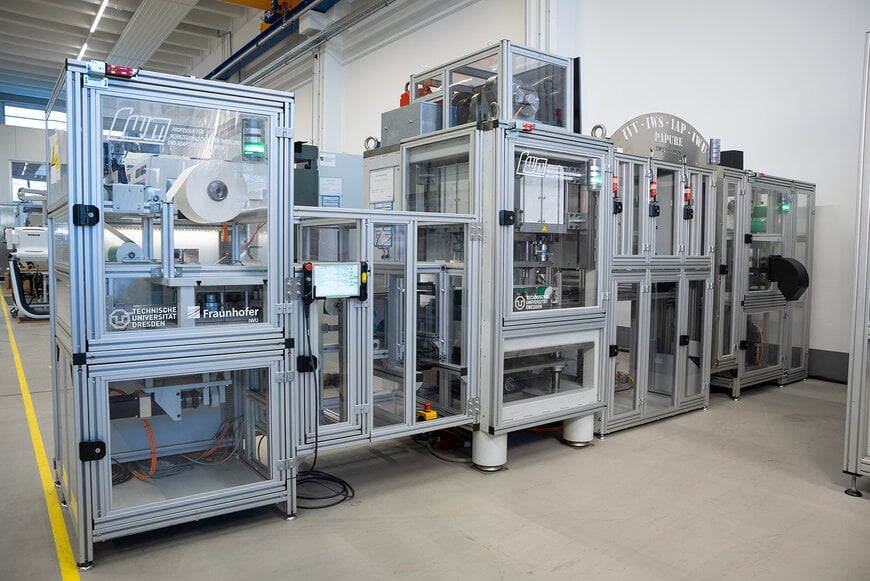
To demonstrate scalability, Fraunhofer IWU is constructing a modular, roll-to-roll manufacturing unit in Dresden. This six-meter-long pilot plant integrates a laser module and a sealing-punching tool to produce four-sided flat bags at a target rate of ten units per minute.
Similar to how an automotive data ecosystem relies on standardized communication between components, this pilot plant utilizes a digital twin and industrial sensors to monitor moisture and surface quality in real-time. This data-driven approach allows for the automated adjustment of laser intensity and sealing parameters to compensate for material variations.
Future Implementation and Standardization
The modular design of the PAPURE system allows for the retrofitting of existing packaging lines. The technology is scheduled for a technical demonstration at the Interpack trade show in Düsseldorf, Germany, from May 7 to 13, 2026. Hosted at the VDMA Technology Lounge, the presentation will focus on the integration of laser modules into high-speed mechanical engineering environments for the packaging and food industries.
www.fraunhofer.de
