
www.foodpackautomation.com
17
'26
Written on Modified on
Gallus advances industrial digital label production
New hybrid press installation shows how converters are scaling flexible packaging workflows while reducing setup time and material waste.
www.gallus-group.com
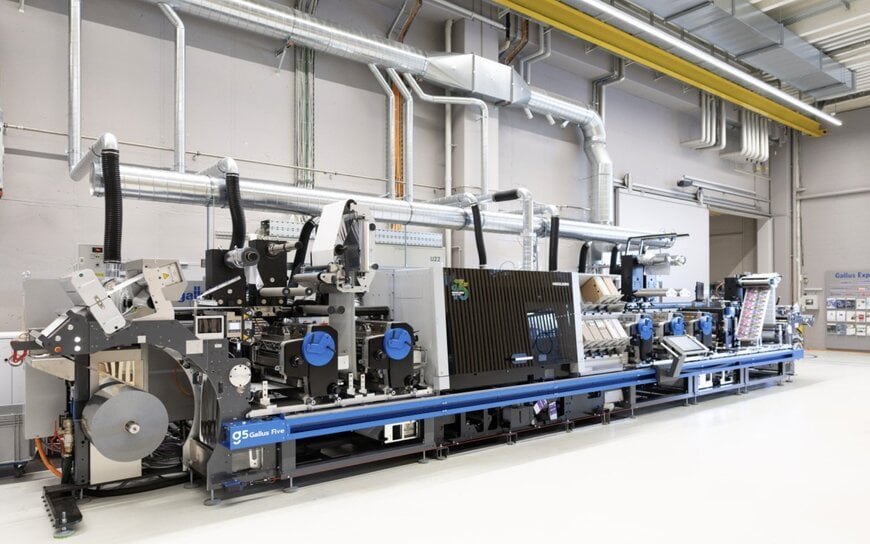
Hybrid digital printing systems are increasingly used in label converting to balance production flexibility with the throughput requirements of industrial packaging applications. In this context, Gallus Group installed its Gallus Five hybrid press at Italian label manufacturer Artes Etichette to expand digital production capacity.
Scaling digital label production for packaging markets
Operating in the label printing sector for industries such as food packaging, chemicals, cosmetics, pharmaceuticals, and durable goods, Italian converter Artes Etichette sought to expand its digital production capacity to address growing demand for shorter lead times, higher product variation, and consistent print quality.
The company aimed to transition part of its conventional printing workload toward digital production to reduce setup times, limit material waste, and improve production flexibility. Maintaining premium label quality while increasing productivity was identified as a key requirement, particularly in food label applications where visual consistency and regulatory compliance are critical.
To support this transition, Artes Etichette selected the Gallus Five hybrid press, developed by Gallus Group, a subsidiary of Heidelberger Druckmaschinen AG (HEIDELBERG). The system combines digital and conventional printing processes, allowing the company to move toward more scalable digital production while maintaining compatibility with existing production workflows.
Hybrid press supports industrial-scale digital workflows
Installed in December 2025, the Gallus Five entered production within weeks and reached full industrial utilization at the beginning of 2026. The system operates two shifts per day, corresponding to approximately 15 hours of daily production.
The press routinely handles jobs of around 10,000 linear meters and has demonstrated production runs of up to 60,000 linear meters. These figures position the installation as part of Artes’ strategy to move digital printing from short-run applications into industrial-scale production.
Operating speeds of up to 100 meters per minute allow the system to support higher throughput requirements while maintaining colour consistency and registration accuracy. Reduced make-ready times also enable faster job changeovers compared with conventional printing processes.
Reducing setup time and material waste
A key technical factor in the investment was the ability of digital printing technology to reduce preparation time and consumable waste. Compared with conventional processes requiring multiple colour stations and setup adjustments, digital workflows allow faster job start-up and fewer material losses during calibration.
The Gallus Five incorporates the HEIDELBERG Saphira® UV05 ink set, which uses a high-pigmentation formulation designed to reduce ink consumption and contribute to lower total cost of ownership. The system also minimizes ink leftovers and start-up waste, supporting more efficient raw material use within label production processes.
The ability to begin complex print jobs in approximately 30 minutes, compared with several hours previously required for setup, allows the company to respond more quickly to urgent orders while maintaining quality requirements.
The modular design of the Gallus Five, based on the Gallus System to Compose platform concept, also allows production configurations to be adapted as application requirements evolve. This supports future scalability while allowing integration with existing production infrastructure.
Supporting flexibility in a changing label market
The installation reflects broader changes in the label and packaging sector, where increasing product variation and shorter product lifecycles require more flexible production methods. Hybrid digital printing platforms are increasingly used to support these requirements while maintaining the productivity levels associated with conventional printing technologies.
Through the deployment of the Gallus Five, Artes Etichette expanded its ability to handle both high-volume and time-critical jobs within a more flexible digital production environment, supporting its transition toward industrial-scale digital label manufacturing.
Edited by industrial journalist, Aishwarya Mambet, with AI-assistance.
www.gallus-group.com
