
www.foodpackautomation.com
20
'26
Written on Modified on
Modular Fermentation Systems for Industrial Scale Alternative Protein Production
Alfa Laval has introduced a modular fermentation system designed to accelerate the transition to next-generation proteins through optimized thermal management and scalable architecture.
www.alfalaval.com
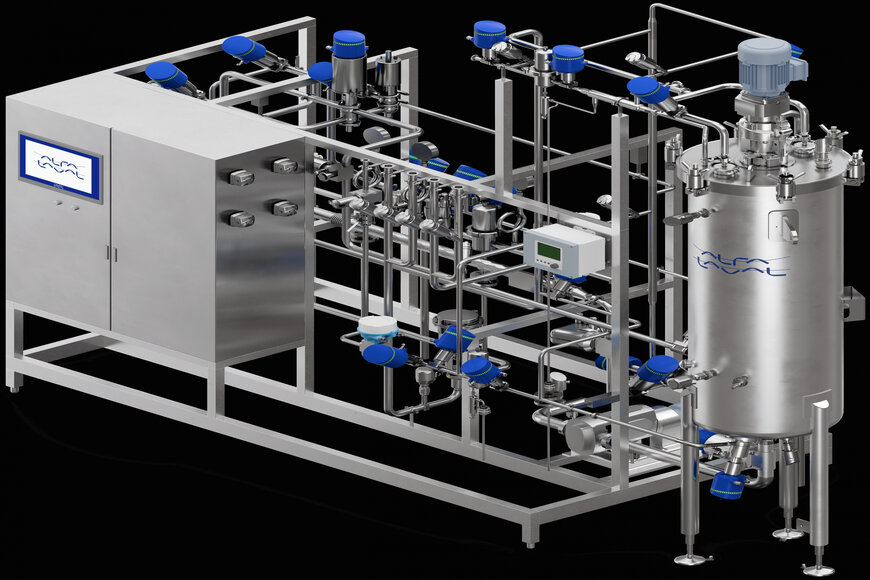
The Alfa Laval Fermentation System is a modular hardware solution designed to facilitate the commercial-scale production of alternative proteins by addressing the cooling and scalability limitations of traditional bioreactor designs. This technology is relevant for the global food and beverage industry, specifically for companies utilizing precision fermentation or biomass fermentation to create sustainable ingredients.
Enhanced Thermal Management and Process Control
As fermentation processes scale up, managing metabolic heat becomes a primary technical constraint. Conventional jacketed or internal coil-cooled fermenters often lack the surface-area-to-volume ratio necessary to dissipate heat effectively in large-scale vessels. The Alfa Laval system replaces these traditional methods with an external heat-exchange loop.
By circulating the fermentation broth through an external plate heat exchanger, the system achieves higher cooling efficiency and more precise temperature control. This mechanism ensures consistent product quality and eliminates the need for energy-intensive cooling jackets or internal coils that can interfere with mixing and complicate cleaning-in-place (CIP) procedures. This advancement is a critical component of a robust digital supply chain for food, as it ensures process repeatability and data-backed quality assurance at high volumes.
Modular Infrastructure and Retrofit Capabilities
The system is built on a modular framework where primary components — including heat exchangers, control panels, and valve manifolds—are pre-assembled on a single skid. This design philosophy reduces engineering complexity and shortens commissioning timelines compared to site-built infrastructure.
For producers with existing assets, the technology supports a retrofit model. Rather than replacing entire tank installations, operators can integrate the external cooling loop and modular controls into existing vessels to achieve commercial-scale performance. This approach minimizes capital expenditure and reduces the technical risk associated with expanding production capacity.
Integration within the Food Production Ecosystem
The fermentation system is designed to operate as part of a broader automotive data ecosystem of food processing, integrating with separation and heat transfer technologies to create end-to-end production lines. Hans Christian Ebbe, Global Sales for Agro & Protein Systems at Alfa Laval, noted that the system enables the production of high-quality ingredients using fewer resources through increased process efficiency.
From a technical positioning standpoint, Joosep Masik, Process Engineer at Alfa Laval, stated that transitioning from pilot to industrial scale requires high levels of reliability and flexibility. The modular nature of the system allows for incremental capacity expansion, providing a standardized platform that supports the entire lifecycle of protein production from initial development to full-scale manufacturing.
Edited by Evgeny Churilov, Induportals Media - Adapted by AI.
www.alfalaval.com
