
www.foodpackautomation.com
08
'26
Written on Modified on
Vision Automation Advances Packaging Flexibility
ABB’s B&R division introduced new mechatronics and machine vision technologies at Interpack 2026 to support flexible, simulation-driven packaging production and printing automation.
www.br-automation.com
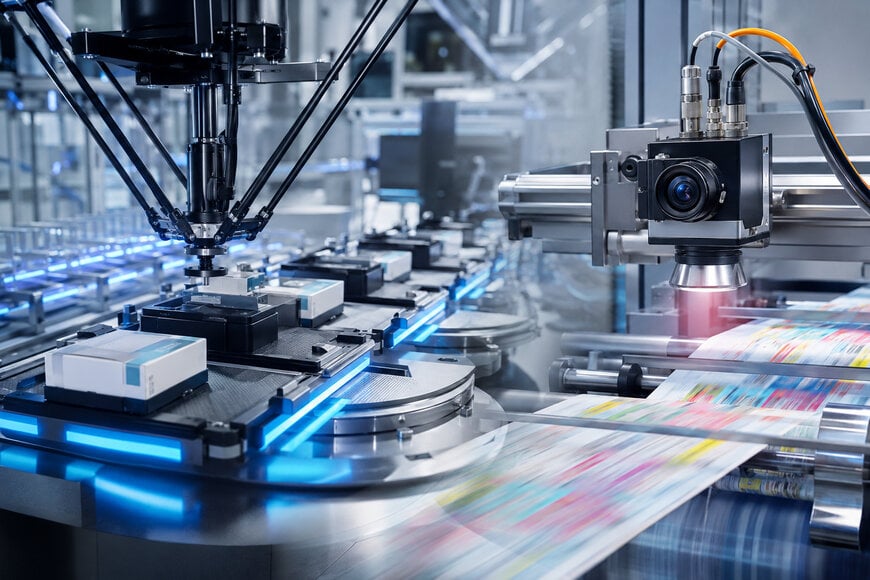
Packaging manufacturers are facing increasing pressure from shorter product lifecycles, higher product variation and stricter production efficiency targets. At the Interpack 2026 (7–13 May 2026 ) trade fair, held in Düsseldorf, Germany, ABB’s Machine Automation division presented new B&R-based automation technologies intended to improve adaptability and reduce engineering complexity in packaging and printing operations.
Simulation-Driven Transport Systems
One of the central developments presented was the expansion of the ACOPOS 6D planar transport platform with the introduction of ACOPOS 6D Hybrid and the ACOPOS 6D LaunchPad software environment. The system combines magnetically levitated shuttle transport with conventional conveyor technologies, robots and manipulators within a unified control architecture.
The hybrid approach allows manufacturers to reserve high-precision levitating transport for critical process stages while using conventional motion systems for less demanding operations. This configuration is intended to reduce infrastructure costs while maintaining flexibility in complex packaging environments.
ACOPOS 6D LaunchPad adds simulation-based engineering capabilities to the transport platform. Machine layouts, shuttle movement paths and process sequences can be configured and validated virtually before physical hardware installation. According to B&R, the “Configure and Run” workflow transfers validated simulation parameters directly to production hardware, reducing commissioning effort and limiting late-stage engineering modifications.
The technology is designed for packaging applications requiring modular expansion, rapid product changeovers and scalable digital supply chain integration. Typical use cases include high-mix consumer packaged goods production, pharmaceutical packaging and customized labeling operations.
Integrated Vision for High-Speed Printing
B&R also introduced a new Color Camera system for packaging and printing applications. The machine vision solution is designed for inline process correction at production speeds of up to 500 m/min.
Integrated directly into the machine control loop, the camera system enables real-time print monitoring and correction using deterministic synchronization between motion, vision and control systems. B&R stated that the platform operates with microsecond-level synchronization, enabling in-cycle adjustments during active production rather than post-process inspection.
The system targets packaging applications involving frequent artwork changes and difficult substrate conditions, including glossy, transparent and multicolored materials. Adaptive algorithms such as automatic exposure adjustment continuously compensate for changing production conditions without manual recalibration.
Unlike standalone machine vision systems that operate independently from motion control, the B&R platform integrates vision processing and machine automation within a unified engineering environment. The same hardware and software architecture supports both monochrome and color inspection tasks, which can simplify machine configuration and reduce commissioning time.
The integrated approach is intended to improve overall equipment effectiveness while reducing substrate waste through earlier defect correction. Applications include label printing, flexible packaging production and high-speed consumer goods packaging lines within the broader automotive data ecosystem and industrial packaging sectors.
Packaging Automation for High-Variant Production
According to Lazaros Patsakas, Global Industry Segment Manager CPG at B&R, the technologies were developed to address increasing demand for rapid production turnovers, greater product customization and higher productivity requirements in packaging operations.
The solutions presented at Interpack reflect a broader industry trend toward autonomous and simulation-assisted machine automation, where virtual engineering, adaptive vision systems and modular transport architectures are increasingly combined to support flexible manufacturing environments.
Edited by an industrial journalist Sucithra Mani with AI assistance.
www.br-automation.com
