
www.foodpackautomation.com
15
'26
Written on Modified on
Next-generation rotating retractors clean hard-to-reach areas in processing lines
Alfa Laval’s new Controlled Rotating Retractors improve cleaning of hard-to-reach surfaces in hygienic spray-drying applications, reducing contamination risks, product loss, and downtime.
www.alfalaval.com
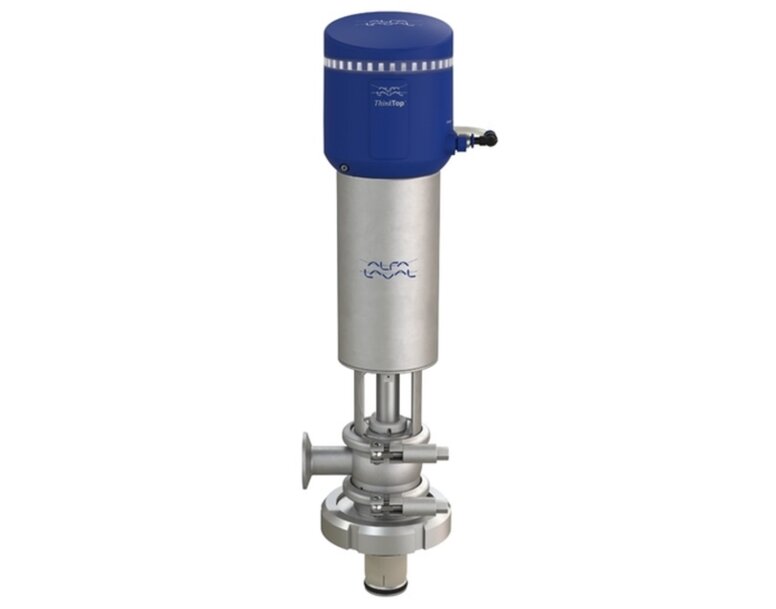
Alfa Laval has introduced its Controlled Rotating Retractors, a line of retractable Clean-in-Place (CIP) cleaning devices engineered to remove residues and contaminants from ducts, pipes, tanks, and enclosed areas. The high-performance devices are developed for spray-drying systems and powder production plants across the dairy, food, beverage, pharmaceutical, and biotechnology industries.
Operational Efficiency and Fluid Optimization
In hygienic processing lines, the accumulation of residues on hard-to-reach surfaces presents significant contamination risks, product loss, and operational downtime. The Controlled Rotating Retractors expand the company's tank cleaning portfolio, delivering up to twice the cleaning efficiency of traditional static spray ball installations.
By utilizing extended jet impact mechanics, the rotating nozzles reach challenging shadow zones while reducing water and cleaning media consumption by up to 55%. This extended reach allows a smaller number of total units to cover a larger overall surface area, lowering initial capital expenditure (CAPEX) and ongoing operating costs (OPEX).
Control Integration and Pneumatic Actuation
The retractable cleaning systems are engineered to integrate directly with the Alfa Laval ThinkTop® V70 sensing and control unit. This automation linkage provides real-time position monitoring and cleaning performance validation, ensuring process control, minimizing line downtime, and improving workplace safety by removing manual verification steps.
The units utilize a specialized hygienic design to preserve product integrity during active processing:
- Production Phase: The rotating cleaner head remains retracted, completely sealed, and flush with the vessel wall, preventing contact with the product flow area and eliminating dead legs where bacteria could breed.
- Cleaning Phase: Pneumatic or hydraulic pressure actuates the mechanism, extending the cleaner head into the vessel volume to deliver full coverage of all product-contact surfaces.
- Post-Cleaning Phase: Upon completion of the CIP cycle, the head automatically retracts back into its isolated housing, leaving the duct, pipe, or tank ready for immediate production.
Maintenance and Regulatory Compliance
To simplify mechanical maintenance in hard-to-reach or elevated processing installations, the devices are designed for tool-free or single-handed servicing. This allows operators to remove internal wear parts without detaching the main media supply tube, keeping the retractor body securely connected to the pipework during service procedures.
The product line supports Good Manufacturing Practices (GMP) and complies with FDA, EU, and China hygienic regulations. For high-purity pharmaceutical and biotechnology applications, the company offers the specialized Controlled Rotating Retractor UltraPure version. This variant includes the comprehensive Alfa Laval Q-doc documentation package, which provides material traceability for all product-contact parts, including conformity declarations, material certificates, and test data to support qualification and validation protocols.
Additional Context
This section details technical specifications not included in the original news release.
Automated Clean-in-Place (CIP) fluid dynamics depend on balancing four core variables defined by Sinner’s Circle: mechanical action, chemical concentration, temperature, and contact time. Traditional static spray balls rely entirely on a cascading film of water to dissolve residues, which provides minimal mechanical shear stress and requires high volumetric flow rates to wet the vertical walls of a vessel. Controlled rotating retractors alter this dynamic by replacing the static distribution holes with targeted, high-impact fluid jets driven by a rotating nozzle head. The internal turbine or gear mechanism is propelled directly by the pressurized flow of the incoming cleaning solution, ensuring a constant, regulated rotational velocity that delivers high kinetic energy impacts to break down stubborn powder crusts and organic soils.
The physical integration of a retractable nozzle within a sanitary vessel wall requires precise mechanical design to satisfy stringent aseptic criteria. Static pockets or crevices where the product can accumulate out of reach of the fluid stream can lead to biological biofilms. To eliminate this risk, the retractor housing utilizes specialized internal self-cleaning channels. When the cleaning head extends, a calibrated portion of the CIP fluid is automatically directed backward into the spring chamber and around the sliding piston shaft. This internal bypass flow continuously flushes the seals, o-rings, and guide sleeves during the active cycle, preventing cross-contamination and satisfying the strict cleanability criteria mandated by international hygienic standards like EHEDG and 3-A.
Edited by Romila DSilva, Induportals Editor, with AI assistance.
To simplify mechanical maintenance in hard-to-reach or elevated processing installations, the devices are designed for tool-free or single-handed servicing. This allows operators to remove internal wear parts without detaching the main media supply tube, keeping the retractor body securely connected to the pipework during service procedures.
The product line supports Good Manufacturing Practices (GMP) and complies with FDA, EU, and China hygienic regulations. For high-purity pharmaceutical and biotechnology applications, the company offers the specialized Controlled Rotating Retractor UltraPure version. This variant includes the comprehensive Alfa Laval Q-doc documentation package, which provides material traceability for all product-contact parts, including conformity declarations, material certificates, and test data to support qualification and validation protocols.
Additional Context
This section details technical specifications not included in the original news release.
Automated Clean-in-Place (CIP) fluid dynamics depend on balancing four core variables defined by Sinner’s Circle: mechanical action, chemical concentration, temperature, and contact time. Traditional static spray balls rely entirely on a cascading film of water to dissolve residues, which provides minimal mechanical shear stress and requires high volumetric flow rates to wet the vertical walls of a vessel. Controlled rotating retractors alter this dynamic by replacing the static distribution holes with targeted, high-impact fluid jets driven by a rotating nozzle head. The internal turbine or gear mechanism is propelled directly by the pressurized flow of the incoming cleaning solution, ensuring a constant, regulated rotational velocity that delivers high kinetic energy impacts to break down stubborn powder crusts and organic soils.
The physical integration of a retractable nozzle within a sanitary vessel wall requires precise mechanical design to satisfy stringent aseptic criteria. Static pockets or crevices where the product can accumulate out of reach of the fluid stream can lead to biological biofilms. To eliminate this risk, the retractor housing utilizes specialized internal self-cleaning channels. When the cleaning head extends, a calibrated portion of the CIP fluid is automatically directed backward into the spring chamber and around the sliding piston shaft. This internal bypass flow continuously flushes the seals, o-rings, and guide sleeves during the active cycle, preventing cross-contamination and satisfying the strict cleanability criteria mandated by international hygienic standards like EHEDG and 3-A.
Edited by Romila DSilva, Induportals Editor, with AI assistance.
