
www.foodpackautomation.com
24
'26
Written on Modified on
Industrial Bioreactor for Scalable Fermentation Processes
Tetra Pak deploys its first bioreactor following the acquisition of Bioreactors.net to optimize the industrial production of food ingredients.
www.tetrapak.com
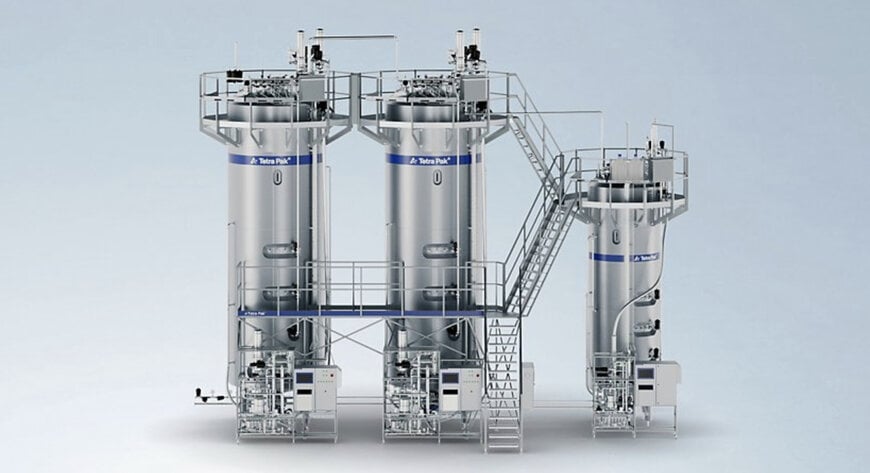
Food processing company Tetra Pak is integrating large-scale fermentation technology with the launch of the Tetra Pak Bioreactor RF. This technical solution, developed following the acquisition and integration of Bioreactors.net, is designed for the food industry to produce novel foods and ingredients through the action of microorganisms.
Industrial Context and Technical Cooperation
The food processing sector faces the technical challenge of scaling fermentation processes from initial pilot testing to industrial production levels without increasing system variability or operational burden. To address this structural need for ingredient diversification and resource efficiency, Tetra Pak consolidated its technological offering by integrating the fermentation expertise of Bioreactors.net. This operational consolidation provides manufacturers with the ability to maintain consistent yields and stable physical conditions during large-scale operations.
Technical Solution and Components
The Tetra Pak Bioreactor RF operates as a fermentation vessel equipped with a patented magnetic agitation system. This mechanism eliminates the need for mechanical seals, directly mitigating the risk of contamination and operational instability found in conventional designs. The system is structured to maintain power and oxygen transfer across its entire capacity range, which spans from 10 to 50,000 liters. The technical architecture utilizes a uniform design platform and control logic, operating with a high level of automation and self-adjusting control functions that stabilize parameters without the need for continuous manual intervention.
Deployment and Implementation
The implementation of the bioreactor is carried out using pre-assembled and factory-tested units, which accelerates physical installation in processing plants and reduces disruptions to overall production planning. The integrated platform eliminates the need for independent support structures, facilitating direct deployment into existing industrial infrastructures. Its modular configuration allows for the technical adaptation of alarm thresholds, impellers, and other parameters as a plant's production capacities evolve, without adding systemic complexity.
Applications and Technical Use Cases
Primary applications target industrial processing facilities for novel foods, where yeasts, bacteria, and fungi transform raw materials into commercially valuable ingredients. Technical use cases encompass integrated data monitoring and the execution of predefined operational strategies, from the pilot validation phase to mass manufacturing. The uniformity of the control environment simplifies daily operations and the technical training of operators across different plants and production scales.
Quantifiable Impacts on Infrastructure
The platform's integrated design eliminates the need for secondary structures, reducing initial investment costs by up to 8 percent compared to conventional industrial vessels. Simultaneously, the mitigation of contamination risks through magnetic agitation prevents the loss of production batches, which hold a market value of around 1,000 euros per cubic meter. Overall, automation, reduced contamination risk, and production process stability allow manufacturers to decrease their total operational costs by up to 12 percent.
Edited by Maria Brueva, Editor at Induportals – adapted by AI.
www.tetrapak.com
