
www.foodpackautomation.com
03
'26
Written on Modified on
GEA Expands Process Test Center for Separation Technology
The Oelde facility expansion will increase capacity for complex pilot tests and customized process development by late 2026.
www.gea.com
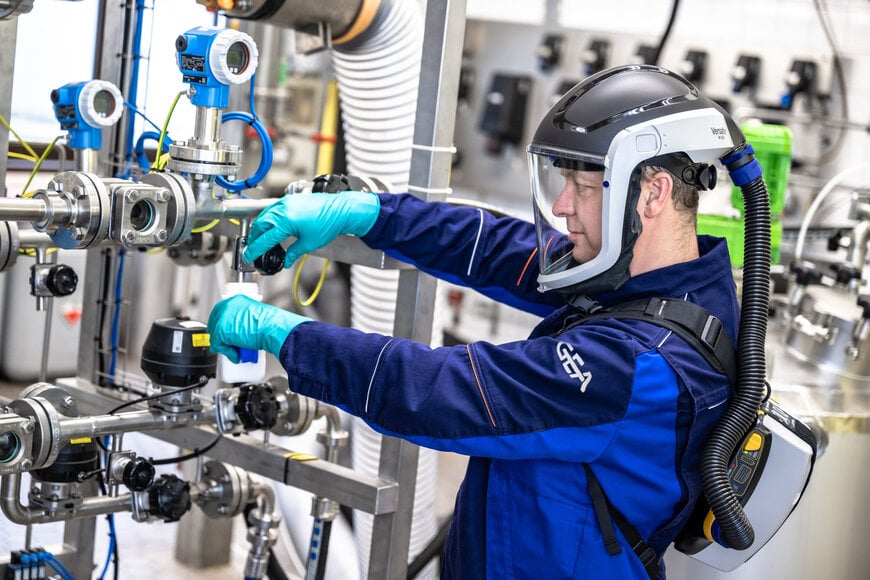
GEA has announced a significant investment to expand its Process Test Center (PTC) for mechanical separation technology at its headquarters in Oelde, Germany. Scheduled for completion by the end of 2026, the project will add a third test room, bringing the facility's total footprint to 3,500 square meters. This expansion will provide critical additional capacity to conduct complex pilot tests capable of handling raw material or media inputs of up to 5,000 liters per hour. The upgraded infrastructure is designed to accommodate larger disk stack and decanter centrifuges, alongside advanced, near-industrial scale skid solutions.
Driven by growing industrial demand, the PTC currently evaluates approximately 800 product samples annually across the chemical, pharmaceutical, renewable energy, and food processing sectors. The facility houses over 120 test machines, including an ATEX-certified room for safely handling potentially explosive atmospheres. By testing applications under real-world conditions, GEA enables manufacturers to determine optimal process parameters, validate product consistency, and safely scale operations. Aligning with internal sustainability goals, the newly modernized facility will also integrate a dedicated wastewater treatment system and a commercial GEA heat pump to ensure resource-efficient operation.
Additional Context
This section provides technological and market background not explicitly detailed in the original release.
In process engineering, scaling mechanical separation from a laboratory environment to full industrial production carries significant financial and operational risk. The complex fluid dynamics within disk stack and decanter centrifuges are highly sensitive to minor variations in feedstock viscosity, particle size distribution, and temperature. As manufacturing sectors increasingly transition toward sustainable or bio-based raw materials—such as plant-based proteins, alternative dairy, or advanced biofuels—the rheological properties of these new inputs are often highly unpredictable compared to standardized petrochemicals. By utilizing a high-capacity pilot facility, plant operators can physically validate yield, purity, and phase-separation efficiency under intense, real-world G-forces. This empirical data is critical during the front-end engineering design (FEED) phase, allowing engineers to accurately size equipment, optimize energy consumption, and avoid costly process retrofits after plant commissioning.
Edited by Lekshman Ramdas, Induportals editor – adapted by AI.
www.gea.com
