
www.foodpackautomation.com
30
'26
Written on Modified on
Automatic Milking Systems Dairy Automation Engineering
GEA Introduces DairyRobot R9500 to Address Udder Morphology and Multisite Herd Management Challenges in Commercial Dairy Production.
www.gea.com
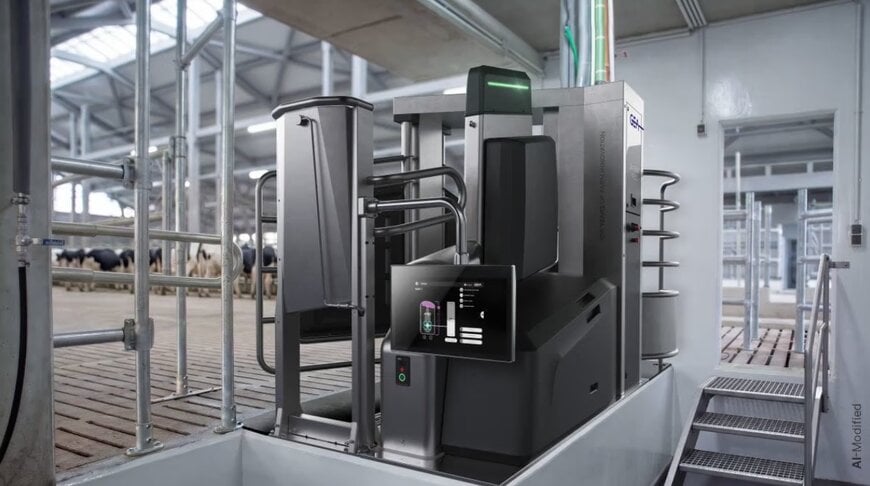
Commercial dairy operations face increasing pressure to balance rising labor costs, evolving animal genetics, and multisite herd logistics with consistent milk extraction efficiency. In high-throughput livestock environments, automated milking technology must accommodate wider variances in animal anatomy while integrating diagnostic telemetry into farm-wide control systems.
Milking Automation and Morphological Adaptation
Automated milking robots rely on guided attachment mechanisms that locate teats and attach milking clusters autonomously. Modern dairy breeding has progressively selected for larger frame sizes and higher-set udder placements, particularly in primiparous heifers and high-yielding dairy cows. When anatomical dimensions exceed standard mechanical reach thresholds, automated attachment success rates decline, requiring manual operator intervention.
GEA addressed these operational parameters with the DairyRobot R9500 100 Years Edition, introduced at EuroTier 2026 (November 10 to 13, Hanover, Hall 13, booth C25). The system features an optional High Udder Attachment Kit engineered exclusively for new installations to expand the operational envelope of the attachment arm, facilitating reliable teat cup engagement on cows with high udder suspensions.
Operational Ergonomics and Human-Machine Interface Upgrades
To reduce maintenance downtime and improve operator monitoring in the barn, the robot integrates the company's Kinetic Edge industrial design. Mechanical contours are rounded to streamline washdown, and access pathways to internal service modules have been widened for maintenance technicians.
The terminal uses an 18.5-inch control screen configured in a 16:9 aspect ratio with Full HD resolution to display operational telemetry and diagnostic alarms. Above the milking stall, a tricolor visual status array provides remote visibility across the facility: green signals routine milking cycles, blue designates automated system sanitization and rinsing phases, and red indicates an alarm state requiring operator assistance.
Software Architecture and Milking Process Stabilization
The platform runs the AMS Software 2.0 package, which controls cluster detachment thresholds, pulsation rates, and animal interaction sequencing to achieve a more uniform milk flow profile. The software interfaces directly with the GEA DairyNet cloud architecture, supporting several automated analytics modules:
The Multifarm Management Module handles distributed herd tracking for multi-facility operations where animals transition between calf-rearing sites, breeding barns, and active production facilities. Communication protocols route animal performance metrics, health indices, and historical yield data between decentralized DairyNet field boxes via secure cloud infrastructure, removing the requirement for manual CSV or batch file transfers.
CattleEye integrates automated computer vision into the system. Overhead optical cameras capture cow locomotion and physical morphology as animals enter and exit the station. An integrated machine-learning algorithm evaluates gait dynamics to flag early-stage lameness and calculates deviations in Body Condition Score, alerting herd managers before clinical symptoms compromise production.
AutoDry manages the physiological cessation of lactation. The algorithmic control sequence calculates decreasing extraction targets based on lactation curve data and automatically triggers earlier cup detachment, decreasing daily production gently before dry-off.
Initial commercial deliveries of the DairyRobot R9500 in the updated design are scheduled for late March 2027, with on-farm site installations commencing in April and May 2027.
Additional Context
This section details technical specifications and competitive benchmarking not included in the original product announcement.
Automatic milking systems operate within rigorous international standards, including ISO 5707 (Milking machine installations — Construction and performance) and ISO 12187 (Milking machines — Vocabulary and technical specifications), which define vacuum stability, pulsation ratios, and sanitary wash cycle requirements.
In commercial dairy engineering, AMS platforms generally split between single-stall box robots (such as the GEA DairyRobot R9500 and the Lely Astronaut A5) and multi-stall or robotic rotary platforms (such as the DeLaval VMS series and GEA DairyProQ). Benchmarking attachment kinematics across these platforms focuses on initial cluster attachment time, cluster reattachment frequency, and coordinate tracking methods. While earlier-generation robotic milkers utilized optical laser sensors mounted directly to the teat cup carrier, modern platforms utilize three-dimensional time-of-flight cameras and computer vision to accelerate coordinates acquisition.
Lely Astronaut A5 systems employ a hybrid robotic arm that tracks cow movement beneath the animal using multi-axis spatial modeling, whereas GEA utilizes a mechanical arm guided into the milking stall from the side, parking clear of the stall footprint between milkings to minimize physical contamination from manure. Incorporating dedicated morphology adaptation kits and distributed cloud data synchronizers reflects an industry-wide transition toward continuous optical welfare monitoring and standardized multisite herd analytics.
Edited by Evgeny Churilov, Induportals Media - Adapted by AI.
www.gea.com
