
www.foodpackautomation.com
09
'26
Written on Modified on
How J.L. Clark Uses 3D Printing to Accelerate Packaging Prototyping
J.L. Clark uses Stratasys PolyJet 3D printing to produce functional packaging prototypes and simplify design iterations.
www.stratasys.com
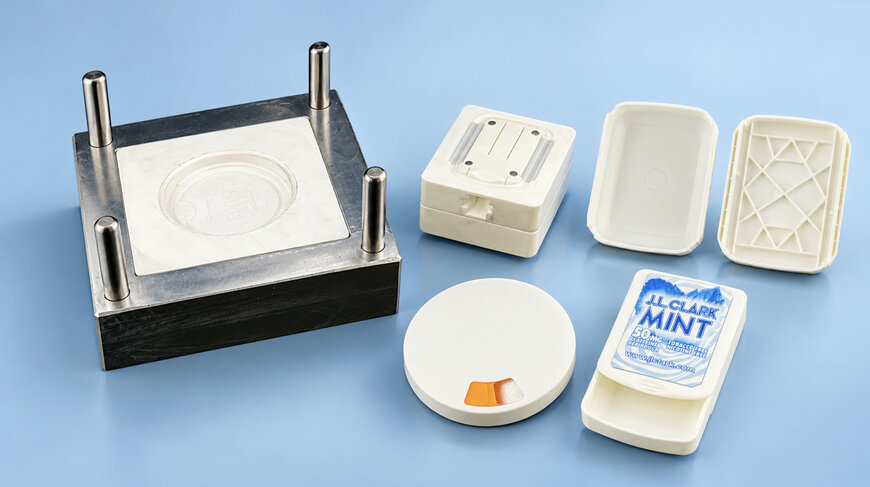
Founded in 1904, J.L. Clark manufactures packaging for consumer markets including confectionery, health and beauty, spices, smokeless tobacco, and wine and spirits. Its packaging engineering team works with customers to develop and evaluate new packaging concepts before they enter production.
Traditionally, creating prototypes required prototype injection molds, which involved significant costs and long lead times. Design revisions added further expense because changes could require additional tooling work. These constraints made it more difficult to evaluate multiple concepts and incorporate customer feedback quickly.
Reproducing the physical features of production packaging presented another challenge. Many of J.L. Clark's designs use injection-molded polypropylene and incorporate thin walls, snap-fit closures, and living hinges. These features need to function correctly in a prototype, making material selection and dimensional accuracy important considerations. The team also needed prototypes that closely resembled the appearance and feel of the intended production parts.
Using PolyJet Technology to Produce Functional Prototypes
To address these requirements, J.L. Clark adopted Stratasys PolyJet additive manufacturing technology with PolyJet ToughONE material. The combination enables the engineering team to produce detailed prototypes with thin walls, durable snap fits, living hinges, and full-color graphics.
Unlike the previous approach, which required prototype injection molds, 3D printing allows the team to produce physical samples directly from digital designs. Engineers can evaluate packaging concepts, make revisions, and prepare updated prototypes without repeating the same tooling process for every design change.
PolyJet ToughONE provides improved durability for thin walls and snap-fit features compared with previous PolyJet materials. Its appearance and feel also more closely resemble molded polypropylene, helping J.L. Clark create prototypes that provide customers with a more realistic representation of the final packaging.
The technology also allows customer artwork and branding to be incorporated directly into printed samples. This helps customers assess not only the packaging's physical design but also its visual presentation before committing to production tooling.
Extending 3D Printing to Manufacturing Support
J.L. Clark's use of additive manufacturing extends beyond packaging development. The engineering team also reverse engineers components from production equipment and manufactures replacement parts in-house.
This capability helps the company respond to equipment maintenance needs while avoiding some of the delays associated with sourcing replacement components. As a result, 3D printing serves both as a prototyping method and as an additional resource for addressing manufacturing challenges.
Improving Design Iteration and Engineering Flexibility
By eliminating the need for prototype injection molds, J.L. Clark can prepare customer samples more quickly and begin design evaluations earlier in the development process. Engineers can refine packaging concepts and respond to feedback without waiting for new prototype tooling, supporting a more flexible development workflow.
The ability to reproduce thin walls, snap fits, and living hinges also enables the team to evaluate packaging features that are difficult to represent with simple visual models. Combined with the inclusion of customer-specific graphics, these prototypes provide a more realistic basis for reviewing designs before production begins.
Beyond prototyping, the ability to manufacture replacement equipment components in-house gives the engineering team another option for responding to operational requirements.
J.L. Clark's experience demonstrates how additive manufacturing can support packaging engineering at multiple stages, from early design evaluation to manufacturing maintenance. By integrating Stratasys PolyJet technology into its workflow, the company has reduced its reliance on prototype injection molds and expanded the role of 3D printing in its engineering operations.
Edited by Sucithra Mani, Induportals editor – adapted by AI.
www.stratasys.com
