
www.foodpackautomation.com
14
'26
Written on Modified on
Hygienic Rotary Lobe Pump Fluid Handling Solutions
Alfa Laval introduced MaxiLobe and MaxiLobe UltraPure pumps to improve volumetric efficiency, reduce shear stress, and simplify sanitary processing maintenance.
www.alfalaval.com
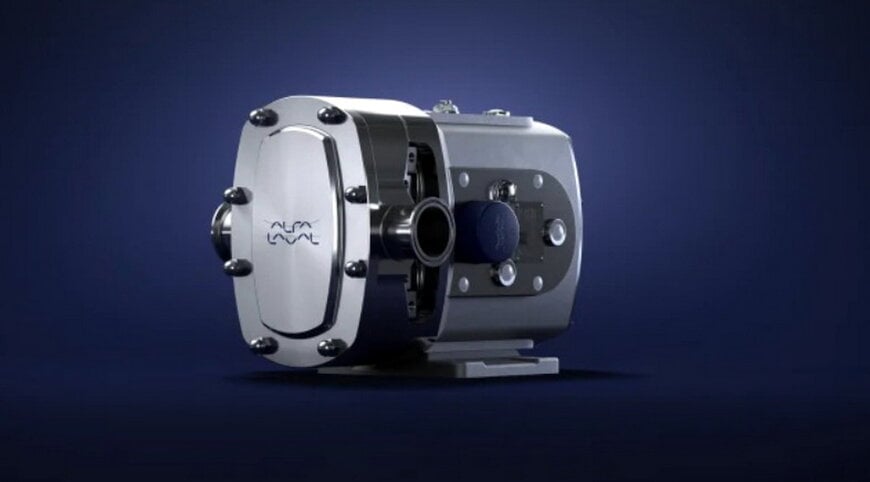
Industrial fluids in dairy, food, beverage, personal care, and pharmaceutical manufacturing present complex rheological challenges that frequently strain conventional fluid handling systems. Processing shear-sensitive emulsions, high-viscosity pastes, and fragile cellular suspensions requires positive displacement equipment capable of maintaining continuous displacement rates without causing mechanical degradation, excessive heat generation, or contamination risks.
Hygienic Processing Challenges and Operating Constraints
Positive displacement pumps deployed in sanitary process lines must balance volumetric throughput against product integrity. In high-viscosity applications, traditional rotary lobe designs often require elevated rotational speeds to overcome internal fluid slip, especially when operating against higher system backpressures.
Operating at higher shaft speeds increases fluid shear rates proportionally. For delicate biological matrices, dairy proteins, and pharmaceutical intermediates, excessive shear forces can lead to product separation, protein denaturation, or emulsion breakdown. Furthermore, elevated rotational velocities accelerate mechanical seal wear, increase thermal expansion risks across rotating assemblies, and drive up operational power consumption.
Fluid Displacement Mechanisms and Volumetric Efficiency
Alfa Laval MaxiLobe and MaxiLobe UltraPure rotary lobe pumps are engineered to address these fluid dynamics constraints by expanding the operational envelope and increasing volumetric efficiency. By optimizing the rotor geometry and internal tolerances between lobes and the pump casing, the design reduces internal slip across a broader pressure range.
This fluidic control allows operators to select smaller displacement pumps to satisfy identical process duties. Running at lower rotational speeds while maintaining required volumetric flow rates decreases fluid velocity gradients across the pump head. According to manufacturer specifications, running at reduced speeds can yield energy reductions exceeding 25% compared to less efficient setups, while mitigating shear stress on fragile media and reducing mechanical strain on bearings and seals.
Under defined operating conditions, the MaxiLobe delivers at least a 5% higher flow rate than equivalent previous-generation Alfa Laval SRU units. To minimize retrofit overhead in brownfield facilities, key porting dimensions match those of legacy Alfa Laval SRU models and most SX and SX UltraPure pumps, allowing direct integration into existing hygienic piping runs without line modification.
Sanitary Standards and High-Purity Validation
Process contamination control demands precise design geometries that facilitate complete Clean-in-Place and Steam-in-Place cycles. The MaxiLobe series utilizes precision-profiled elastomer seals and hygienic internal surfaces certified to both EHEDG and 3-A sanitary standards, in addition to full compliance with FDA regulations.
For biopharmaceutical manufacturing, the MaxiLobe UltraPure configuration aligns with ASME BPE standards and Good Manufacturing Practice guidelines. The pump features specific surface finishes, product-wetted metallurgy, and elastomer formulations compliant with USP Class VI requirements. To facilitate regulatory qualification in validated environments, units are supplied with comprehensive Alfa Laval Q-doc packages providing full material traceability, surface finish verifications, and pre-delivery factory test certificates validating operational curves.
Mechanical Architecture and In-Line Maintenance
Minimizing process downtime during scheduled maintenance intervals remains a critical requirement in continuous processing plants. MaxiLobe units incorporate a front-loading mechanical seal arrangement that allows maintenance personnel to replace worn single seals directly from the front cover without disconnecting the pump casing from the process piping or removing the drive motor.
Interchangeable wear parts and easily accessible shimming mechanisms streamline clearance adjustments during routine overhauls. A reinforced gearbox housing supports rotor shaft alignment under sustained hydraulic loads, preventing rotor contact, mitigating vibration, and extending mean time between failures across continuous duty cycles.
Additional Context
This section details technical specifications and competitive benchmarking not included in the original product announcement.
Rotary lobe positive displacement pumps operate in the same hygienic fluid handling sector as circumferential piston pumps and twin-screw sanitary pumps. In bioprocessing and high-purity fluid transfer, competitive designs from manufacturers such as Waukesha Cherry-Burrell, Fristam, and Bornemann address overlapping hygienic applications across food, dairy, and active pharmaceutical ingredient synthesis.
Circumferential piston pumps typically offer tighter internal clearances and slightly higher pressure capabilities for ultra-low viscosity fluids, but they often present higher component wear and more demanding clearance adjustment procedures compared to rotary lobe systems. Conversely, sanitary twin-screw pumps provide dual-duty capability by handling both viscous process fluids and low-viscosity Clean-in-Place fluids at high rotational speeds, though typically at a higher initial capital investment and with longer shaft configurations requiring precise bearing support. Rotary lobe platforms like the MaxiLobe remain the standard workhorse for viscous hygienic fluid transfer due to their balanced footprint, low internal fluid velocity, robust solids-handling geometry, and predictable maintenance schedules.
Edited by Evgeny Churilov, Induportals Media - Adapted by AI.
www.alfalaval.com
