
www.foodpackautomation.com
04
'26
Written on Modified on
Semi-Automated Milking Systems for Conventional Dairy Parlors
GEA introduces the DairyProX system to automate teat preparation, milk harvesting, and sanitation routines inside existing conventional milking parlors with a subway.
www.gea.com
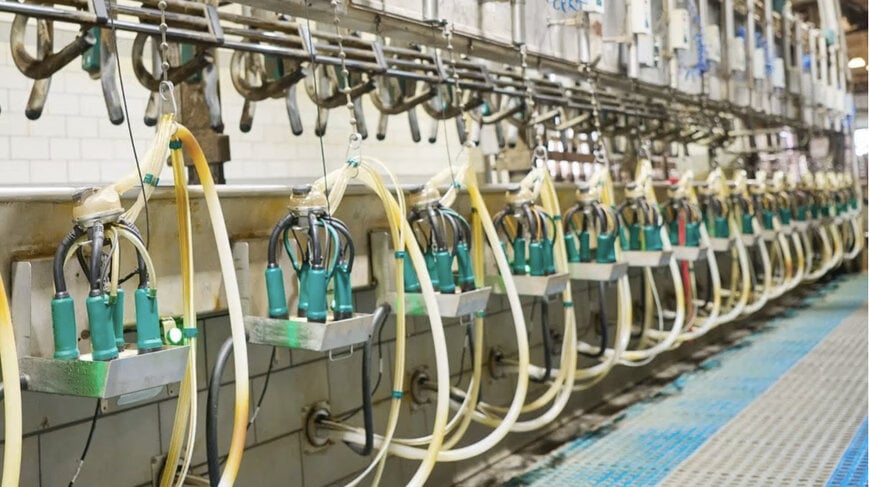
Commercial dairy operations face persistent skilled labor shortages and rising quality demands, yet replacing functional conventional milking parlors with full robotics requires prohibitive capital investment and structural modifications. To bridge the operational gap between manual batch milking and full robotic installations, GEA has engineered the DairyProX semi-automated milking system, which integrates automated in-liner teat preparation and harvesting processes directly into existing conventional milking parlors equipped with a basement or subway.
Standardizing Milking Workflows in Conventional Dairy Operations
In conventional parallel, herringbone, and rotary milking parlors, milking efficiency and udder health rely heavily on manual operator adherence to standard operating procedures. Traditional workflows require workers to manually forestrip, clean, stimulate, dry, and attach clusters, followed by manual post-milking teat disinfection. Variations in operator technique or timing between stimulation and unit attachment frequently result in bimodal milk letdown curves, extended unit-on times, teat-end hyperkeratosis, and elevated cross-contamination risks.
While fully automatic milking systems eliminate human variability through robotic arms and optical sensors, many large-scale dairy farms operate structurally sound conventional parlors with subways—enclosed service corridors located directly beneath the milking platform that house milk receivers, pulsation lines, and wash pipelines. Retrofitting these high-throughput batch facilities requires a control architecture that automates physiological cow preparation without altering the stall layout or operator pit geometry. GEA developed the DairyProX system specifically for these subway-equipped conventional parlors, first introducing the concept for the U.S. and broader North American market with plans for international expansion as regional regulatory requirements and parlor configurations are evaluated. The system will be presented at EuroTier 2026, taking place November 10 to 13 in Hanover, Germany, in Hall 13, Booth C25.
In-Liner-Everything Operating Principle and System Architecture
The core engineering mechanism behind the DairyProX system is GEA’s In-Liner-Everything technology, a multi-stage fluid and pneumatic control sequence previously deployed in the company's DairyRobot R9500 box robots and DairyProQ automated rotary systems. Rather than relying on external mechanical brushes, separate preparation cups, or manual spray applicators, the system executes the entire milking sequence within the single teat cup liner after a human operator manually attaches the milking cluster.
Once the operator attaches the teat cups and adjusts the hose support in the parlor pit, the control valves and dosing hardware located in the underlying parlor subway initiate an automated cycle. First, the liner performs mechanical and pneumatic teat stimulation alongside automated teat cleaning and pre-dipping procedures to remove surface organic matter. This controlled preparation triggers a consistent oxytocin release from the cow's pituitary gland, ensuring optimal alveolar milk ejection prior to the main vacuum phase. Following stimulation and forestripping, the system transitions directly into milk harvesting without cluster removal or air admission.
When milk flow sensors detect the completion of milking, the system executes automated post-dipping directly inside the teat cup immediately prior to automatic cluster detachment. After the unit detaches from the cow, an automated backflushing cycle sanitizes the interior of the liners and claw before the cluster is attached to the next animal, mitigating the transfer of contagious mastitis pathogens across the herd.
Operational Throughput and Udder Health Performance in Parlor Subways
By relocating the valve manifolds, fluid dosing pumps, and automated backflush controls into the parlor subway, the DairyProX architecture preserves the familiar workspace in the operator pit while shielding sensitive automation components from moisture and physical impact. Because workers only perform physical cluster attachment and hose alignment, cognitive load and physical strain per cow are substantially reduced, simplifying operator training and standardizing workflow execution across shifts.
Empirical operational data from pilot dairy farm deployments in the United States demonstrate measurable gains in both parlor productivity and biological milk quality. Pilot facilities integrating the semi-automated milking system reduced parlor labor requirements by nearly 50 percent while increasing cow throughput by more than 33 percent within the exact same parlor footprint. Furthermore, eliminating manual timing discrepancies between stimulation and milk harvest yielded shorter overall unit-on milking times. On the biological side, standardized pre-cleaning, post-dipping, and inter-cow backflushing contributed to a reduction in bulk tank somatic cell count of up to 30 percent alongside a decline in clinical mastitis incidence.
Additional Context:
This section details technical specifications and competitive benchmarking not included in the original product announcement.
In industrial dairy engineering, the mechanical construction, vacuum stability, and sanitary performance of milking installations are governed by international standards ISO 5707 (Milking machine installations — Construction and performance) and ISO 6690 (Milking machine installations Mechanical tests). Under these standards, maintaining stable claw vacuum levels (typically 38 to 42 kilopascals at the teat end during peak flow) and minimizing air admission during cluster attachment are essential to prevent liner slips and reverse pressure gradients that propel bacteria into the teat canal.
Independently sourced technical documentation from GEA indicates that the DairyProX system utilizes the Classic 300 milking cluster geometry paired with silicone or rubber liners rated for 5,000 and 2,500 milkings, respectively. The system is engineered for cross-brand compatibility in conventional parallel parlors with a subway, connecting to existing automatic cluster removers and milk metering architectures. In field benchmarks documented at a double-8 parallel parlor in the United States, the system achieved a steady throughput of more than seven parlor turns per hour.
Within the agricultural equipment sector, semi-automated conventional milking systems compete with two primary technological alternatives: standalone automated post-dipping and backflushing systems, and fully robotic milking installations. Previously, conventional parlor automation relied on systems such as the GEA Apollo MilkSystem or DeLaval automated dipping and backflushing units, which automate post-milking disinfection and inter-cow cluster sanitation—removing up to 95 percent of residual pathogens on the liner surface but still require manual pre-milking teat scrubbing, forestripping, and drying by parlor staff.
Conversely, fully automatic milking systems from manufacturers such as Lely (Astronaut series), DeLaval (VMS series), and BouMatic (Gemini series) automate both attachment and preparation, but use distinct mechanical architectures. Lely systems utilize twin counter-rotating mechanical brushes for pre-milking teat cleaning and stimulation before laser-guided cup attachment, whereas DeLaval VMS platforms employ a separate dedicated teat preparation cup prior to attaching the four milking teat cups. While full robotics eliminate attachment labor entirely, a single robotic stall typically handles 55 to 70 cows per day. By separating robotic 3D camera attachment from the fluid-handling mechanics and retaining manual attachment, the in-liner semi-automated parlor approach allows commercial dairies to apply robotic-grade physiological preparation across high-density batch parlors handling hundreds of cows per hour at a fraction of the capital and maintenance cost of multi-box or robotic rotary installations.
Edited by Sucithra Mani, Induportals editor – adapted by AI.
www.gea.com
