
www.foodpackautomation.com
24
'26
Written on Modified on
Paper-based barrier advances aseptic carton design
Tetra Pak introduces fibre-based barrier technology with Sterilgarda Alimenti to enable low-carbon aseptic packaging and improve recyclability in beverage supply chains.
www.tetrapak.com
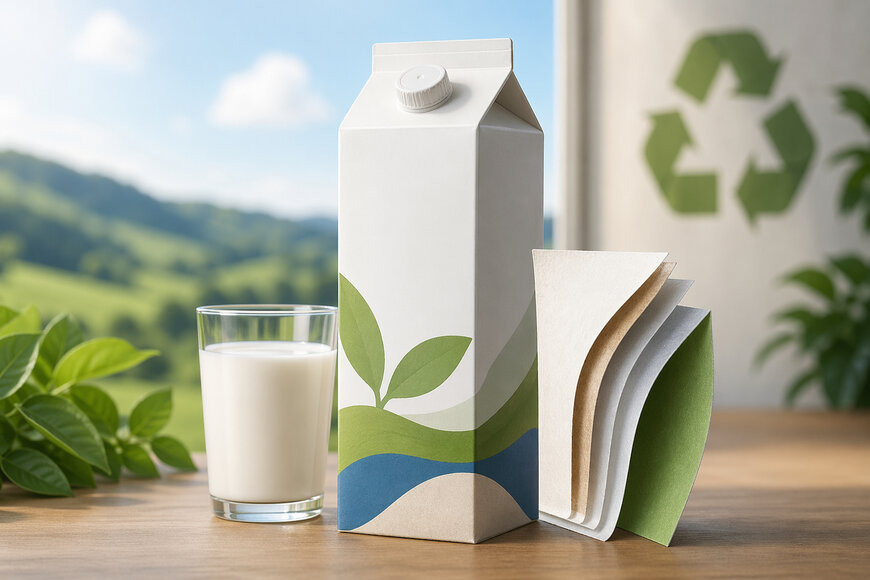
A new 1-litre aseptic carton integrating a paper-based barrier replaces conventional aluminium layers, increasing renewable material content while maintaining shelf-life performance for ambient beverage distribution.
Transition from aluminium to fibre-based barriers
Tetra Pak, in collaboration with Sterilgarda Alimenti, has developed a 1-litre aseptic carton that replaces the traditional aluminium foil barrier with a paper-based alternative.
This design increases the renewable material share to approximately 90% when combined with plant-based polymers. The shift reduces dependence on multi-layer composite structures and simplifies the material composition, aligning with broader efforts to optimise the digital supply chain and material traceability in packaging systems.
Maintaining aseptic performance without aluminium
The carton is designed for ambient distribution and achieves shelf-life and product protection comparable to conventional aseptic packaging formats. Barrier functionality typically provided by aluminium for oxygen and light protection is instead delivered through engineered fibre-based layers and polymer coatings.
Independent verification by the Carbon Trust indicates that the new structure can reduce the carbon footprint by up to 50%, depending on sourcing and lifecycle assumptions.
Material simplification and recycling compatibility
The innovation reduces the packaging structure from three primary materials (paperboard, aluminium, polymers) to two (paper and polymers). This simplification supports improved fibre recovery in recycling systems by reducing separation complexity and contamination risks.
Higher paper content also enhances rigidity and mechanical stability, ensuring that the carton maintains structural integrity during filling, transport, and storage. These characteristics are critical for aseptic systems where packaging must preserve sterility without refrigeration.
Industrialisation and scalability
The paper-based barrier technology was initially introduced in 2023 in smaller portion packs and later adapted to high-speed filling lines, demonstrating compatibility with industrial-scale beverage production.
A €60 million pilot plant in Lund, Sweden supports ongoing development and industrial validation of fibre-based barrier materials. This complements a broader investment strategy of approximately €100 million annually through 2030 to advance sustainable packaging technologies.
Application in beverage and dairy sectors
The technology is particularly relevant for dairy and liquid food producers requiring long shelf life without cold-chain logistics. By enabling ambient distribution with reduced carbon impact, the solution supports both operational efficiency and sustainability targets.
Early adoption by Sterilgarda Alimenti demonstrates feasibility in high-volume dairy applications, where consistent barrier performance and processing compatibility are essential.
Industry context and differentiation
Conventional aseptic cartons rely on aluminium layers to provide near-zero oxygen transmission rates. Alternative approaches such as polymer-based barriers or bio-based coatings have been explored, but often face trade-offs in barrier performance or recyclability.
The paper-based barrier represents a measurable shift by combining high renewable content with reduced material complexity, while maintaining functional equivalence in aseptic conditions. This positions it as a transitional technology toward fully fibre-based packaging systems.
Outlook for sustainable carton packaging
The development reflects a broader industry trend toward renewable, low-carbon materials and simplified packaging architectures. By integrating fibre-based barriers into established aseptic formats, the solution enables incremental adoption without requiring major changes to existing filling infrastructure.
As regulatory and environmental pressures increase, such innovations are expected to play a central role in reshaping the beverage packaging ecosystem toward higher recyclability and reduced lifecycle emissions.
Edited by an industrial journalist Sucithra Mani with AI assistance.
www.tetrapak.com
