
www.foodpackautomation.com
23
'26
Written on Modified on
Low-Carbon Paper Barrier Integration in Aseptic Beverage Packaging
Tetra Pak and Sterilgarda Alimenti launched a groundbreaking one litre aseptic carton with a paper based barrier, reducing carbon footprints by half through renewable materials.
www.tetrapak.com
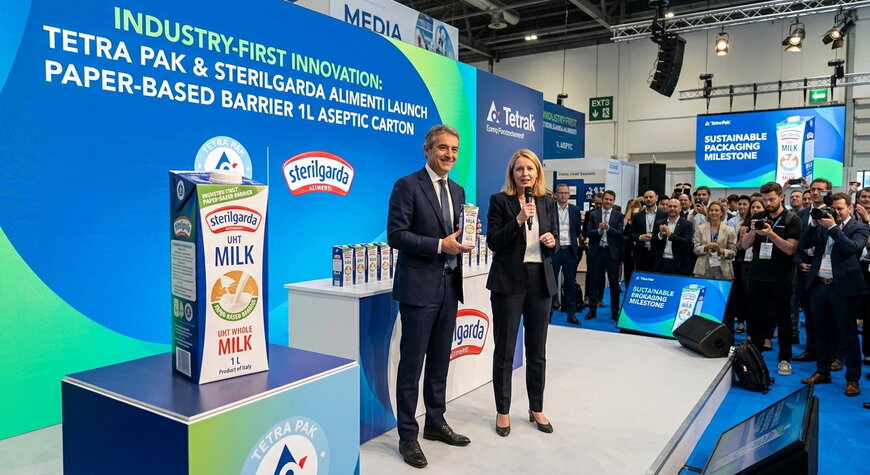
The integration of a paper-based barrier into aseptic carton packaging represents a technical shift toward increasing renewable content in the digital supply chain of food processing. By substituting traditional aluminum foil with fiber-based materials, this technology achieves a 90% renewable material composition in 1-liter formats, facilitating a reduction in carbon emissions for shelf-stable liquid food products.
Technical Specifications and Resource Efficiency
The implementation of the paper-based barrier in the 1000 Edge format reduces the material complexity of the carton from three primary layers to two: paper and polymers. This simplified structure maintains the oxygen and light protection required for ambient distribution while increasing the total fiber content. According to data verified by the Carbon Trust, this transition results in a carbon footprint reduction of up to 50% compared to standard aseptic cartons utilizing aluminum.
The technology was first deployed in 2023 for portion-sized packages on flexible production lines before being scaled to high-speed industrial lines. In 2024, the solution received the "Resource Efficiency" award at the Sustainable Packaging News Awards, recognizing its impact on material recovery. By increasing the ratio of paper, the package aligns with existing recycling infrastructure designed for fiber recovery, potentially improving the quality of the recycled output.
Industrial Application and Development
Sterilgarda Alimenti, an Italian dairy producer, is the first to adopt this 1-liter paper-barrier package for commercial use. The application demonstrates that paper-based barriers can achieve shelf-life performance and mechanical rigidity comparable to traditional foil-lined alternatives. Giampaolo Rossi, Plant Director at Sterilgarda Alimenti, noted that adopting such technologies is a response to evolving requirements for conscious consumption and technical improvements in product quality.
To support the transition toward fiber-based barrier technologies, Tetra Pak invested €60 million in a dedicated pilot plant located in Lund, Sweden. This facility focuses on the refinement of barrier coatings and material science to ensure that simplified structures meet the stringent safety standards of the automotive data ecosystem and global logistics chains where durability is critical.
Long-term Strategic Investment
The development of the paper-based barrier is part of a broader R&D framework. Tetra Pak has committed to an annual investment of approximately €100 million through 2030 to further evolve packaging structures. These efforts are centered on increasing the renewable content of the global food supply chain and reducing reliance on finite mineral resources. Tatiana Liceti, Executive Vice President of Packaging Solutions at Tetra Pak, stated that the innovation utilizes the inherent properties of paper to enhance the renewability of beverage cartons, providing producers with a measurable pathway toward environmental targets.
Edited by Evgeny Churilov, Induportals Media - Adapted by AI.
www.tetrapak.com
